HomeBlogsBlogsBest 4X4 Tyres

Best 4X4 Tyres

Why 4x4 Tyres Are a Different Beast

The SUV Became Britain's Default Family Car

Two decades ago a 4×4 on a suburban street was unusual. Today the school gates are full of them. Crossovers and SUVs have quietly become the normal choice for British families, and that shift has put a lot more weight on a lot more tyres.

Here is the part that gets missed. The vehicles changed, but driving habits did not. People moved from a 1.3-tonne hatchback to a 2-tonne SUV and carried on braking at the same distances, taking roundabouts at the same speed, and buying tyres the same way. The tyre is the only thing connecting all that extra mass to the road, and it is usually the last thing anyone thinks about.

Bigger wheels came with the trend too. Many SUVs now sit on 19 or 20-inch rims, which means a shorter sidewall doing a harder job. If that describes your vehicle, it is worth understanding how low profile tyres behave differently when you hit a pothole.

Why an Ordinary Car Tyre Won't Do the Job

A 4×4 tyre is not simply a bigger version of a car tyre. It is built to a different brief, and three things change.

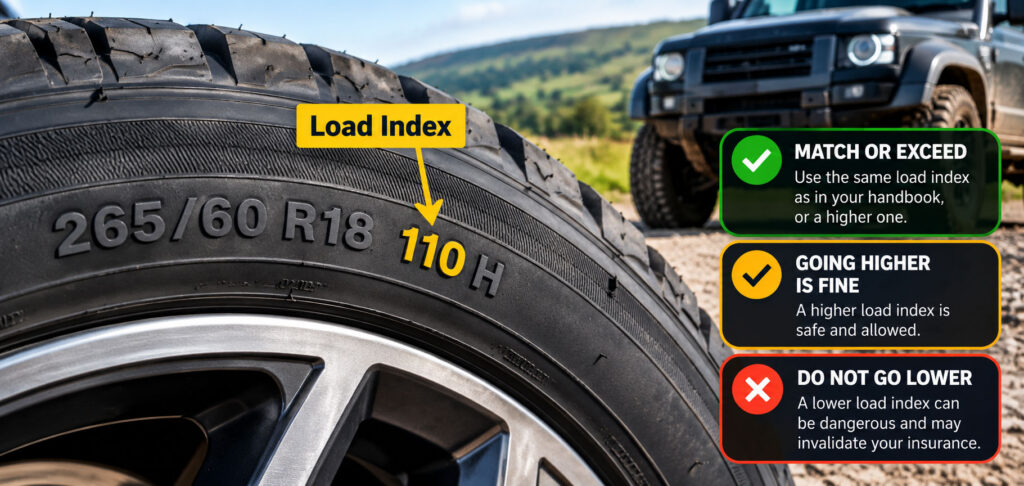
It has to carry more. Every tyre has a load index, a number that sets the maximum weight it can take. Fit a tyre with too low a rating and it runs hotter than it was designed to, which shortens its life and, in the worst case, ends in a failure at speed.

It has to resist sideways force. A tall vehicle leans more in corners, which pushes the load onto the outer shoulder of the tyre. That is why 4×4 and SUV tyres get reinforced or XL sidewalls. Without that stiffness the steering goes vague and the shoulders wear out long before the centre does.

It has to shed more heat. Heat is what kills tyres. More weight means more flex, more flex means more heat, and towing adds more again.

Standard Car Tyre vs 4x4 Tyre

What changes

Standard car tyre

4×4 and SUV tyre

Typical load index

82 to 91 (475–615 kg each)

100 to 120 (800–1,450 kg each)

Sidewall build

Standard casing

Reinforced or XL, thicker casing

Weight it carries

Lower, spread fairly evenly

Higher, with far more sideways load in bends

Heat it has to shed

Modest

Significant, especially when towing

Fitting the wrong one

Usually no drama

Overheating, fast uneven wear, possible MOT fail

The One Number Almost Nobody Checks

Your load index is printed on the sidewall right after the rim size, and it is the single most important number when you are buying for a 4×4. It is also the number online checkouts quietly let you get wrong. Always match or exceed the figure in your handbook. Going higher is fine. Going lower is not, and it can invalidate your insurance.

H/T, A/T or M/T? Understanding the Big Three

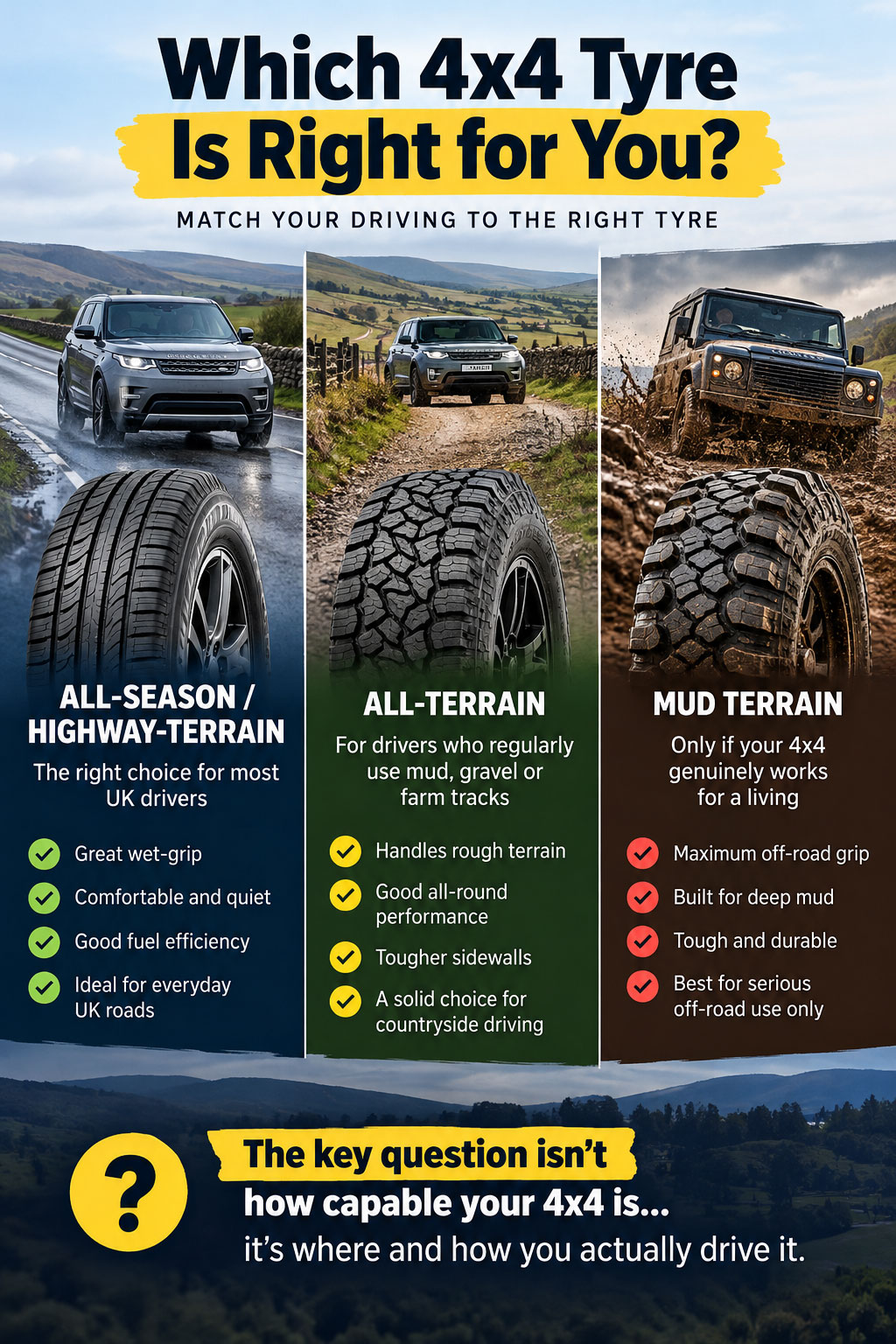
Nearly every 4×4 tyre falls into one of three families. Pick the right family and the individual brand matters far less than you would think. Pick the wrong one and even an expensive tyre will disappoint you every day.

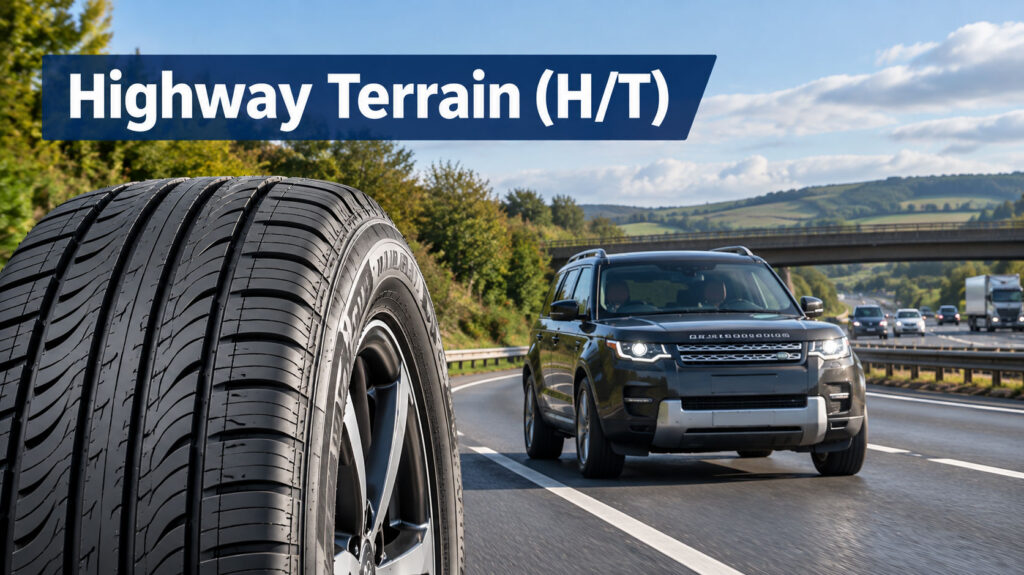
Highway Terrain (H/T) — Built for the School Run and the M6

These are road tyres, shaped for a heavy vehicle. Closely packed tread blocks, lots of fine siping to clear water, and a compound tuned for grip on tarmac. They are the quietest option, the most economical, and they stop the shortest in the wet.

If your off-roading amounts to a gravel driveway and the occasional grass verge at a car boot sale, this is your tyre. There is nothing timid about that choice. It is simply the one that matches the job.

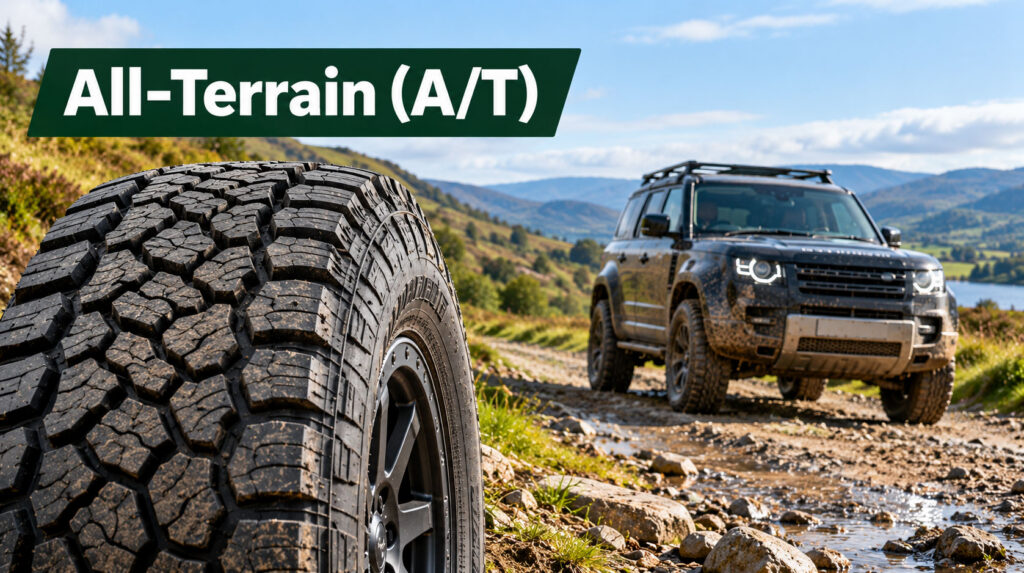
All-Terrain (A/T) — The Sweet Spot for Rural Britain

All Terrain Tyres

All-terrain tyres sit in the middle, and for a good number of UK drivers they are the honest answer. Chunkier blocks with proper gaps between them for mud to escape, a tougher casing to survive flint and farm tracks, but still enough contact area to behave sensibly on a wet dual carriageway.

Modern A/T tyres are far better on the road than their reputation suggests. The latest generation has closed most of the gap on noise and wet braking while keeping the toughness. If you live down a long unmade lane, tow a trailer across a field in summer, or spend weekends on byways, this is the family to shop in.

Mud Terrain (M/T) — For Vehicles That Work for a Living

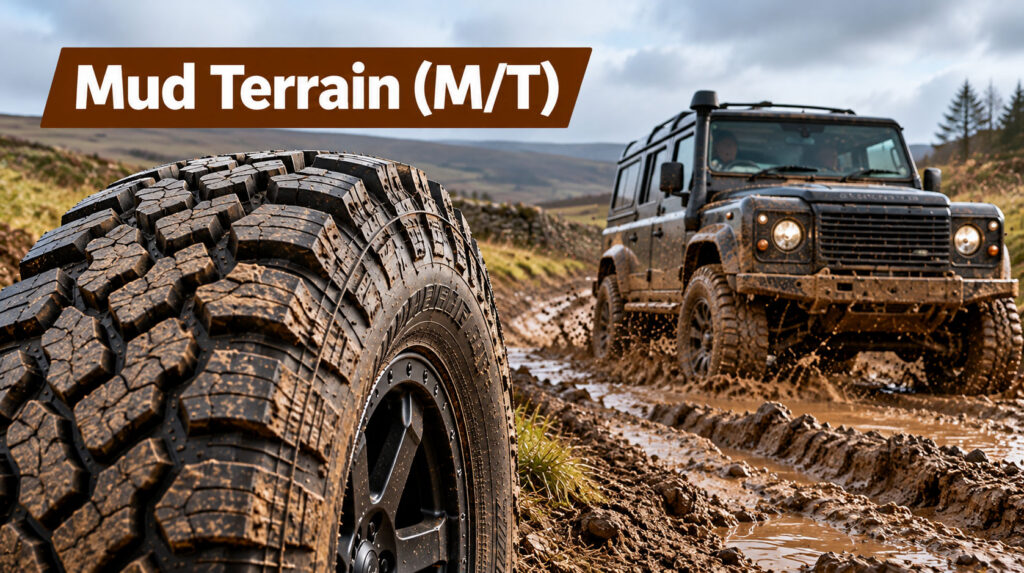
Mud Terrain

Mud terrains are specialist equipment. Huge tread blocks, deep voids, and a casing built to be aired down and abused. In deep clay and churned ground nothing else comes close, because the gaps are wide enough for mud to clear itself as the wheel spins.

On tarmac those same features work against you. Less rubber touches the road, so wet braking distances stretch. Rolling resistance climbs, which you will notice when you look at how tyres affect fuel consumption. And the noise is real. Unless your vehicle genuinely spends its week in a field, a mud terrain costs you more than it gives back.

Where Do You Actually Drive?

Your typical week

Road / off-road

Tyre type to choose

What it costs you

Commuting, motorway miles, school run, supermarket

95% / 5%

Highway terrain or all-season

Nothing. This is genuinely the right tyre for you

Country lanes, gravel drive, the odd muddy field entrance

70% / 30%

All-terrain

A little extra noise and a small fuel penalty

Farm tracks, towing across grass, green laning most weekends

50% / 50%

Aggressive all-terrain

Noticeable hum on the motorway, quicker wear on tarmac

Deep mud, clay, forestry, a working vehicle

30% / 70%

Mud terrain

Real noise, higher fuel use, longer wet braking distances

A Quick Honesty Check

Think back over the past month. If you cannot remember driving on anything that was not tarmac, you do not need all-terrain tyres. Fitting them anyway trades away fuel, quiet and wet grip for capability that will sit unused. There is no shame in buying the tyre that suits the driving you actually do.

The British Weather Factor

Wet Braking Matters Far More Than Off-Road Grip

Here is the uncomfortable truth about buying 4×4 tyres in Britain. The conditions people shop for are not the conditions they drive in. Buyers picture mud and snow. What they actually face, almost every single day between October and April, is cold wet tarmac.

Water is the problem. A heavy vehicle pushes a bigger wedge of water in front of each tyre, so it aquaplanes sooner than a lighter car on the same road. The deciding factor is how quickly the tread can clear that water, which is a function of tread design and compound, not of how aggressive the tyre looks.

Cold matters too. A summer compound stiffens as the temperature drops, and below roughly 7°C it stops gripping properly. In Britain that covers a large slice of the year, especially on shaded country lanes that stay damp long after the main roads have dried out.

Do You Need Three-Peak Mountain Snowflake Tyres?

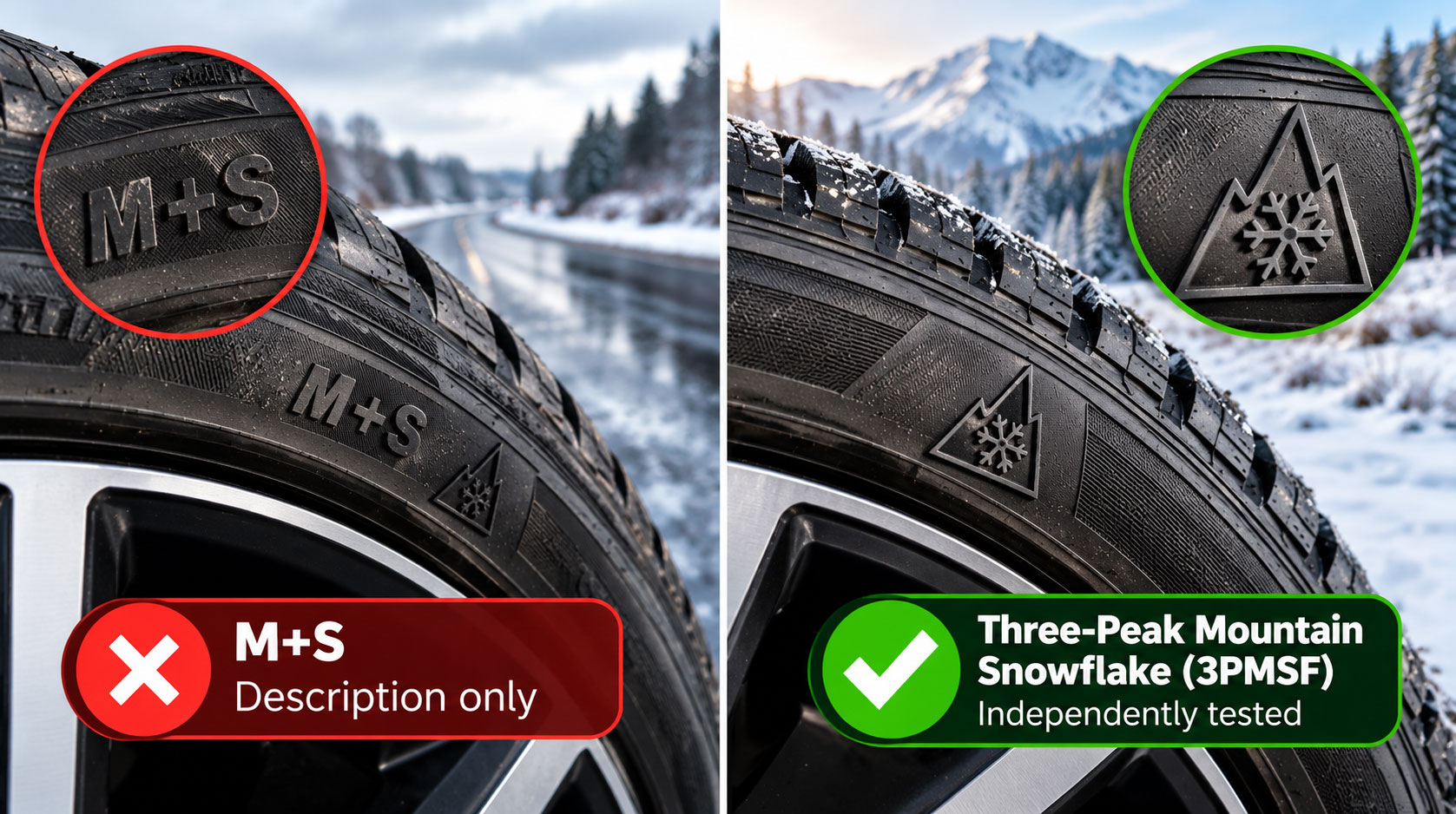
You will see two winter-related markings on tyre sidewalls, and only one of them means anything.

M+S stands for mud and snow. It sounds reassuring. In reality it is a marking the manufacturer applies to its own product based on tread pattern, with no independent test behind it. Treat it as a description, not a guarantee.

The Three-Peak Mountain Snowflake symbol is different. A tyre only carries it after passing an official snow traction test. It is a measured result, which is why it is the marking worth looking for.
Tyre Marketing M+S vs 3PMSF

M+S vs 3PMSF — Which Marking Actually Counts

Marking on the sidewall

What it actually means

Worth paying for in Britain?

M+S (Mud and Snow)

A self-declared marking. The maker applies it based on tread pattern. No independent test is required.

Not on its own

3PMSF (Three-Peak Mountain Snowflake)

Earned only by passing an official snow traction test. It is a measured result, not a claim.

Yes, if you drive rural roads or hills

Both together

Normal on good all-terrain and all-season tyres. Covers slush, cold tarmac and light snow.

This is the combination to look for

Neither

A summer-biased tyre. Grip drops away sharply once the road falls below about 7°C.

Fine for a summer-only second vehicle

Driving to Europe? The Rules Stop Being Optional

Britain has no law requiring winter tyres. Much of the continent does. Several Alpine and Nordic countries legally require 3PMSF-marked tyres during winter months, and enforcement can mean an on-the-spot fine or being turned back at the roadside.

If you take your 4×4 skiing, or drive through the Alps towing a caravan, check the requirements for every country on your route rather than just your destination. A good all-season with the snowflake marking usually satisfies them, which saves swapping to a full winter tyre set for one trip a year.

Expert Insight

TyreSafe makes the same point repeatedly: tread depth and correct pressures do more for your safety in bad weather than almost any other factor. A premium tyre run 10 PSI low will stop worse than a mid-range tyre set correctly. The free thing you can do this weekend beats the expensive thing you might do next year.

Reading Your Sidewall and the Tyre Label

Two sets of markings decide whether a tyre is right for your vehicle. One is moulded into the rubber. The other is on the label at checkout. Between them they tell you almost everything that matters, and most buyers read neither.

What Those Numbers on Your Tyre Actually Mean

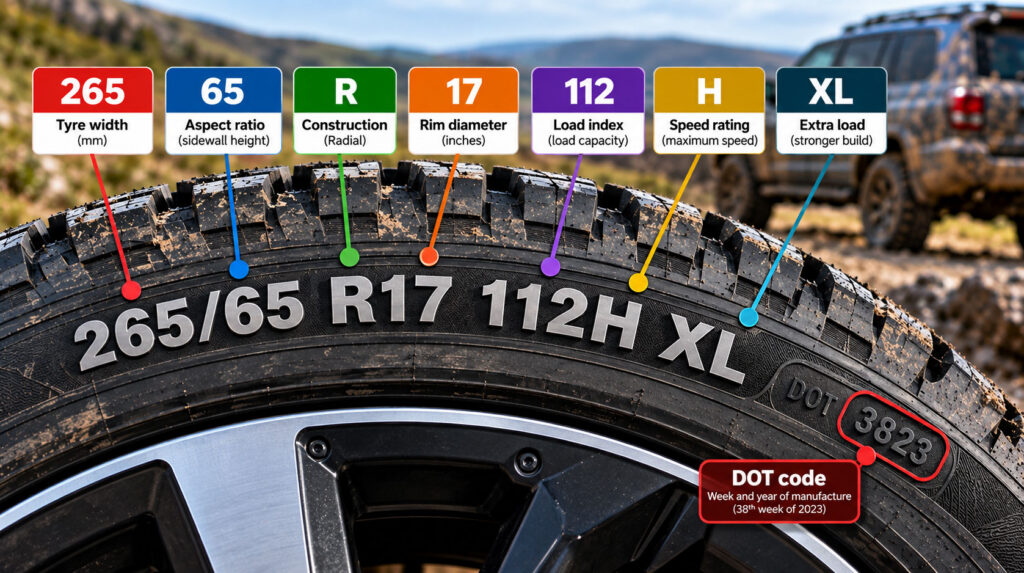
Take a typical 4×4 size: 265/65 R17 112H XL. It looks like a registration plate, but every part of it is doing a job.

Read Off Road Tyre Sidewall

Your Sidewall, Decoded — Example: 265/65 R17 112H XL

Marking

In our example

What it tells you

Section width

265

The tyre is 265 millimetres wide across the tread

Aspect ratio

65

The sidewall height is 65% of the width. Higher numbers mean a taller, softer sidewall

Construction and rim

R17

Radial construction, built to fit a 17-inch wheel

Load index

112

Each tyre can carry up to 1,120 kg. Never fit a lower number than your handbook states

Speed rating

H

Rated to 130 mph. Your insurer can take an interest if this is too low

XL or Reinforced

XL

A stronger casing built for heavier loads. Common and often required on 4x4s

DOT code

DOT…3823

Week and year of manufacture. 3823 means week 38 of 2023

The Tyre Label, Decoded

Every new tyre sold in the UK comes with a standardised label carrying three ratings. Fuel efficiency runs from A to G. Wet grip runs from A to G. Noise is given in decibels with a wave symbol.
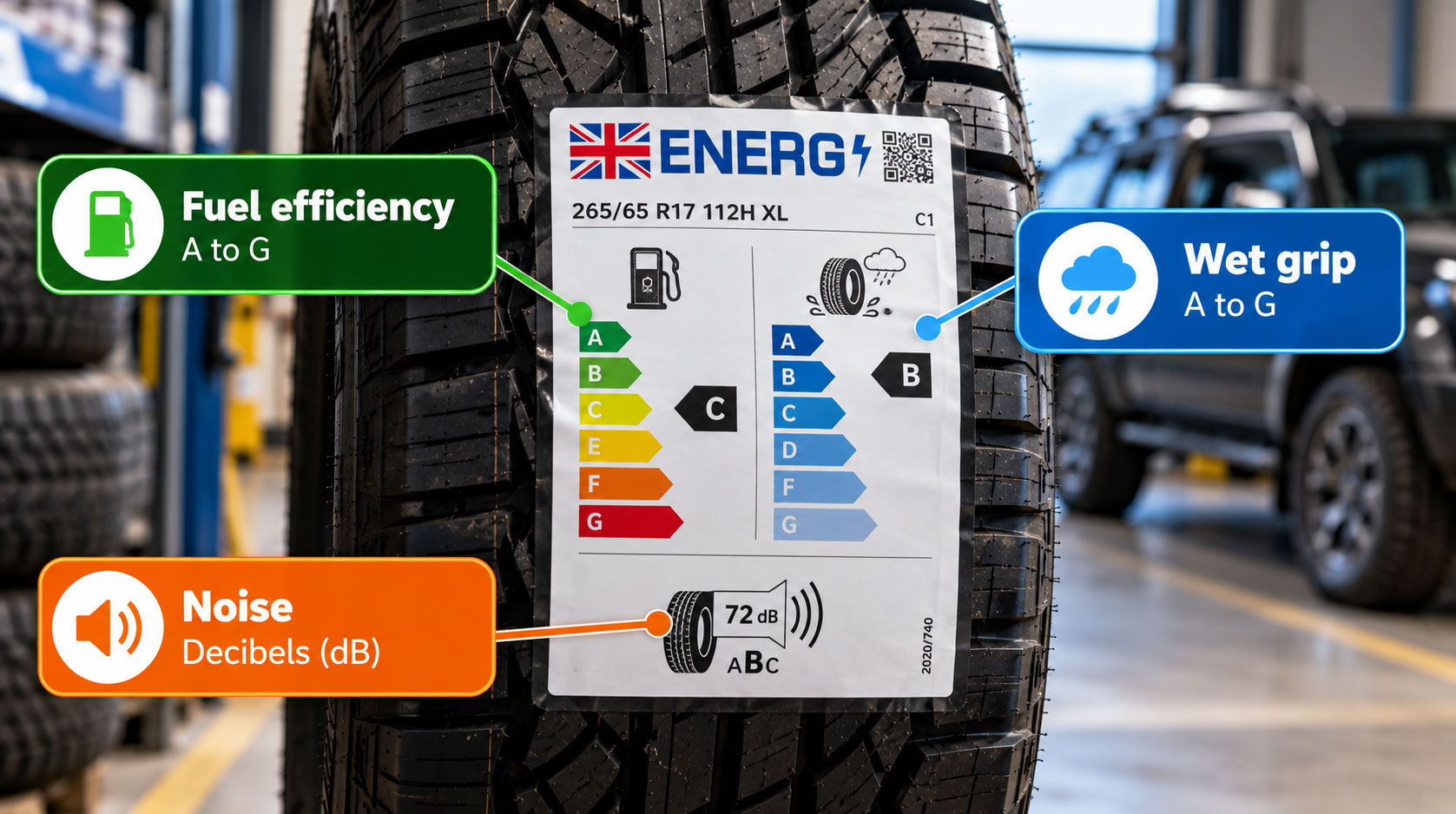
Tyre Label Ratings

If you read only one of them, read wet grip. On a heavy 4×4 the gap between an A and a C rating can stretch an emergency stop from 50 mph by several car lengths. That is the difference between stopping behind the car in front and not.

Fuel efficiency is worth a glance if you cover big mileages, though the savings are modest. Noise is largely a comfort question, and it is where all-terrain tyres always score worst.

One thing the label cannot tell you is how tough the casing is. If you drive on flinty tracks or kerb your wheels in town, casing strength matters as much as grip, and it is worth knowing how to spot sidewall damage before it becomes a blowout. Owners of performance SUVs should also check whether their car came on run-flat tyres, because those have their own replacement rules.
Quick Tip

Photograph your sidewall markings and the label on your current tyres before you start shopping. Having the load index, speed rating and your existing wet grip score on your phone stops you from accidentally downgrading, which is the most common mistake people make when buying online.

The Best 4x4 Tyres You Can Buy Right Now

The recommendations below are grouped by the job they do rather than by price, because the most expensive tyre on this page would be the wrong buy for plenty of the people reading it.

Best All-Terrain Tyres, Based on Independent Testing

All-terrain tyres are the hardest category to judge from a product page, because every manufacturer claims the same things. Independent back-to-back testing is the only way to separate them. The most recent all-terrain group test put five of the most popular aggressive all-terrains through dry, wet, snow and off-road running on the same vehicle, and the results are a useful reality check.

The headline finding was that the newest tyre in the group won not by being the most capable off-road, but by being the most liveable on the road, which is exactly the trade-off most UK owners are making.

All-Terrain Tyres Ranked on Independent Test Results

Tyre

Where it wins

Where it gives ground

Best suited to

Quietest of the group, shortest dry braking, best cost per mile on a 60,000-mile warranty

Weakest on snow of the tyres tested

A 4×4 driven daily that sees mud at weekends

Toughest sidewall, class-leading snow braking and dirt traction

Firmer ride over bumps, more road noise at speed

Defenders, pickups and genuine working vehicles

Best wet braking and wet handling in the test

Firm ride, lowest aquaplaning resistance of the group

Mostly-road 4x4s in consistently wet regions

Strong snow handling, stays quiet at town and B-road speeds

Longest wet braking distance, highest cost per mile

Rural drivers in hilly or upland areas

Best aquaplaning resistance, good front-end bite off-road

Noticeably loud, and it carries no severe snow rating

Summer-focused off-roaders that avoid winter use

All-Terrain Tyre Ratings

Tyre

Wet

Dry

Snow

Off-road

Noise

Overall

8.5

9.5

6.0

9.0

9.5

9.0

7.0

6.5

9.5

9.5

7.5

8.7

9.0

9.0

7.5

7.0

7.0

8.0

6.5

7.5

9.0

7.0

8.0

7.5

7.5

7.0

n/r

7.5

6.0

7.0

Scores are out of 10 and derived from published independent test placings within this group, not from our own testing. The BFGoodrich is rated on the outgoing KO2’s results plus the KO3’s documented gains in wear, gravel durability and snow traction. “n/r” means the tyre carries no severe snow rating.

A word on the BFGoodrich All-Terrain T/A KO3. If you have been researching for a while you will have seen the KO2 recommended everywhere. It was the default all-terrain for a decade, but it has now been replaced. The KO3 reached European markets during 2025 and improves on its predecessor for wear, gravel durability and snow traction while keeping the sidewall toughness the KO2 was famous for. If a retailer is still pushing KO2 stock, it is worth asking what the price difference actually is.

Falken is the other name to know here. The Wildpeak AT4W took the overall win in that test on the strength of its road manners and a long tread warranty, which made it the cheapest tyre in the group per thousand miles despite not having the lowest sticker price.

Best Premium Tyres for Road-Biased SUVs

If your 4×4 never leaves tarmac, you should be shopping in the SUV road tyre category rather than the off-road one. This is where the real engineering money goes.

Michelin leads this segment. The CrossClimate 3 is the all-season to beat for British conditions, pairing genuine 3PMSF snow capability with wet performance that holds up against dedicated summer tyres. For drivers who want outright dry and wet handling on a heavier performance SUV, the Pilot Sport 4 SUV has been a repeat test winner and carries unusually large aquaplaning reserves.

Continental, Goodyear, Pirelli and Bridgestone all field strong SUV ranges and are worth comparing on price in your exact size, because premium tyre pricing varies enormously between fitments. Nokian Tyres is the specialist to look at if you want winter capability without a seasonal swap. We go deeper on the full lineup in our guide to the leading tyre brands.

All-Season SUV Tyre Ratings

Tyre

Wet

Dry

Snow

Comfort

Economy

Overall

9.5

8.0

9.5

9.5

9.0

9.3

9.0

8.5

8.5

8.5

8.5

9.0

8.5

8.5

9.0

8.0

7.5

8.7

8.5

9.0

7.5

9.0

7.0

8.5

7.5

9.5

7.5

9.0

8.5

8.3

Scored the same way, from independent SUV all-season test placings. The Michelin Pilot Sport 4 SUV is not listed here because it is a summer tyre rather than an all-season, but it rates 9.3 overall across nine independent tests with five outright wins.

Best Mid-Range and Value Options for Potholed British Roads

The mid-range is where most sensible money goes, and it has improved enormously. The gap between a good mid-range tyre and a premium one is now measured in metres of braking distance rather than in whether the tyre is safe at all.

Hankook and Vredestein both offer SUV and all-terrain ranges that punch above their price. Kumho produced the best wet braking of any tyre in that all-terrain test, which is a serious result for the money. Toyo and Nitto are worth a look for rugged road-biased options, and Avon is a British name with a long history on heavier vehicles. General Tire builds the Grabber range, which is a common choice for owners who want an all-terrain look without a full off-road compromise, while Cooper remains popular on pickups.

If budget is the main constraint, read our rundown of budget tyre options and our comparison of mid-range tyres worth buying before committing. Avoid buying on price alone in this category — a tyre that saves you £30 and adds four metres to your stopping distance is not a saving.

Match the Tyre to the Vehicle You Actually Own

Different 4x4s live very different lives. This is the shortcut if you want to skip straight to what suits yours.

Match the Tyre to Your Vehicle

Your 4×4 or SUV

How it usually gets driven

The tyre type that suits it

Nissan Qashqai, Kia Sportage, Ford Kuga

Almost entirely tarmac, short urban journeys

All-season with a 3PMSF marking

BMW X5, Audi Q7, Volvo XC90

Heavy, fast, high motorway mileage

Premium SUV summer tyre, or a premium all-season

Land Rover Discovery, Range Rover

Mixed tarmac and rough estate track

A quiet, road-biased all-terrain

Land Rover Defender, Jeep Wrangler

Regular genuine off-road use

Aggressive all-terrain with a reinforced casing

Toyota Hilux, Ford Ranger, Isuzu D-Max

Towing, site access, carrying real weight

All-terrain with a high load index and LT construction

Suzuki Jimny

Light, nimble, frequently green-laned

All-terrain in the smaller sizes, or a mud terrain if it works for a living

Premium German SUVs are a special case, because many are supplied with manufacturer-approved tyres carrying a specific marking on the sidewall. Straying from that approval can change how the car rides and handles more than you would expect. Our guide to choosing tyres for a BMW goes through how those approval codes work.

What Should You Actually Pay?

Tyre pricing confuses people because the same model can swing by more than £100 between sizes. The bands below are a guide for common 17 and 18-inch 4×4 fitments. Larger rims and load-rated commercial sizes sit higher, and prices move with the market, so treat these as a sense check rather than a quote.

What a 4x4 Tyre Should Cost You

Tier

Guide price per tyre

What your money is buying

Budget

£55 – £85

Legal and road-safe. The savings almost always come out of wet braking performance and tread life

Mid-range

£85 – £140

The sweet spot for most owners. You keep most of the premium wet grip for noticeably less money

Premium

£140 – £260+

Shortest braking distances, longest life, lowest noise, and usually the best cost per mile overall

All-terrain

£110 – £230

Off-road capability and a tougher casing. Expect a small fuel and noise penalty for it

The Lowest Price Is Rarely the Lowest Cost

Work in cost per thousand miles rather than cost per tyre. A £90 tyre that lasts 20,000 miles costs you more than a £140 tyre that lasts 40,000, and the more expensive one stopped shorter every single time you needed it to. Tread warranties are the easiest way to compare this before you buy.

Fitting is the other half of the bill, and it is where surprises usually appear. Our breakdown of what mobile tyre fitting costs in the UK sets out what a fair price looks like, and we keep an affordable mobile fitting option for drivers watching the total.

One route we would steer you away from on a 4×4 is part-worn. The margins look tempting, but matched sets are almost impossible to find and the history of the casing is unknown. We explain the risks in detail in our piece on whether part-worn tyres are safe.

Golden Rules That Protect Your Drivetrain

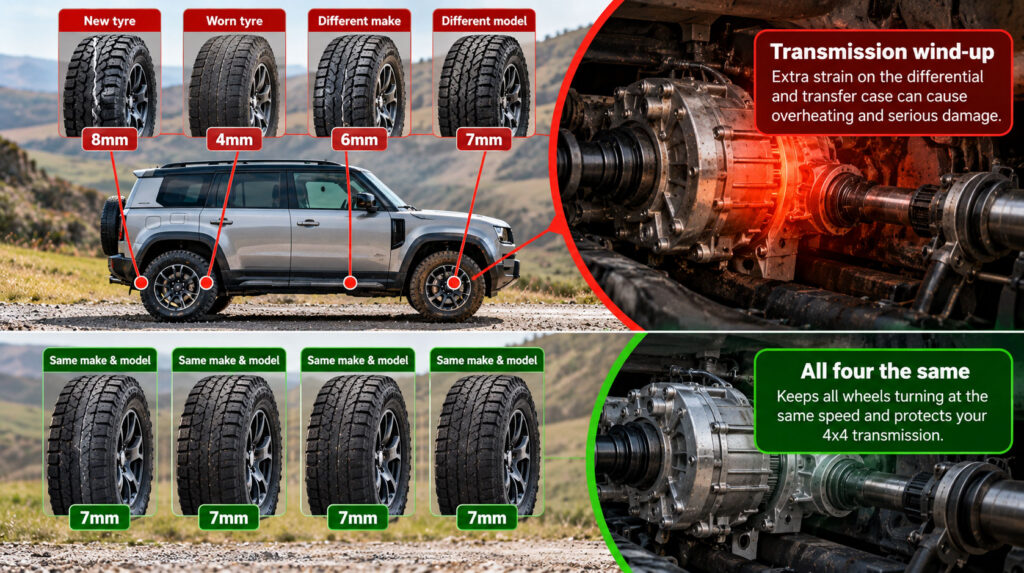
Never Mix Tyres on a 4x4 — This One Can Cost You a Gearbox

This is the most expensive mistake in this entire guide, and it is the one people make by accident.

A new tyre has a slightly larger rolling circumference than a worn one. On a two-wheel-drive car that difference is harmless. On a permanent four-wheel-drive vehicle it is not, because all four wheels are mechanically linked. If one is turning at a marginally different speed to the others, the differential and transfer case have to absorb that difference continuously, mile after mile.

That is called transmission wind-up. It generates heat, it wears the internals, and on some systems it can destroy a transfer case in a few thousand miles. A repair bill in four figures is an entirely normal outcome.

The rule is simple. Keep all four tyres the same make, the same model and within about 2mm of each other on tread depth. If one is damaged beyond repair and the rest are well worn, replacing all four is often the better-value decision. At absolute minimum replace in matched pairs across the same axle — here is why tyres should be changed in pairs.

Getting Your Pressures Right

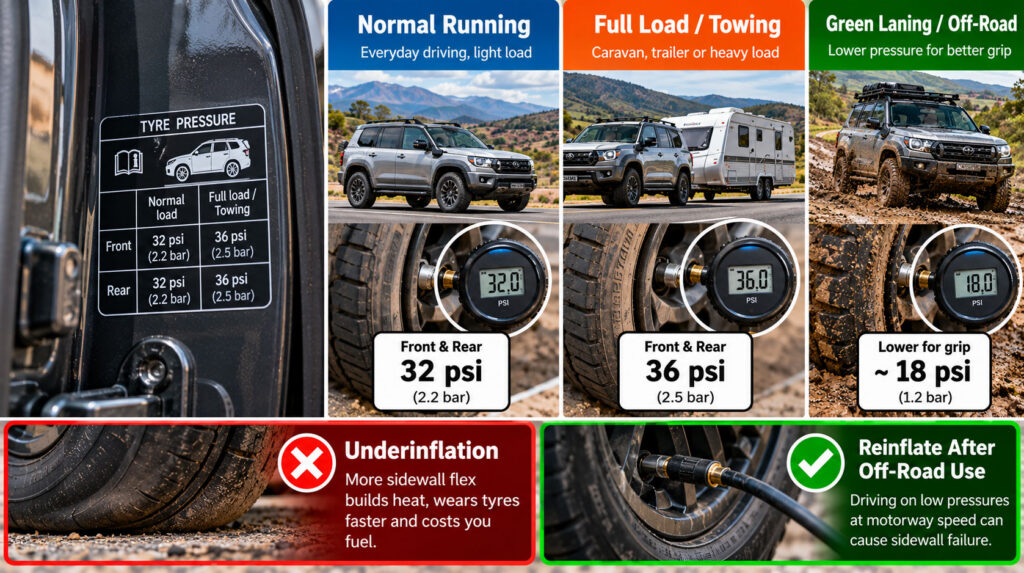
4x4 Tyre Pressure Guide

Your door shut or filler flap carries two sets of pressures: one for normal running and a higher one for full loads or towing. Most 4×4 owners never use the second set, then wonder why the vehicle feels soggy with a caravan behind it.

Underinflation is the quiet killer. It makes the sidewalls flex more, which builds heat, wears the shoulders early and costs you fuel on every journey. Check pressures cold, roughly once a month, and before any long trip. Our tyre pressure guide has the full method.

Green laning is the one time you deliberately drop below the placard. Lowering pressure spreads the contact patch and finds grip on loose ground. The part people forget is the reinflation. Driving home on soft tyres at motorway speed is how sidewalls fail, so carry a compressor and bring them back up before you rejoin the road.

What UK Law Actually Requires

The legal minimum tread depth in the UK is 1.6mm, measured across the central three-quarters of the tread and around the entire circumference. Both parts of that sentence matter — a tyre that is legal on the inside shoulder and bald on the outer edge still fails.
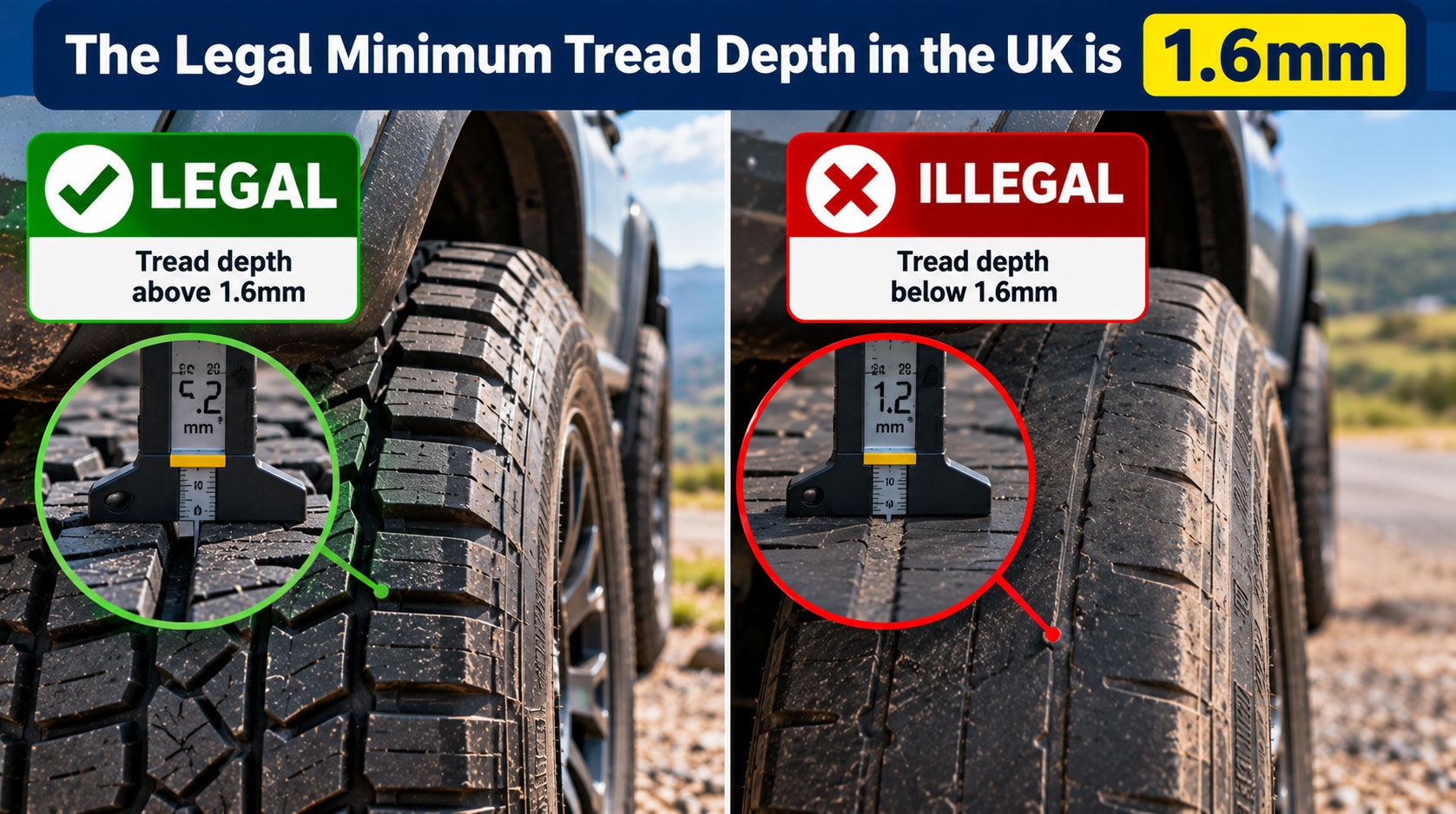
UK Tyre Tread Depth Legal vs Illegal

The penalty is up to £2,500 and three penalty points per tyre. On a 4×4 with four illegal tyres that is twelve points and a licence gone. It is also an automatic MOT failure, and a reason an insurer can decline a claim.

Uneven wear across an axle is usually a geometry problem rather than a tyre problem. If one edge is disappearing faster than the other, get the alignment checked before you spend money on rubber that will wear out the same way. It is worth learning how to check tread depth with a 20p coin so you catch it early.
Legal Minimum Is Not a Safe Minimum

Wet performance falls off a cliff well before 1.6mm. Most testing shows stopping distances lengthening sharply once tread drops below 3mm, because there is no longer enough depth to clear standing water. Treat 3mm as your replacement trigger and 1.6mm as the point where you are already in trouble.

The Mistakes We See Most Often

  • Buying on price alone. The cost per mile usually tells a different story to the price on the invoice.
  • Ignoring the load index. Online checkouts will happily sell you a tyre your vehicle is not rated for.
  • Fitting all-terrains for the look. You pay for them every day in fuel, noise and wet braking.
  • Mixing brands across an axle. Different compounds grip differently, which unsettles the car exactly when you need it most.
  • Forgetting the spare. A full-size spare on a 4×4 needs to match the others, and it ages whether you use it or not.
  • Skipping balancing. Heavier all-terrain tyres show up imbalance quickly — wheel balancing is not optional on these.
  • Judging a tyre by tread alone. Rubber hardens with age, so how long a set really lasts is a question of years as well as miles.

None of this is complicated, but it does need doing. A short monthly tyre maintenance routine — pressures, tread, a look at the sidewalls — catches almost every one of these problems before it costs you anything.

One Stop for 4x4 and SUV Tyres, Wherever You Are

Once you have decided which tyre is right for your vehicle, actually getting it fitted should be the easy part.

If your tyres are already sitting in the garage, we will come and fit and balance them for you. If you have not bought them yet, we carry all the major brands in stock at competitive prices, which means one visit instead of two trips and a wait. Either way you are not driving anywhere on a questionable tyre to get the job done.

Our vans come to your home, your workplace or the roadside, and we handle cars, vans, light commercials, 4x4s and SUVs with the same equipment. Same-day and last-minute callouts are available, and we run 24-hour cover for urgent and emergency situations, including motorway roadside work where a rapid response matters most. Pricing is given up front with no hidden fees.

You can check where we cover, book fitting at your home or workplace, or arrange emergency roadside tyre fitting if the need is immediate. For a straightforward replacement at the kerb, mobile tyre replacement is usually the fastest route. We also cover Sunday appointments if a weekday simply does not work.

Questions 4x4 Owners Ask Us Most

Yes, though usually less than people fear. An all-terrain tyre has deeper, blockier tread and a heavier casing, so it rolls slightly less freely than a road tyre. On a typical SUV you might see a drop of around 2 to 5 per cent. A full mud terrain is a bigger step again and can cost closer to 10 per cent. Keeping your pressures correct claws back most of that difference, because an underinflated tyre wastes far more fuel than an aggressive tread pattern ever will.

You can, as long as the size, load index and speed rating all match what your handbook specifies. Whether you should is a different question. Most crossovers are front-wheel drive and spend their lives on tarmac, so an all-terrain tyre adds noise, lengthens wet braking and trims your fuel economy in exchange for grip you will almost never use. If you like the look, a rugged-styled all-season gives you the appearance without the compromise.

That noise is the tread design doing its job. Mud terrain tyres use large, widely spaced blocks so mud can pack in and then fling itself clear as the wheel turns. Those same gaps slap against smooth tarmac thousands of times a minute and the gaps between the blocks trap and release air, which is what you hear as a drone. It is normal rather than a fault. It does tend to settle a little after the first few hundred miles, and it usually gets worse again as the tyre wears unevenly, which is a sign you need to rotate them.

On a permanent four-wheel-drive vehicle this is risky. A new tyre has a larger rolling circumference than a part-worn one, so the two wheels turn at slightly different speeds. The differential and transfer case then absorb that difference continuously, which builds heat and wear. Many manufacturers specify replacing all four, and most of the rest want a matched pair across the same axle at minimum. If you only need one, ask whether your remaining tyres can be shaved to match, or budget for a pair.

Most owners get somewhere between 20,000 and 40,000 miles. Road-biased tyres on a light crossover sit at the top of that range. Aggressive all-terrains on a heavy pickup that tows sit at the bottom. Age matters as much as mileage, because rubber hardens over time whether you drive on it or not. Once a tyre passes about six years old its wet grip has usually fallen off noticeably, even if the tread still looks healthy.

For the large majority of UK drivers, yes, and they are often the better choice. Britain rarely gets deep or sustained snow, but it gets a great deal of cold rain. A quality all-season with a 3PMSF marking holds its grip well below 7 degrees, clears standing water properly, and saves you storing a second set of wheels. Only drivers in upland areas or those who regularly cross to Europe in winter really need a dedicated winter tyre.

The labels overlap, which is where the confusion starts. SUV generally describes a road-focused tyre built for a taller, heavier car, with a stiffer sidewall to control body roll. 4×4 usually implies some genuine off-road ability, with deeper tread and a tougher casing. A Qashqai wants an SUV tyre. A Defender that works for a living wants a 4×4 tyre. Plenty of vehicles sit between the two, which is exactly where all-terrain tyres earn their keep.

Yes, and it matters more than it does on a road tyre. All-terrain tyres are heavier and their tread blocks are distributed less evenly, so even a small imbalance shows up as a vibration through the wheel at motorway speed. Balancing should be part of any fitting. If you feel a wobble appear a few thousand miles later, that usually means a balance weight has been knocked off rather than anything being wrong with the tyre itself.

Registered Office:

Mobile Tyre Fitter

Unit J20, Hastingwood Ind. Park Wood Ln, Birmingham, B24 9QR

© 2024 Mobile Tyre Fitter. All rights reserved.