Best Tyres for a BMW: Star-Marked, Run-Flat and Performance Choices Explained
A BMW is engineered as a complete system, and its tyres are part of that engineering rather than a bolt-on afterthought. The four contact patches under the car shape how it steers, stops, rides and even how much fuel it drinks, which is exactly why the wrong set can dull a car that should feel sharp. Picking the best tyres for your BMW is less about chasing a single ‘best’ brand and more about matching the right tyre to your specific model, wheel setup and driving style.
This guide walks through everything that matters: the star (★) approval BMW puts on its own tyres, the run-flat question that trips up so many owners, the categories that suit M cars, saloons and the X-range, and the label ratings worth reading before you pay. We finish with the quickest, least disruptive way to get them fitted, so you can spend more time driving and less time sitting in a waiting room.
Quick Answer
For most BMWs, the safest choice is a star-marked (★) tyre in the exact size, load and speed rating your car specifies, then matched to how you drive. Fit Ultra-High-Performance rubber on M and sport models, a premium touring tyre on the 3 and 5 Series for a quiet ride, and a reinforced performance tyre on X-range SUVs. Keep run-flats if your BMW has no spare wheel, and always replace tyres in matching pairs – or all four on xDrive cars – to keep the car balanced.
Understanding BMW Tyre Requirements
Before comparing brands or prices, it helps to understand what makes a BMW tyre a BMW tyre. Three things set them apart from a generic replacement: the star approval, the widespread use of run-flats, and the way tyre choice ties into the car’s all-wheel-drive hardware and warranty.
Star-Rated Tyres: What the ★ Symbol Means
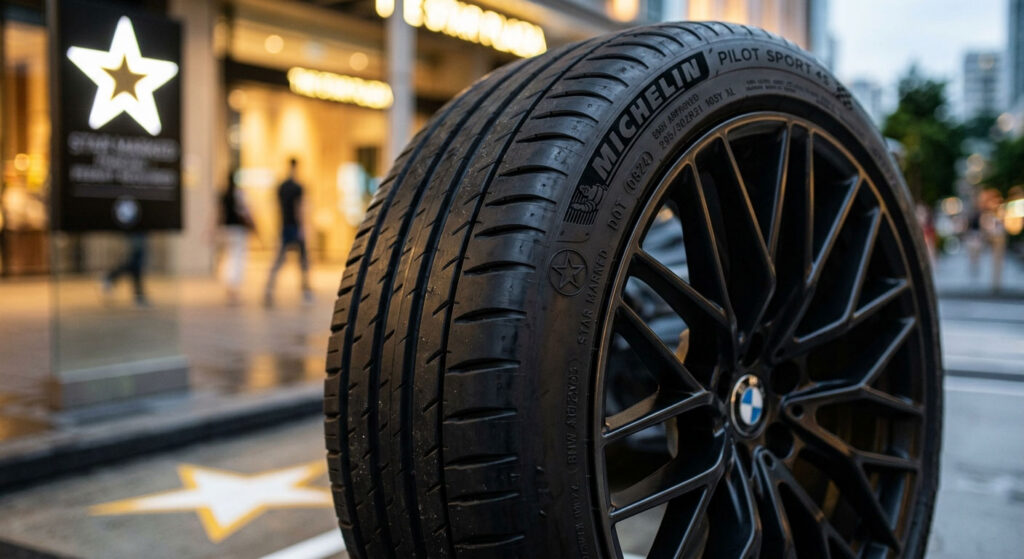
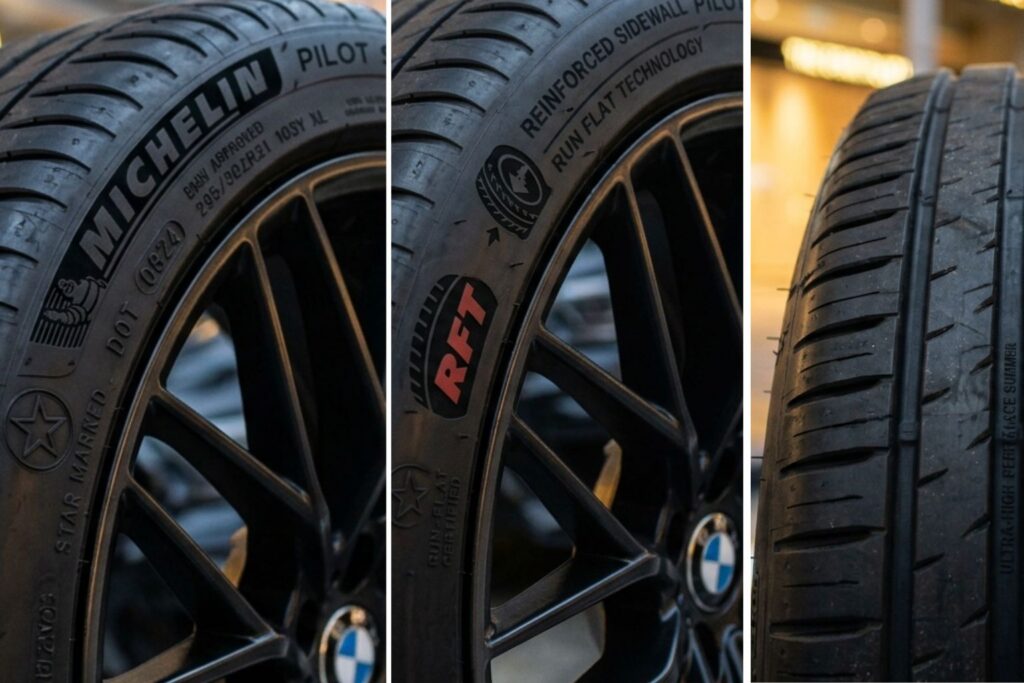
A small star stamped on the sidewall is BMW’s own seal of approval. It marks an Original Equipment (OE) tyre that BMW and the tyre maker developed together, tuning the compound, casing and tread specifically for BMW models before signing it off. According to Michelin’s official BMW partnership information, star-marked tyres go through additional development and testing beyond the standard version of the same tyre, which is why they behave so predictably with a BMW’s steering, braking and stability systems.
You are legally free to fit any correctly sized tyre with the right load and speed rating, and plenty of owners do. But a star-marked tyre takes the guesswork out of matching, and if you want to compare the makers that hold these approvals, our rundown of the best tyre brands is a useful starting point.
Run-Flat Tyres (RFT) vs Standard Tyres
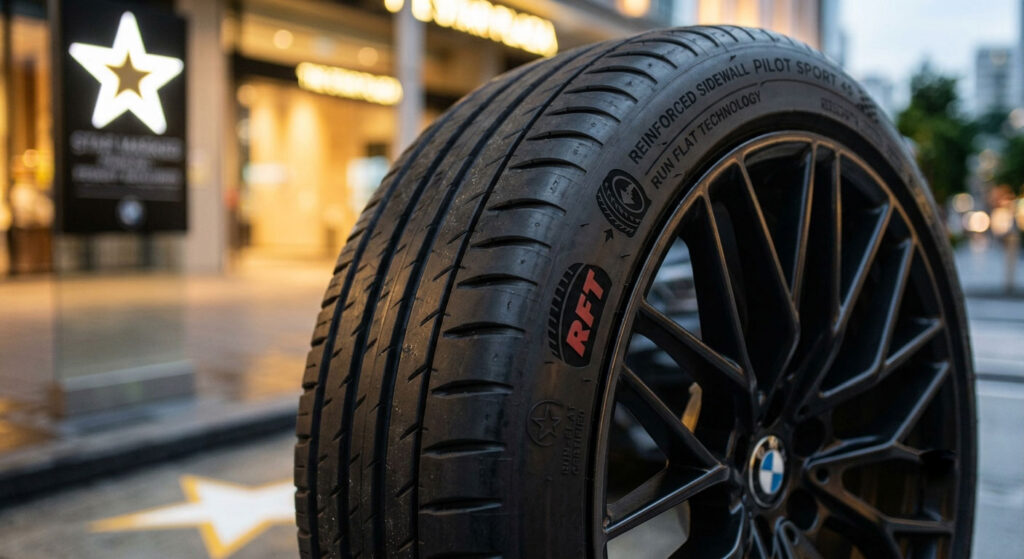
Many BMWs leave the factory on run-flats and carry no spare wheel at all. A run-flat has reinforced sidewalls that briefly support the car’s weight after a loss of pressure, letting you drive on at reduced speed to reach safety instead of stopping at the roadside. That safety net is the main reason BMW favours them.
Switching to standard tyres is possible and often improves ride comfort and lowers cost, but it comes with a trade-off: without a spare, a deflation leaves you stranded. If you do move to standard tyres, it is worth carrying a repair or inflation kit and knowing who to call. The table below sums up the choice.
| Consideration | Run-Flat (RFT) | Standard Tyre |
|---|---|---|
| Ride comfort | Firmer, stiffer sidewall | Softer, more absorbent |
| After a puncture | Drive on briefly to safety | Loss of pressure ends the journey |
| Spare wheel needed | No – that's the point | Recommended, or a backup plan |
| Typical cost | Higher | Lower |
| Best suited to | Owners prioritising safety cover | Owners prioritising comfort and value |
Homologation, xDrive and Your Warranty
Homologation is simply the sign-off that a tyre meets a car maker’s exact specification. It matters most on xDrive (all-wheel-drive) BMWs, where the system constantly shuffles power between axles and relies on all four tyres sharing a near-identical rolling circumference. Mixing worn and new, or different makes across an axle, can confuse xDrive and accelerate wear on the drivetrain.
The practical rules are straightforward: replace in matching pairs across an axle, keep all four closely matched on xDrive cars, and stick to the size printed on your placard. Doing so protects both the car’s balance and any tyre-related terms in your warranty. If you’re unsure how much life is left across your set, our guide on how long tyres last and spotting wear explains what to look for.
Best Tyre Performance Categories for BMW Models
The ‘best’ BMW tyre depends entirely on which BMW you drive. An M car chasing lap times wants something very different from a 5 Series eating up motorway miles or an X5 hauling a family and its luggage. Broadly, BMW tyres fall into three camps.
Ultra-High Performance (UHP) – for M and Sport Models
If you drive an M model, an M Sport, or simply enjoy a spirited B-road, UHP tyres are built for you. They use soft, grippy compounds and stiff constructions that reward precise inputs with sharp turn-in and huge dry and wet grip. The trade-offs are a firmer ride, faster wear and a higher price. Standout options include the Michelin Pilot Sport 5 and the Continental SportContact 7, both offered with BMW star approval on the right sizes.
Touring & Comfort – for the 3 Series, 5 Series and Daily Drivers
For everyday saloons and Touring estates, comfort and quietness usually matter more than the last ounce of cornering grip. Premium touring tyres such as the Goodyear Eagle F1 Asymmetric 6 strike that balance, delivering low cabin noise, long tread life and strong wet braking without the harshness of a track-focused tyre. This is the sweet spot for most commuters.
SUV Performance – for X3, X5 and the X-Range
BMW’s X models are heavier and sit higher, so their tyres need extra load capacity and stronger sidewalls to keep body movement in check. Performance SUV tyres like the Pirelli P Zero (PZ4) are engineered for exactly that, combining the grip of a sports tyre with the weight support an X5 demands. Look for reinforced or HL (High Load) markings where your car specifies them.
At a Glance: Which Category Fits Your BMW
| Category | Best-suited BMW models | Priorities | Example tyres |
|---|---|---|---|
| Ultra-High Performance | M, M Sport, 2/3/4 Series coupes | Grip, precision, response | Michelin Pilot Sport 5, Continental SportContact 7 |
| Touring & Comfort | 3 Series, 5 Series, Touring estates | Quiet ride, long life, efficiency | Goodyear Eagle F1 Asymmetric 6 |
| SUV Performance | X1, X3, X5, X-range | Load support, stability, grip | Pirelli P Zero PZ4 |
Whichever category you land on, fitting quality tyres in matching pairs pays off in feel and safety. Our brand comparison digs deeper into how the leading makers stack up.
Key Factors to Consider Before Buying
Once you’ve settled on a category, a few practical details decide whether a tyre is genuinely right for your car and your roads. Get these three right and you’ll avoid the most common (and expensive) mistakes.
Seasonality: Summer, All-Season or Winter
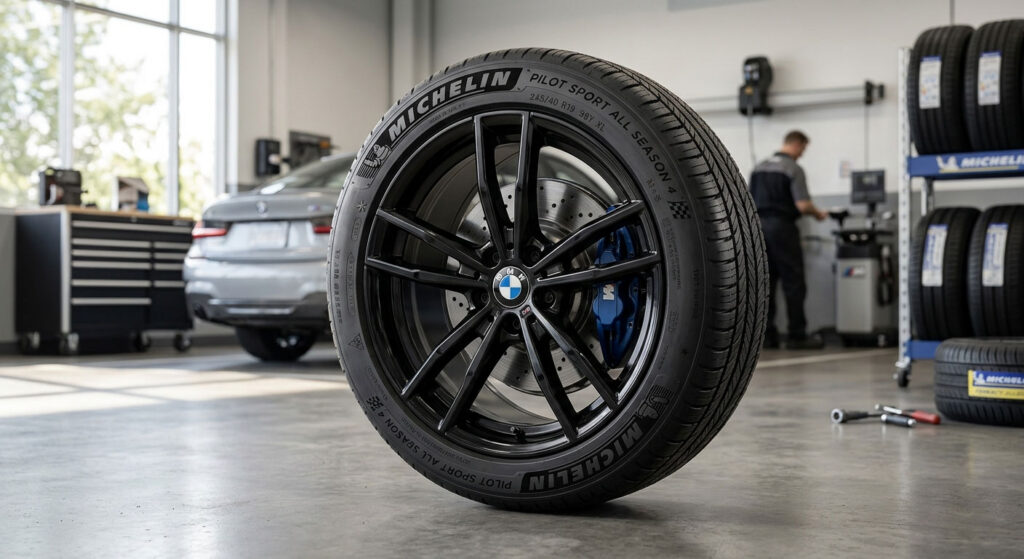
UK drivers have three broad options. Summer tyres give the best dry and warm-weather grip and suit performance BMWs used mostly in milder months. Winter tyres use a softer compound that stays flexible below roughly 7°C, transforming grip on cold, wet or snowy roads. All-season tyres split the difference and make sense for year-round drivers who don’t want to swap sets. Whatever you choose, keeping pressures correct matters just as much – see our tyre pressure guide for the details.
Staggered Fitments: Wider Rears Than Fronts
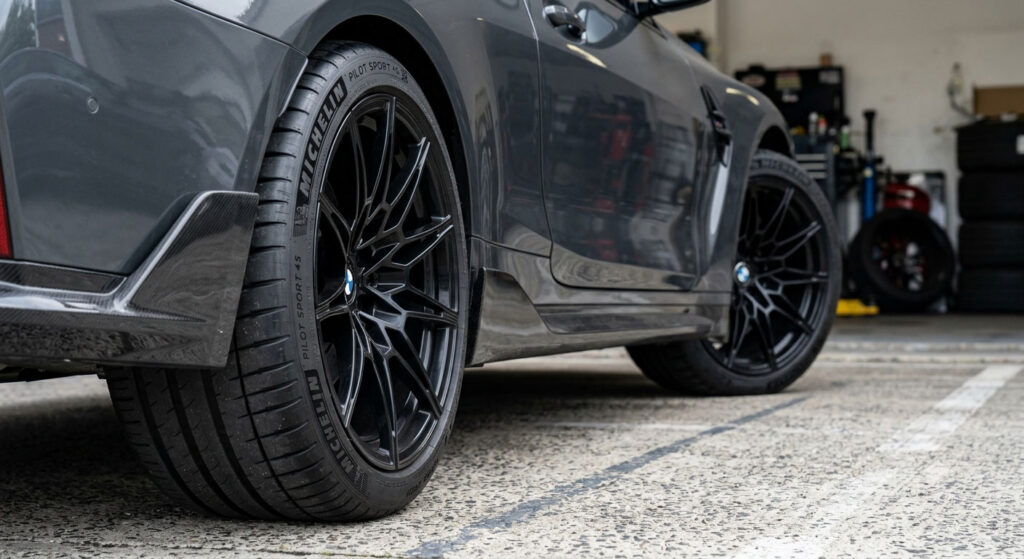
A lot of rear-wheel-drive BMWs, and most M cars, run a staggered setup – wider tyres on the rear axle than the front. This improves traction and handling balance, but it has a catch: you cannot rotate tyres front-to-back, so rear tyres often wear out first and get replaced on their own. Always check both the front and rear sizes printed on your sidewalls before ordering. Because staggered wheels are sensitive to balance, our explainer on wheel alignment versus balancing is worth a read.
Fuel Efficiency and Noise: Reading the Tyre Label
Every new tyre sold in the UK carries a standardised label rating three things: fuel efficiency (rolling resistance), wet grip, and external noise. For a BMW, wet grip is the rating not to compromise on, while a strong fuel-efficiency grade quietly saves money over the tyre’s life. Guidance from TyreSafe is a reliable, independent place to understand what each grade means before you buy.
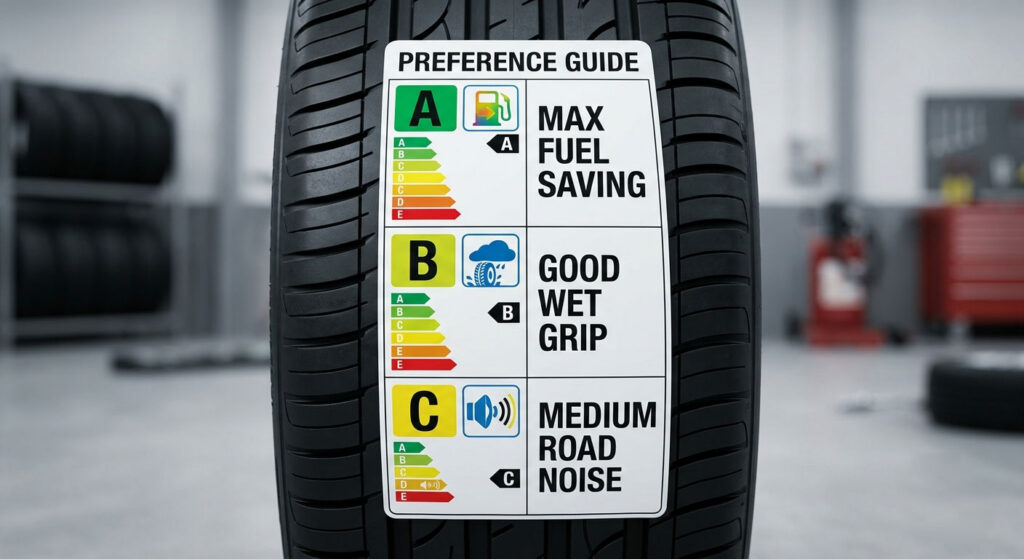
| Label rating | What it measures | Aim for |
|---|---|---|
| Fuel efficiency | Rolling resistance and its effect on economy | A–C for lower running costs |
| Wet grip | Braking distance on wet roads | A or B – don't compromise on safety |
| Noise (dB) | External rolling noise | Lower dB for a quieter cabin |
The Modern Solution: Same-Day Mobile Tyre Fitting
Choosing the right BMW tyre is only half the job – getting it fitted without losing half a day is the other half. This is where mobile tyre fitting has changed the game for BMW owners.
What Is Mobile Tyre Fitting?
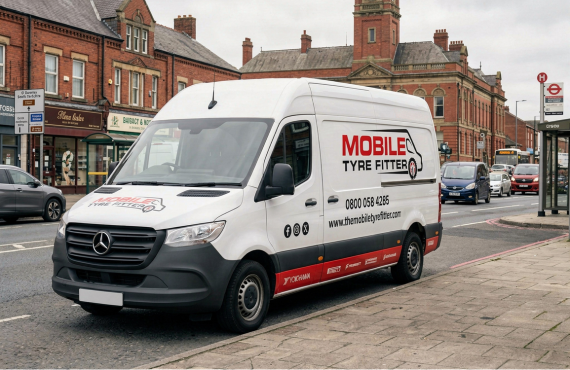
Mobile tyre fitting brings the workshop to you. Instead of driving to a garage and waiting, a fully equipped technician arrives in a van carrying your tyres, a fitting machine, a wheel balancer and the tooling to do the whole job on your driveway or in a car park. It’s the same professional fit you’d get in a depot, done wherever you happen to be. You can book it same-day, close to where you are.
Unmatched Convenience
For a car you rely on, the time saved is the real prize. Have your BMW’s tyres changed while you work through your inbox, get on with the school run, or relax at home – no queue, no courtesy-car juggling, no lost afternoon. Fitting at your home or workplace means the car is ready the moment you need it, and if you’re caught out mid-journey, roadside replacement comes to you instead.
Expert Precision for BMWs: TPMS and Large Alloys
BMWs bring two things that reward an experienced fitter: sizeable, easily-marked alloy wheels and a Tyre Pressure Monitoring System (TPMS). A good mobile technician uses the right mounting heads and protective procedures to avoid scuffing your rims, handles the delicate TPMS sensors correctly, and finishes with an on-site balance so there are no vibrations at motorway speed. Pairing that with a proper balance and valve service keeps a staggered BMW setup feeling exactly as it should.
How to Book Your BMW Mobile Tyre Fitment
Booking takes three simple steps. Have your car handy for the first one and the rest follows quickly.
Step 1: Check Your Tyre Size
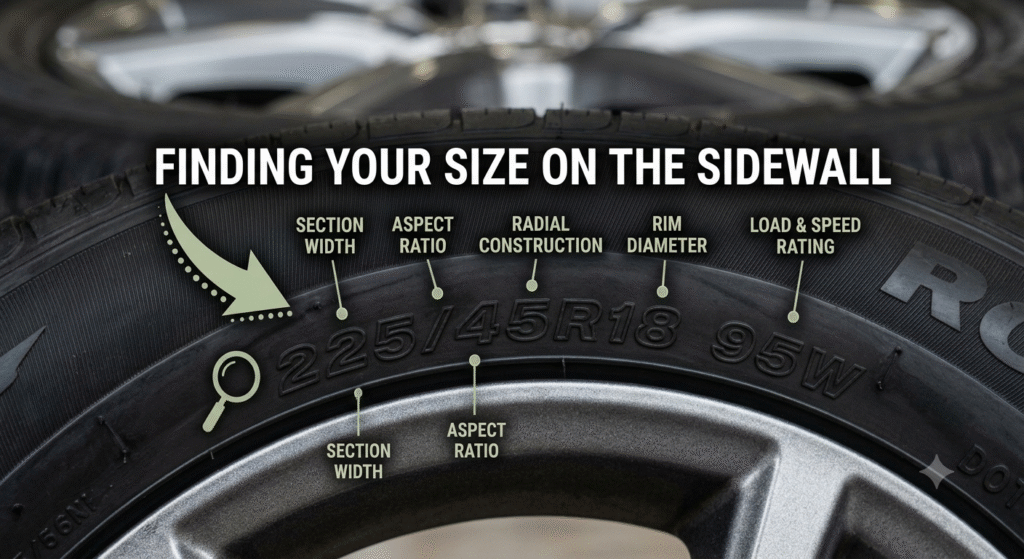
Your tyre size is printed along the sidewall as a short code, for example 225/45 R18 95W. Each part tells the fitter exactly what you need. On a staggered BMW, remember to read both the front and rear tyres, because they differ. The table below breaks the code down.
| Marking | Meaning | Example |
|---|---|---|
| 225 | Tyre width in millimetres | 225 mm |
| 45 | Profile – sidewall height as % of width | 45% |
| R18 | Radial construction & wheel diameter | 18-inch rim |
| 95 | Load index – max weight per tyre | 95 = 690 kg |
| W | Speed rating – max rated speed | W = up to 168 mph |
Not sure you’re reading it right? Our guide to checking tread depth also shows where these markings sit on the tyre.
Step 2: Choose Your Premium Tyres
With your size and driving style in mind, pick your tyre. Match it to the category that suits your model, look for the star (★) if you want factory-approved rubber, and check the label ratings. If cost is on your mind, our breakdown of mobile tyre fitting costs in the UK sets clear expectations before you commit.
Step 3: Schedule the Time and Place
Finally, tell us where and when. Give the address – home, office or roadside – pick a slot, and the van comes to you. It really is that simple. You can see the areas we cover or head straight to our homepage to get booked in.
BMW Tyre FAQs
No, it isn’t a legal requirement. Any tyre in the correct size with the right load and speed rating is road-legal. Star-marked tyres simply guarantee a fit that BMW has tested and approved, so they’re the safest default – but a quality non-star tyre of the same size is a valid choice, especially once the car is out of warranty.
Yes, many owners do for a softer ride and lower cost. The important thing to remember is that most BMWs on run-flats carry no spare wheel, so switching to standard tyres means you should carry an inflation or repair kit and have a plan if you lose pressure. Fit them as a full matching set rather than mixing run-flats and standard tyres.
They should be very closely matched. xDrive all-wheel drive relies on every tyre having a similar rolling circumference, so ideally run the same make, model and wear level across all four. Large differences can strain the drivetrain and upset how the system distributes power.
Check the sidewall codes on the front and rear tyres. If the rear width is larger than the front (for example 255 at the rear against 225 at the front), your car is staggered. That also means the tyres can’t be rotated front-to-back, so budget for rears wearing sooner.
A competent mobile technician handles TPMS sensors as a matter of routine, taking care during removal and refitting and checking the system reads correctly afterwards. Larger BMW alloys are also protected against scuffing with the right equipment, then balanced on-site.
For a car engineered around its tyres, usually yes. Premium tyres tend to brake shorter in the wet, last longer and stay quieter, which suits the way a BMW is built to drive. Budget tyres can look tempting on price, but the gap in wet grip and lifespan often makes premium the better value over time.
It depends on driving style and tyre type, but replace once tread nears the 1.6 mm legal minimum – many drivers change at 3 mm for safety. Age matters too: tyres over roughly five to six years should be inspected regularly, whatever the tread looks like.
Key Takeaways
- Match the tyre to the BMW: UHP for M and sport, touring for saloons, reinforced performance for the X-range.
- Look for the star (★) if you want factory-approved, homologated rubber.
- Keep run-flats if your car has no spare; switch to standard only with a backup plan.
- Replace in matching pairs – and all four on xDrive – and mind staggered sizes.
- Read the label: never compromise on wet grip.
The Fast, Simple Way to Fit Them
Once you know what you need, skip the garage queue altogether. Same-day mobile fitting brings the right BMW tyres to your door, fitted and balanced on-site by technicians who know their way around big alloys and TPMS.
Final Thoughts
The best tyre for a BMW is the one that fits your model, your wheels and the way you drive – fitted correctly and in matching sets. Get that right and the car feels exactly as its engineers intended: composed, grippy and quietly quick. Choose well, fit properly, and enjoy the drive.