What Should You Do the Moment a Tyre Bursts at the Wheel?
Few things rattle a driver like a tyre giving way at speed. One second you’re cruising along without a care; the next there’s a bang, the wheel is shuddering, and the car feels as though it wants to wander off on its own.
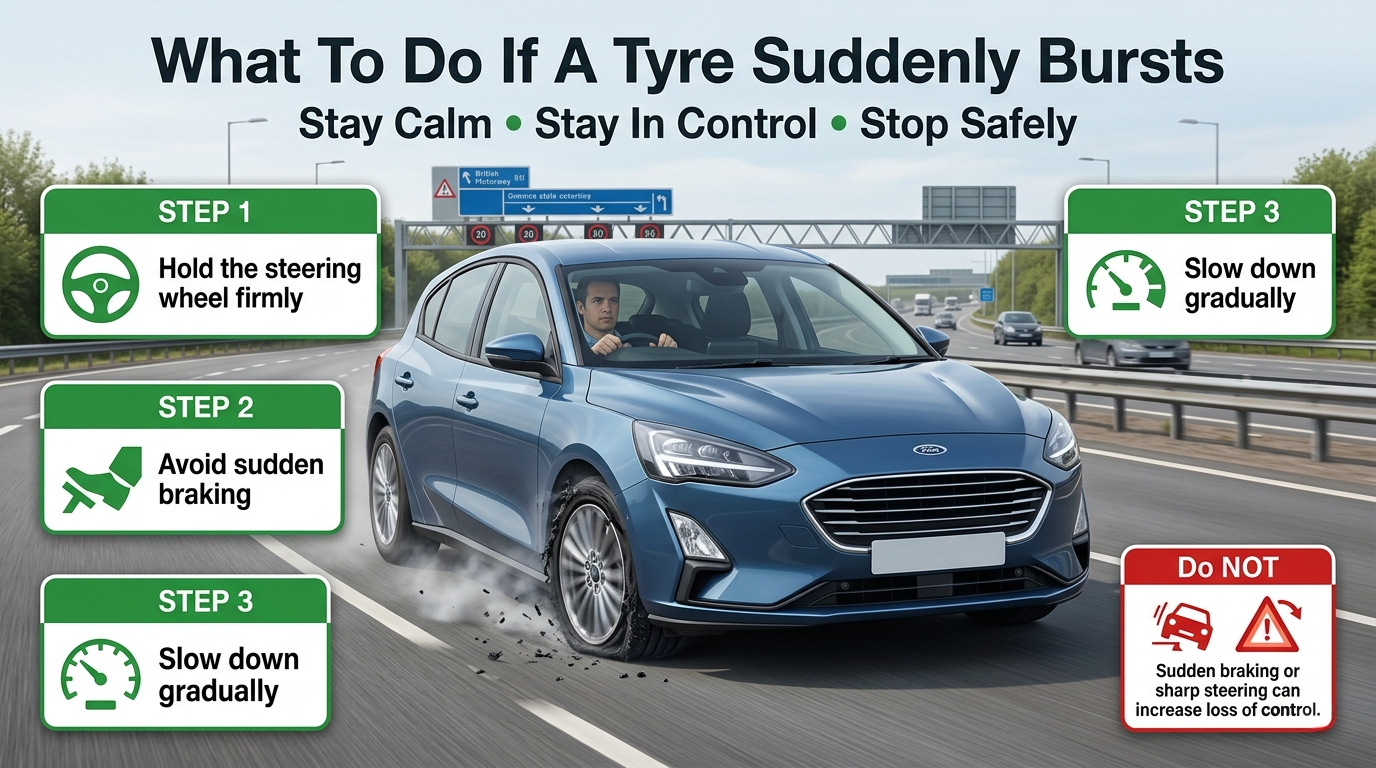
As alarming as that is, what you do in the opening moments usually counts for more than the failure itself. Keep a firm hold of the wheel, resist the urge to stamp on the brakes, and let the car wash off its own speed – that alone puts you back in charge.
Both TyreSafe and National Highways make the same point: your first job is to keep the car controlled and pointing straight, and only then think about stopping and checking the damage.
Here’s what this guide covers:
Table of content:
The First Few Seconds: Reacting to a Blowout
Handling a High-Speed Tyre Blowout
Can You Still Steer After a Tyre Lets Go?
More often than not, yes. The real hazard tends to be the driver’s instinctive reaction rather than the burst tyre itself. Slamming the brakes or yanking the wheel is what tips a recoverable moment into a dangerous one.
Blowout? Work Through These Steps in Order
- Hold the steering wheel firmly with both hands.
- Keep the car tracking in a straight line.
- Stay off the brake pedal as much as you can.
- Lift gently off the accelerator.
- Switch your hazard lights on.
- Ease towards a safe stopping spot once the speed has dropped.
The Things You Should Never Do When a Tyre Bursts
| Driver Reaction | Recommended |
|---|---|
| Hard braking | ❌ No |
| Sharp steering correction | ❌ No |
| Gradual slowing | ✅ Yes |
| Hazard lights | ✅ Yes |

Expert Insight
Safety bodies say much the same thing time and again: staying in control matters more than stopping quickly. Letting the car wind down steadily is nearly always safer than trying to halt on the spot.
Quick Answer: Grip the wheel, keep off the brakes, and shed speed slowly and smoothly.
Bringing the Car to a Safe Stop
Where's the Safest Spot to Pull Over After a Blowout?
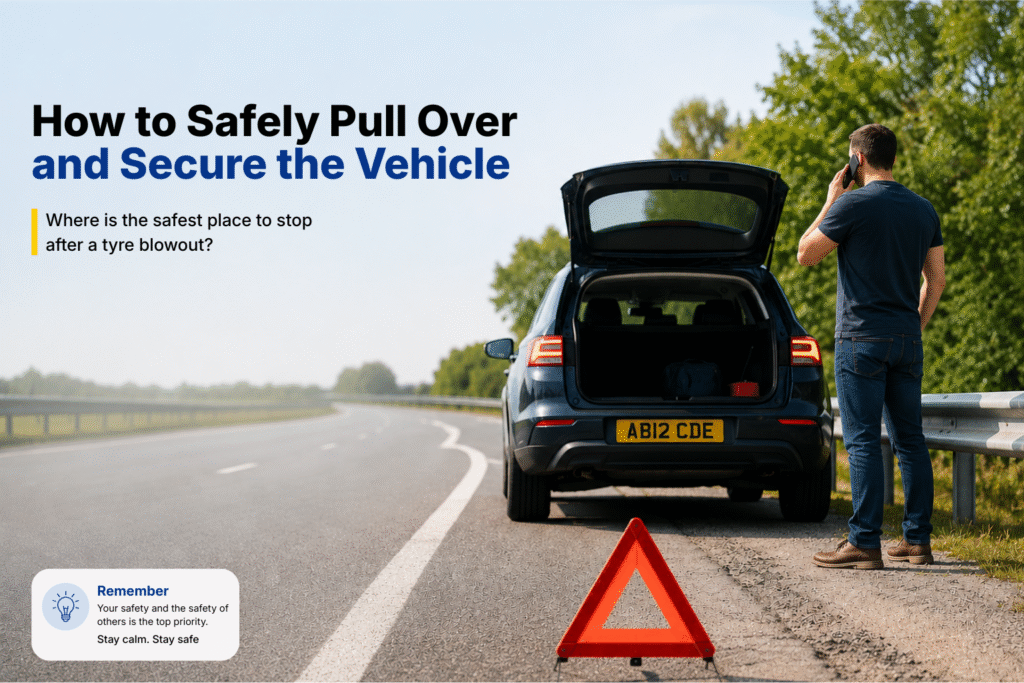
Once the car is back under control, your aim is somewhere clear of moving traffic. Depending on where you are, that might be:
the hard shoulder, an emergency refuge area, a slip road off a services, or a safe lay-by.
When you’ve stopped, put the handbrake on, leave the hazards flashing and switch the engine off. Take a moment to check the traffic before you so much as open a door.
Plenty of drivers come unstuck by pulling up on a blind bend, standing right beside live lanes, or diving straight into a roadside repair – all of which invite a second, worse incident.
Guidance from National Highways is to put as much distance as you sensibly can between yourself and the running lanes rather than lingering by the car. That gap between you and the carriageway is one of the safest things you can give yourself while help is on the way.
Safety Checklist
| Task | Complete? |
|---|---|
| Hazard lights activated | ✅ |
| Parking brake applied | ✅ |
| Passengers moved safely | ✅ |
| Assistance contacted | ✅ |
Keeping Passengers Safe Once You've Stopped
Are Passengers Better Off Inside or Outside the Car?
Not necessarily. If you’ve come to rest on a motorway hard shoulder, everyone is usually safer out of the car and behind a barrier, wherever one exists.
Passenger Safety Checklist
- Get out on the side away from traffic
- Move to the far side of any barrier
- Keep a close eye on children
- Keep the whole group together
- Put on hi-vis clothing if you have it
Why Does This Matter So Much?
A parked car on a live road is still at risk of being hit. Putting space between your passengers and the traffic makes a real difference to how safe they are.
Key Rule
The tyre isn’t going anywhere. The people in your car come first.
Is It Ever Okay to Drive on a Flat Tyre?
Can You Cover a Short Distance on a Fully Flat Tyre?
In theory you might manage a short distance on a fully flat tyre, but in almost every case it’s a bad idea. Keep rolling and you’ll quickly wreck the tyre’s inner structure and risk harming the wheel as well. A cheap puncture repair can turn into a full replacement in minutes. If it’s safe, it’s far better to pull in and call for help than to limp on.
What Actually Happens When a Tyre Loses Its Air?
With no air holding things up, the sidewalls end up carrying the full weight of the car. That squashes the tyre out of shape and tears up its internal layers. Carry on and you also pile stress onto the wheel rim and knock the alignment out, which usually means a bigger bill.
Potential Consequences
| Component | Possible Damage |
|---|---|
| Tyre | Complete failure |
| Alloy Wheel | Scratches or cracks |
| Suspension | Additional strain |
| Steering Geometry | Misalignment |
What Do the Tyre Experts Say?
TyreSafe points out that running on a soft or flat tyre can do hidden structural harm that you won’t necessarily spot from the outside.
Read more about the lasting damage caused by driving on a bare wheel rim.
Reading the Damage on Your Tyre
Slow Puncture or Sidewall Blowout: Spotting the Difference
Not Every Flat Is a Blowout – So How Do You Tell?
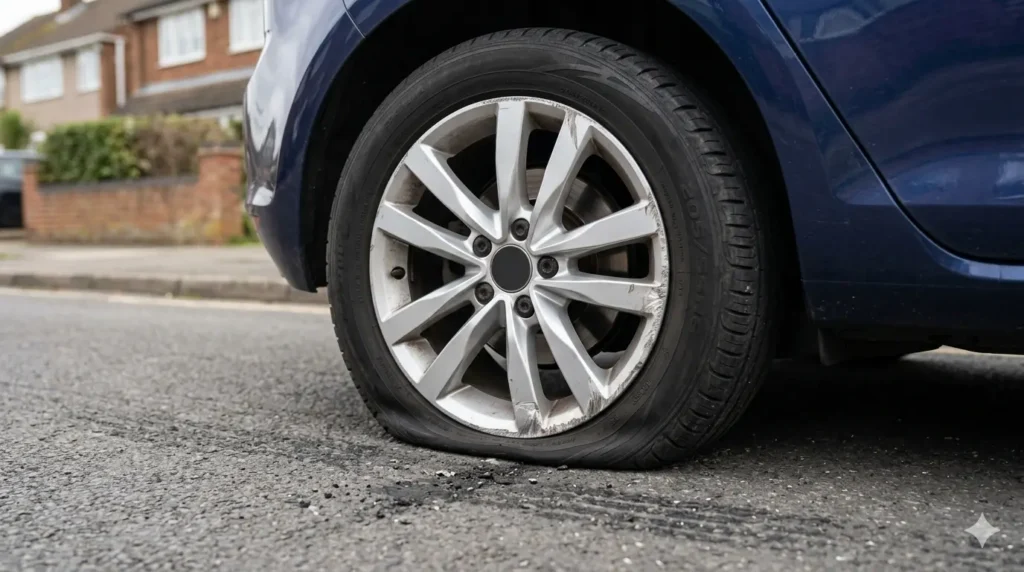
They usually feel very different. A slow puncture creeps up over hours or even days, while a blowout lands all at once with little or no warning.
Comparison Table
| Slow Puncture | Sidewall Blowout |
|---|---|
| Gradual pressure loss | Immediate pressure loss |
| Often caused by nails | Often caused by impact damage |
| Vehicle remains controllable | Sudden steering changes |
| May be repairable | Often requires replacement |
Telltale Signs of a Slow Puncture
- A slow puncture leaks away bit by bit rather than dropping all at once. You might see the pressure warning light keep coming back, find yourself topping up the air more often, notice fuel economy slipping, or feel the car handling a little lazily on the road.
Telltale Signs of a Blowout
- A blowout is far more dramatic and hard to miss. Plenty of drivers describe a loud bang followed by an instant loss of pressure. The car may drag sharply to one side, and once it’s safe to look, the damage is usually there in plain sight.
Why Does the Difference Actually Matter?
Working out whether you’re dealing with a small puncture or a full blowout shapes what you do next. A minor puncture might still be repairable, whereas a blowout often leaves damage that only a new tyre will fix. Knowing the cause also lets the roadside team turn up with the right kit and a suitable replacement if one’s needed.
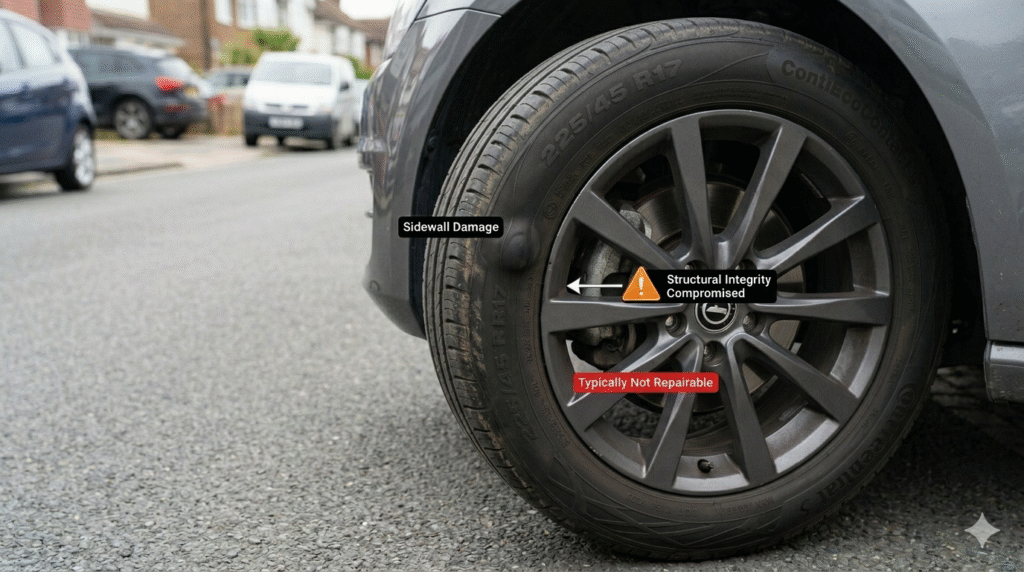
What Makes Sidewall Damage So Serious?
Why the Distinction Is Worth Knowing
The sidewall does a lot of quiet work – it’s one of the tyre’s key structural parts. Unlike the tread, it flexes with every turn of the wheel and helps carry the car’s weight.
The Usual Forms Sidewall Damage Takes
- Sidewall damage shows up in all sorts of ways, from light surface wear to serious structural faults. Typical culprits include bulges from internal damage, deep gouges left by road debris, cracks that appear with age, splits in the rubber, and impact damage from clipping a kerb or dropping into a pothole. Even the ones that look harmless can sap the tyre’s strength, so none of them are worth ignoring.
When Does a Damaged Tyre Have to Be Replaced?
⚠ Bulges you can see
⚠ Cords showing through
⚠ Deep cuts in the sidewall
⚠ Large cracks
Expert Insight
TyreSafe’s advice is that sidewall damage generally can’t be repaired, because it undermines the tyre’s structural integrity.
Even a sidewall that looks only lightly marked may already be weakened underneath.
Run-Flat Tyres: Warning Signs to Watch For
Do Run-Flats Save You From Roadside Trouble?
They help, but they’re not a magic fix. Run-flats are built to hold the car up for a short, limited distance once the pressure has gone.
Warning Signs You Shouldn't Ignore
- Sidewall trouble doesn’t always announce itself, but there are usually hints. A pressure-monitor warning, odd road noise, a rougher ride, or steering that feels a touch vague can all point to a developing fault. If any of that crops up, get the tyre looked at promptly to find out whether the sidewall or something else is to blame.
Where Run-Flats Genuinely Help
| Feature | Benefit |
|---|---|
| Reinforced sidewall | Supports vehicle temporarily |
| Limited mobility after puncture | Reduces roadside exposure |
| No immediate wheel change required | Added convenience |
Important Reminder
Run-flats have their limits – push past the maker’s recommended speed or mileage and you can do permanent damage to the tyre.
Repairable or Ruined? Knowing When a Tyre Is Finished
Not every puncture can be mended. Whether a tyre can be saved comes down to where the damage is and how bad it is. As a rule, a repair is possible when there’s a small puncture in the middle of the tread, only one puncture to deal with, no structural damage, and the car was stopped before the tyre ran flat. Some damage, though, rules a repair out for safety – sidewall injuries, several punctures at once, cords poking through, big cuts, or harm done by driving on the tyre while flat. When that’s the case, fitting a new tyre is the safe and sensible choice.
Repair Decision Table
| Damage Type | Repair Possible? |
|---|---|
| Small tread puncture | ✅ Usually |
| Sidewall puncture | ❌ No |
| Bulging sidewall | ❌ No |
| Large tear | ❌ No |
| Exposed cords | ❌ No |
Quick Tip
If you can’t tell whether a tyre is repairable, don’t gamble on it. Having a professional take a look is always the safer route.
Getting Past Roadside Hold-Ups
Lost Your Locking Wheel Nut Key? Here's the Plan
Can a missing locking wheel nut key really hold up a tyre change?
Absolutely – and it catches out more drivers than you’d think.
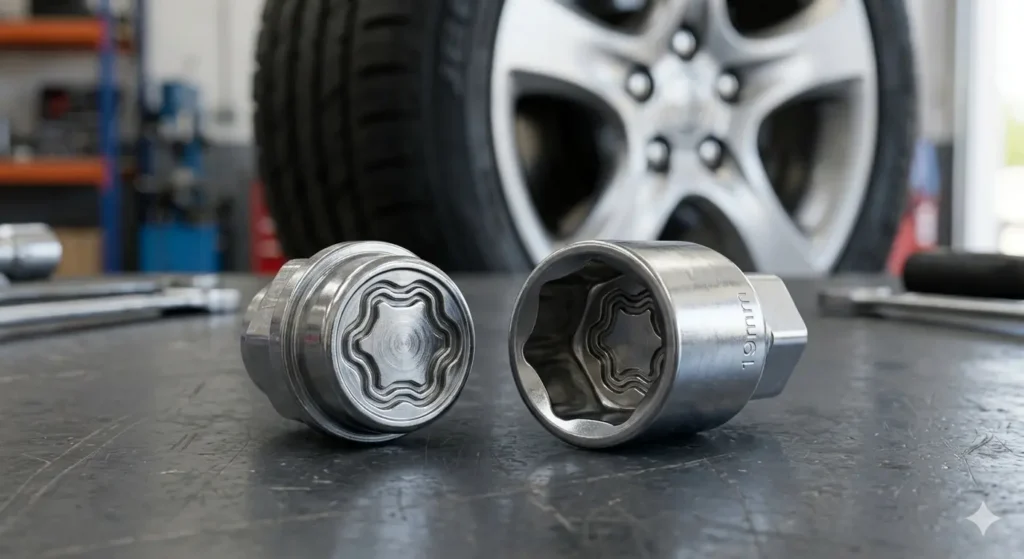
Locking wheel nuts exist to deter wheel thieves, and each set needs its own matching key to undo. Lose that key and swapping a damaged tyre at the roadside suddenly gets a lot trickier.
Where to Look First
Before you decide the key is gone for good, have a look in:
- The glovebox
- The boot storage area
- The spare wheel well
- The car’s toolkit
- The trays tucked under the seats
What If the Key Really Has Gone?
✓ Let your breakdown provider know
✓ Tell the mobile tyre fitter before they set off
✓ See whether a previous owner tucked the key away somewhere
✓ Get in touch with the manufacturer if all else fails
What to Steer Clear Of
| Action | Recommended? |
|---|---|
| Using the wrong socket | ❌ No |
| Hammering tools onto the nut | ❌ No |
| Calling a professional | ✅ Yes |
| Checking the toolkit first | ✅ Yes |
Why Does This Matter?
Specialist removal tools are usually needed. Have a go yourself and you risk damaging:
- The locking nut itself
- The alloy wheel
- The wheel stud
Expert Tip
If you’re often behind the wheel, it’s worth checking right now that your locking wheel nut key is where it should be. Most people only find out it’s missing in the middle of a roadside emergency.
Roadside Help After a Blowout: Who to Ring
Emergency and Motorway Help Numbers Worth Knowing
Who should you ring after a blowout?
It depends on the situation you’re in.
If you’re parked safely on the hard shoulder and nobody’s hurt, a mobile tyre fitter or breakdown provider is usually the sensible call.
If there’s danger or anyone’s injured, ring the emergency services straight away.
Dial 999 When:
There’s been a crash, someone is hurt, your car is sitting in a live lane, or there’s any immediate danger to other road users. Whenever safety is at risk or the situation needs urgent help, the emergency services are who to call.
Call Roadside Assistance When:
You’ve got a flat tyre, need a replacement fitted, want the vehicle recovered, or the wheel damage makes driving on unsafe or impossible. In cases like these, a roadside assistance provider can size up the problem and either get you going again or arrange recovery if that’s what’s required.
Handy Contacts to Keep Within Reach
| Service Type | Why You Might Need It |
|---|---|
| Breakdown Cover Provider | Roadside assistance |
| Mobile Tyre Fitter | Tyre replacement |
| Recovery Company | Vehicle transport |
| Emergency Services | Immediate danger |
Details to Have Ready Before You Call
Before you dial for help, it pays to have a few details to hand. Have ready your registration number, where you are right now, the make and model of the car, the tyre size if you know it, and a quick description of what’s wrong with the tyre. Passing that on early helps whoever’s coming out grasp the situation fast and respond in the right way.
For dependable tyre-safety and motorway advice, drivers can turn to trusted names such as National Highways, TyreSafe, and their own vehicle handbook. These bodies regularly share guidance on tyre maintenance, what to do in a motorway breakdown, and staying safe at the roadside.
Sharing Your Exact Location When You're Stuck
Why do some recovery trucks take longer to turn up than you’d expect?
Usually because they haven’t been given a precise location.
“I’m somewhere on the M6” simply doesn’t give a recovery operator enough to work with.
The Best Ways to Pinpoint Where You Are
✓ Sharing your live location from your phone
✓ A What3Words reference
✓ The nearest junction number
✓ The emergency refuge area number
Location Methods Compared
| Method | Accuracy |
|---|---|
| GPS Pin | Excellent |
| What3Words | Excellent |
| Junction Number | Good |
| Nearby Town | Limited |
| Motorway Name Only | Poor |
Quick Tip
Before you make the call, look around for:
- Blue motorway signs
- Marker posts
- Junction numbers
- Service area names
Giving an accurate location can cut your waiting time considerably.
Mobile Tyre Fitting or Recovery – Which Do You Need?
Is it a recovery truck you need, or a mobile tyre fitter?
Plenty of drivers reach for recovery by reflex after a tyre fails, but that’s not always what the situation calls for.
Often a mobile fitting service can change the damaged tyre right where you’re parked and have you moving again.
Mobile tyre fitting tends to fit the bill when the tyre is damaged but the wheel is still usable, the car is otherwise roadworthy, and a matching replacement can be sourced. In many cases the technician swaps the tyre right where you are and gets you back on the road without any need to move the vehicle.
Recovery services come into their own when the wheel is cracked, there’s suspected suspension damage, more than one tyre has gone, or the car simply isn’t safe to drive. Then, hauling the vehicle to a garage is usually the wisest move.
Comparison Table
| Feature | Mobile Tyre Fitting | Recovery Service |
|---|---|---|
| Tyre replaced roadside | ✅ Yes | ❌ No |
| Vehicle transported | ❌ No | ✅ Yes |
| Often faster for punctures | ✅ Yes | ❌ No |
| Suitable for major vehicle damage | ❌ No | ✅ Yes |
Which One Usually Gets You Moving Sooner?
For everyday punctures and blowouts, mobile fitting often skips the whole business of transporting the car, so there’s less disruption and you’re back on your way sooner.
How Quickly Can a Mobile Fitter Actually Reach You?
How long does roadside tyre help usually take to arrive?
There’s no one-size-fits-all answer.
It hinges on things like where you are, the traffic, the weather, and whether your tyre is in stock.
What Affects How Long You'll Wait
- The time of day
- How far the technician has to travel
- Traffic in the area
- Rough weather
- Whether your replacement tyre is available
Typical Expectations
| Situation | Potential Response Speed |
|---|---|
| Urban location | Often quicker |
| Rural location | Usually longer |
| Peak traffic periods | Potential delays |
| Severe weather | Potential delays |
How Can You Help Speed Things Up?
You can shave time off the wait by pulling a few details together before you call. Where you can, know exactly where you are, snap a clear photo of the damaged tyre, and check the tyre size if it’s safe to do so. It’s worth flagging whether the wheel itself has taken a knock and mentioning if the locking wheel nut key has gone walkabout. Giving accurate information up front means the technician arrives with the right tools and a suitable tyre, so there’s less waiting around before you’re moving again.
Expert Insight
The usual reason for a delay isn’t distance – it’s missing information. A couple of extra details on the phone can save real time.
Frequently Asked Questions
No. Blowouts can just as easily come from other causes, including:
- Under-inflation
- Impact damage
- Tyres worn past their best
- Overloading the vehicle
- Manufacturing faults
- Debris in the road
Checking your tyres regularly cuts the chance of a nasty surprise.
Occasionally, yes – but many tyres drop hints before they fail. Keep an eye out for:
- Uneven wear
- Bulges in the sidewall
- Cracking
- Pressure that keeps dropping
- Unusual vibration
Routine checks help you catch these before they turn into an emergency.
It depends on a few things:
- How much tread is left
- The type of vehicle
- What the manufacturer recommends
- The drivetrain layout
A tyre professional can tell you whether replacing a single tyre is the right call.
Key Takeaways
If a tyre bursts while you’re driving:
Keep these priorities in order:
- Stay in control of the car.
- Keep off the brakes.
- Let your speed fall away gently.
- Get to a safe spot.
- Look after your passengers first.
- Take a careful look at the damage.
- Call the right roadside service.
Quick Emergency Checklist
✓ Hazards on
✓ Car safely positioned
✓ Passengers moved clear
✓ Location pinned down
✓ Help called
✓ Damage checked
✓ Recovery plan sorted
Final Thoughts
A blowout is unnerving, but it doesn’t have to turn into something dangerous. The drivers who come through them best are simply the ones who keep their head, follow a clear routine, and put safety ahead of everything else.
Whether you’re facing a simple puncture, a damaged sidewall, or an outright blowout, knowing the right response protects your passengers, your car, and everyone sharing the road with you.
Checking your tyres regularly, keeping them at the correct pressure, and swapping out worn ones remain some of the surest ways to lower the odds of a roadside tyre emergency.