Best Budget Tyres in the UK (2026): Safe Cheap Tyres Ranked
Budget tyres carry a reputation that no longer matches reality. Mention the word “cheap” in a tyre conversation and plenty of drivers still picture thin rubber, alarming stopping distances and a heart-in-mouth moment on the first wet roundabout of the winter.
That picture belongs to about fifteen years ago. Every tyre legally sold in this country has to clear the same UNECE type-approval testing, carry the same standardised label, and satisfy the same 1.6mm tread requirement as anything wearing a premium badge. Nothing on a UK shelf is unsafe by default.
What genuinely separates the price tiers in 2026 is narrower and more specific than most people assume: how the tyre behaves at the very edge of grip, how well it clears standing water at motorway speed, and how many miles it holds that performance for. Understand those three things and you can spend a lot less without gambling with your safety.
This guide sets out which budget tyres are actually worth fitting this year, which shortcuts are safe, and the exact point at which paying another £15 per corner starts buying you something real.
Here’s what this guide covers:
Table of content:
Quick Answer
The best budget tyres in the UK for 2026 come from established second-tier manufacturers rather than nameless imports. Landsail, Nankang, Davanti, Laufenn, Kumho and Maxxis all build tyres with genuine engineering behind them and sell them for roughly half the price of a premium equivalent. The single most useful filter is the wet grip letter on the label: hold out for a B or better and you will have a tyre that stops properly in British rain.
What Actually Counts as a Budget Tyre in the UK?
There is no legal definition of a “budget tyre”. It is a trade term, not a regulatory one, and it describes where a brand sits on price rather than whether it passed some lower standard. In practice the UK market sorts itself into three fairly clear tiers, and knowing which tier a name belongs to tells you far more than the price tag alone.
The Three-Tier UK Tyre Market at a Glance
| Tier | Typical fitted price* | Names you will see | What the money buys |
|---|---|---|---|
| Budget / Tier 3 | £45 – £70 | Landsail, Nankang, Davanti | Solid everyday grip, legal and label-rated, shorter tread life |
| Mid-range / Tier 2 | £70 – £110 | Laufenn, Kumho, Maxxis, Falken, Hankook, Vredestein | Noticeably better wet braking, quieter, longer lasting |
| Premium / Tier 1 | £110 – £200+ | Michelin, Continental, Pirelli, Bridgestone, Dunlop, BFGoodrich | Best-in-class limit handling, highest mileage, lowest rolling resistance |
*Indicative fitted price for a common 195/65 R15 or 205/55 R16 size. Prices move with size, season and stock.
So where does the extra money actually go?
Almost entirely into compound chemistry and tread engineering. Premium manufacturers spend heavily on silica blends that stay flexible when the road is cold and wet, on tread patterns designed to shift water at 70mph, and on carcass construction that keeps the contact patch flat when you load the tyre up in a corner.
Budget makers buy proven technology rather than inventing it, which is why their tyres are perfectly competent in normal driving and only start to fall behind when conditions turn genuinely hostile. That is the trade-off in one sentence: you are not buying a less safe tyre, you are buying a smaller safety margin at the extremes.
Budget Does Not Mean Unregulated
This is the point most drivers miss. A tyre cannot be sold in the UK unless it holds an E-mark type approval and displays the standard label showing fuel efficiency, wet grip and noise. Those figures come from prescribed test procedures, not from marketing departments.
So a £55 tyre with a B wet grip rating has demonstrably passed the same braking test as a £140 tyre with the same letter. Where the premium tyre pulls ahead is in everything the label does not measure — dry cornering, steering precision, aquaplaning resistance at speed, and how gracefully it wears out. If you want the fuller picture on how manufacturers stack up, our guide to the best tyre brands goes through the whole field.
The One Category Genuinely Worth Avoiding
Part-worn tyres. They are the false economy that costs people the most, because a used tyre arrives with no reliable history: you cannot see how it was stored, whether it was ever driven flat, or what the internal structure looks like. A part-worn at 4mm has already surrendered half its useful life, so the cost per remaining mile is frequently worse than a brand-new budget tyre.
A new Tier 3 tyre with 8mm of fresh tread and a traceable manufacturing date beats a part-worn on every measure that matters. If you are trying to keep costs down, that is where to start — not with second-hand rubber. Our cheap mobile tyre fitting service exists precisely so that price-conscious drivers do not feel pushed towards part-worns.
Top Budget Tyre Picks for 2026
The recommendations below focus on brands with real manufacturing depth behind them — companies that supply vehicle manufacturers, run their own R&D, and publish consistent label data across their range. That matters, because consistency is exactly what unbranded imports cannot promise.
Availability in your size will vary, so treat these as the shortlist to ask for rather than a rigid order of merit. Whichever way you go, check the current label figures for your exact size before you commit — ratings differ between sizes within the same model.
Best 5 Budget All-Season Tyres
All-season tyres suit the British climate better than almost anywhere else in Europe. We get long damp shoulder seasons, occasional hard frost and very little sustained snow, which is precisely the window an all-season pattern is designed for. For drivers who do not want the storage hassle of a second set of winters, they are the sensible default.
| Tyre | Best suited to | Why it earns a place |
|---|---|---|
| Laufenn G Fit 4S LH71 | Hatchbacks and family saloons | Hankook-owned engineering at a Tier 3 price, with the three-peak snowflake marking for genuine cold-weather certification |
| Kumho Solus 4S HA32 | Daily commuters and school runs | One of the most consistently rated affordable all-seasons, with balanced wet and dry manners rather than a compromise in both |
| Maxxis Premitra All Season AP3 | Mixed urban and A-road use | Strong wet performance for the money and a quieter ride than most tyres at this level |
| Nankang Cross Seasons AW-6 | Budget-first buyers who still want winter capability | Usually the cheapest properly certified all-season option, and a big step up from running summer tyres year-round |
| Davanti Alltoura | Drivers wanting a UK-based brand | British-designed range with wide size coverage and dependable label figures |
Are All-Season Tyres Actually Worth It in the UK?
For most people, yes. If you rarely drive above 60mph, live somewhere that sees frost rather than deep snow, and cover under 12,000 miles a year, a good budget all-season removes the annual changeover cost entirely and outperforms a summer tyre every cold morning between November and March.
The exception is high-mileage motorway drivers, who will wear an all-season out faster and lose a little fuel economy compared with a dedicated summer tyre.
Best 5 Budget Tyres for Wet UK Weather
If you only optimise for one thing on this island, make it wet performance. Rain is the condition that exposes a weak tyre fastest, and it is where the gap between a well-engineered budget tyre and a bargain-bin import becomes genuinely dangerous rather than merely noticeable.
The figure to chase is the wet grip letter, which is calculated from a standardised wet braking test. The RAC points out that stopping distances climb sharply once grip starts to fade, so this is not a specification worth economising on.
| Tyre | Typical wet grip band | What it does well |
|---|---|---|
| Davanti DX640 | B | Aggressive water-clearing grooves; a favourite on warm hatchbacks that still need to behave in rain |
| Kumho Ecsta HS52 | B | Genuinely capable wet braking and steering feel that stays predictable as the tyre wears |
| Landsail LS388 | B – C | One of the strongest value propositions in the sub-£60 bracket for ordinary road use |
| Nankang N'blue ECO | B – C | Low rolling resistance without the wet-weather penalty budget eco tyres often carry |
| Maxxis Victra Sport 5 | A – B | Nudges into mid-range performance; the pick if wet grip matters more than absolute price |
Wet grip bands vary by size within the same model — always confirm the rating printed for your exact fitment.
The Letter That Actually Matters
Between an A-rated and an E-rated tyre there can be an 18-metre difference in wet stopping distance from 50mph. That is four car lengths, and it is the difference between a near miss and a claim. A budget tyre rated B is a sound buy. A budget tyre rated D or E is not worth the £10 you saved.
Best 5 Budget Tyres for High Mileage
High-mileage drivers face a different maths problem. When you are covering 20,000 miles a year, the purchase price stops being the number that matters and cost per thousand miles takes over. A tyre that costs 40% less but wears out in half the time is not a saving at all.
The budget tyres that survive this test are the harder-compound touring patterns, which give up a little outright grip in exchange for tread life. It is also the category where stepping up one tier most often pays for itself, something we work through properly in our comparison of the best mid-range tyres.
| Tyre | Realistic tread life* | Best for |
|---|---|---|
| Laufenn G Fit EQ+ LK41 | 25,000 – 32,000 miles | Steady commuting and long motorway runs |
| Kumho Ecowing ES31 | 25,000 – 30,000 miles | Fuel-conscious drivers wanting low rolling resistance |
| Nankang NA-1 | 22,000 – 28,000 miles | Small cars and city runabouts covering big annual mileage |
| Maxxis Premitra HP5 | 24,000 – 30,000 miles | Saloons and estates carrying regular loads |
| Landsail LS588 | 20,000 – 26,000 miles | Larger wheels and performance fitments on a budget |
*Estimates for mixed UK driving with correct pressures and regular rotation. Aggressive driving or poor alignment can halve these figures.
Two Habits That Make Any Budget Tyre Last Longer
Underinflation is the single biggest killer of tread life, and it is entirely free to fix — our tyre pressure guide explains how to find the right figure for your car rather than guessing from the sidewall. The second is alignment: a car pulling half a degree out of true will scrub a shoulder bald in a few thousand miles, which is why the difference between alignment and balancing is worth understanding before you blame the tyre.
Best 5 Budget Tyres for Vans, SUVs and Crossovers
Heavier vehicles punish cheap tyres harder. Extra weight means more heat, more sidewall flex and faster wear, so load index and construction matter more here than on a light hatchback. For vans in particular, fitting a car tyre with an inadequate load rating is both unsafe and illegal.
| Tyre | Vehicle type | Notes |
|---|---|---|
| Landsail LSV88 | Panel vans and light commercials | Reinforced construction with sensible load ratings across common van sizes |
| Maxxis Vansmart AL2 | Working vans carrying regular loads | Built for kerbing abuse and stop-start delivery mileage |
| Kumho PorTran CX11 | Long-distance van use | Harder compound aimed squarely at commercial tread life |
| Landsail CLV2 | Road-biased SUVs and crossovers | Comfortable, quiet and priced well below premium SUV rubber |
| Nankang Cross Seasons AW-6 | Crossovers wanting year-round capability | Available in a wide spread of SUV sizes with winter certification |
Load Index Warning
⚠ Always match or exceed the load and speed index printed in your vehicle handbook. On a van this is not a recommendation, it is a legal requirement, and an underrated tyre can invalidate your insurance after an incident.
How to Choose a Safe Low-Cost Tyre
Choosing well is mostly a process of elimination. You are not trying to find the single best budget tyre in existence — you are trying to avoid the handful of genuinely poor ones while keeping the price sensible. Four checks do almost all of that work.
Understanding UK Tyre Labels (Wet Grip & Fuel Efficiency)
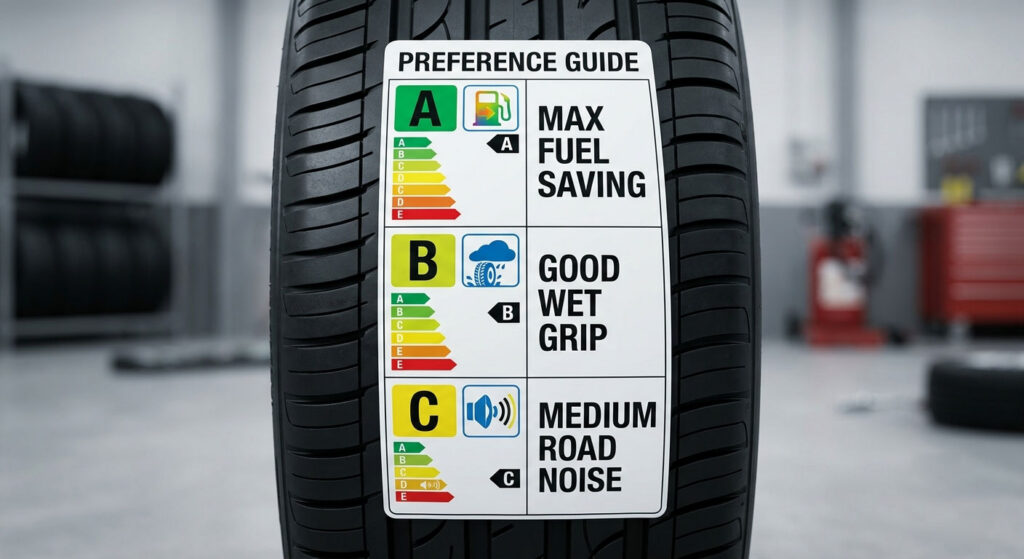
Every new tyre sold in the UK carries a label with three graded measurements. It is the closest thing consumers have to independent test data, it is standardised across all manufacturers, and it costs nothing to read.
| Label element | Scale | What it means in practice |
|---|---|---|
| Wet grip | A (best) to E | Wet braking distance from 50mph. Each letter step is roughly 3 to 6 metres — the most safety-critical figure on the label |
| Fuel efficiency | A (best) to E | Rolling resistance. Over a tyre's life the gap between A and E is worth several hundred pounds in fuel |
| External noise | A, B or C plus decibel value | Pass-by noise measured externally, though it correlates loosely with how quiet the cabin feels |
| Snow / ice icons | Present or absent | The three-peak mountain snowflake is the marking that certifies genuine cold-weather capability |
How to Use the Label Without Overthinking It
Set a floor rather than chasing perfection. For UK driving, a sensible rule is wet grip B or better, fuel efficiency C or better, and everything else is a bonus. That single filter removes almost every genuinely poor tyre from your shortlist while leaving plenty of affordable options in play.
Ignore noise ratings unless you are unusually sensitive to road roar — the differences are small and the measurement is taken outside the car, not inside it.
Quick Answer
Wet grip is the label figure that matters most on British roads. Fuel efficiency saves you money over time; wet grip is what stops the car. If you have to choose between them, choose grip.
Budget vs Premium: How Long Do Cheap Tyres Last?
This is where budget tyres are most often unfairly criticised and most often over-defended. The honest answer is that a good budget tyre typically returns 20,000 to 30,000 miles, while a premium tyre returns 30,000 to 45,000. The gap is real, but it is smaller than the price gap — which is exactly why budget tyres make financial sense for many drivers.
| Tier | Typical tread life | Approx. cost per tyre | Cost per 1,000 miles |
|---|---|---|---|
| Budget | 20,000 – 28,000 miles | £55 | £1.96 – £2.75 |
| Mid-range | 28,000 – 36,000 miles | £85 | £2.36 – £3.04 |
| Premium | 32,000 – 45,000 miles | £140 | £3.11 – £4.38 |
Illustrative figures for a mid-size family car in mixed UK use. Your own results depend heavily on pressures, alignment and driving style.
What That Table Actually Tells You
Per mile, budget tyres usually still win — but not by the margin the headline price suggests. Once you factor in the extra fitting visits and the fact that you spend more of your ownership on worn tread, the real-world gap narrows considerably.
What the maths cannot capture is the safety margin you buy at the top end, which only ever matters on the day something goes wrong. That is the honest case for spending more, and it is why we lay the tiers side by side in our mid-range tyre breakdown rather than pretending one answer suits everyone.
Check the Date Code Before You Accept a Tyre
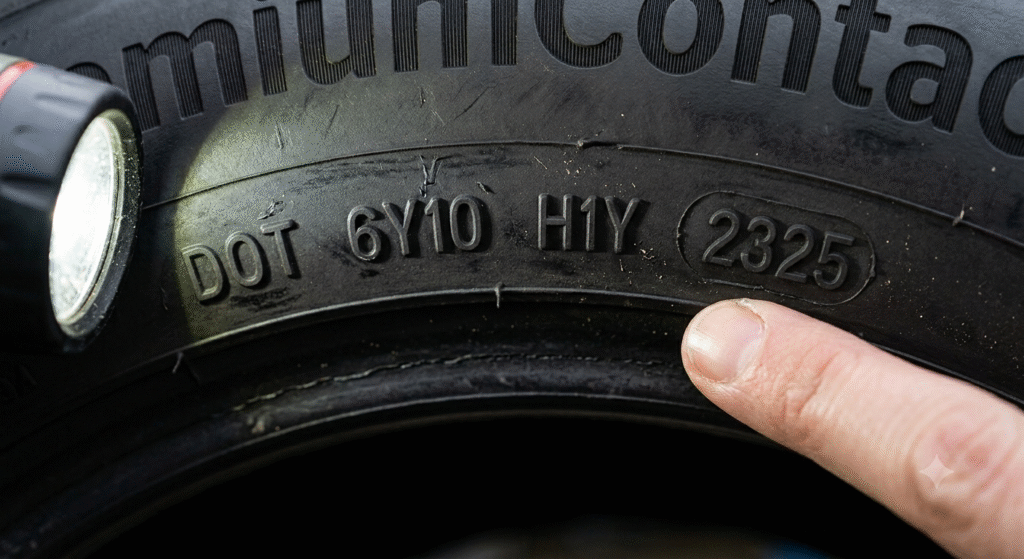
Every tyre carries a four-digit DOT code on the sidewall: the first two digits are the week of manufacture, the last two the year. So 2325 means week 23 of 2025.
Rubber ages whether it is used or not. A tyre that has sat in a warehouse for four years has already lost some flexibility before it turns a single mile. Ask for stock under two years old, and be wary of any deal that seems too good without a date code you can read.
Five Checks Before You Commit
- ✓ Wet grip rated B or better for your exact size
- ✓ Load index and speed rating that meet or exceed the handbook
- ✓ DOT date code within the last two years
- ✓ A manufacturer with a UK presence and a warranty you can actually claim on
- ✓ Matching tyres across the same axle
Do Not Let the Fitting Undo the Saving
A well-chosen budget tyre fitted carelessly will still wear unevenly and feel wrong through the wheel. Correct wheel balancing and a fresh valve on every fitment is not an upsell — it is what stops a new tyre vibrating at 60mph and scalloping its own tread. If you want to know what a fair total should look like, our breakdown of mobile tyre fitting costs in the UK sets out the numbers.
When to Replace Rather Than Push On
The legal minimum in the UK is 1.6mm across the central three-quarters of the tread, but TyreSafe and most safety bodies advise replacing at 3mm because wet braking deteriorates sharply below that point. Our guide to checking your tread depth covers the 20p test and what the wear bars are telling you, and how long tyres last and how to spot wear explains the patterns worth worrying about.
Budget Tyres vs Mid-Range Tyres: Which Is Best For You?
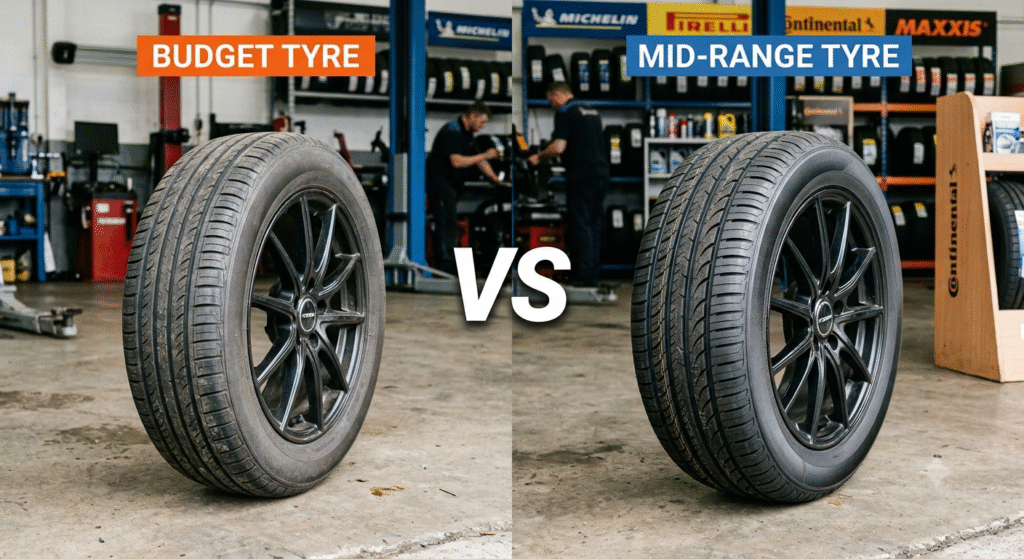
This is the decision most drivers are actually making — not budget against premium, but budget against the tier immediately above it. The price gap is usually £20 to £35 per corner, which is small enough to be worth thinking about properly rather than defaulting to the cheapest line on the quote.
| Factor | Budget tyres | Mid-range tyres |
|---|---|---|
| Purchase price | ✅ Lowest outlay | ❌ Around 40–60% more |
| Wet braking | ✅ Adequate at B rating | ✅ Consistently stronger |
| Tread life | ❌ 20,000–28,000 miles | ✅ 28,000–36,000 miles |
| Cabin noise | ❌ Usually the loudest | ✅ Noticeably quieter |
| Motorway stability | ❌ Adequate rather than reassuring | ✅ Better at sustained speed |
| Cost per mile | ✅ Generally lowest | ❌ Slightly higher |
| Resale of the car | ❌ Can flag as a corner cut | ✅ Neutral to positive |
When to Save with Budget Tyres
Budget tyres are the right answer far more often than the industry likes to admit. Fit them with confidence if most of the following describe you:
- You cover under 10,000 miles a year, mostly on urban and A-roads
- Your car is a small hatchback, city car or older runabout
- You drive calmly and rarely approach the limits of grip
- You are keeping the car for a year or two and want to spread costs
- You need two tyres now rather than four next month
That last point deserves emphasis. Four safe budget tyres beat two premium tyres and two illegal ones every single time. Getting all four corners legal is always the priority.
When to Step Up to Mid-Range Tyres
There are situations where the extra spend genuinely earns its keep, and pretending otherwise would not be doing you any favours:
- You cover 15,000 miles or more each year, much of it on motorways
- You drive something heavy, powerful or rear-wheel drive
- You regularly carry passengers, tools or a full boot
- Refinement matters to you and road noise grates
- You tow, or drive on rural roads in poor weather after dark
Performance cars sit firmly in this camp — the chassis is engineered around a level of grip that Tier 3 rubber simply cannot supply, which is why our guide to the best tyres for BMW steers away from the bottom tier entirely. The same logic applies before a long road trip, where sustained high-speed running is exactly the condition budget tyres find hardest.
Can You Mix Budget and Mid-Range Tyres?
Across the car, yes — with one firm rule. Both tyres on the same axle must match in brand, model, size and tread pattern. Mismatched tyres on one axle produce uneven braking and unpredictable behaviour in the wet, and on some vehicles it will fail an MOT.
If you are only replacing two, fit the new pair to the rear regardless of which wheels drive the car. Better grip at the back keeps the rear planted under braking in the wet, and a car that understeers gently is far easier to correct than one that snaps into oversteer.
Final Verdict: Are Cheap Tyres Worth It?
Yes — provided you buy from a manufacturer with something to lose, and provided you read the label before you read the price tag.
The old warning that cheap tyres are dangerous has not aged well. What is true in 2026 is narrower and more useful: a well-rated budget tyre from an established second-tier manufacturer is a safe, sensible purchase for the majority of British drivers, and an unbranded tyre with an E wet grip rating is a false economy no matter what it costs.
The money you save is real. Spend a little of it on getting the pressures right, the alignment checked and all four corners legal, and you will end up with a safer car than someone running two premium tyres and two worn ones.
| If you are... | Our recommendation |
|---|---|
| A low-mileage city driver | Budget tyres, wet grip B — comfortably the right call |
| A family covering 10–15k a year | Budget all-seasons, or mid-range if the car is heavy |
| A motorway commuter above 15k | Mid-range — the cost per mile lands in your favour |
| A van driver or trade user | Budget commercial pattern with the correct load index |
| Driving something fast or heavy | Mid-range as a minimum; premium if the budget stretches |
| Replacing only two tyres | Match the axle, fit the new pair to the rear |
Getting Them Fitted Without the Garage Trip
Whichever tier you land on, the fitting does not have to mean a morning in a waiting room. We bring the tyres to you and fit them on your driveway or in a car park, which is the whole idea behind mobile tyre fitting at home. If the tyre has already failed, emergency tyre replacement and roadside fitting run around the clock, and same day appointments are usually available when you catch us early enough. You can check whether we reach you on our service areas page.
Frequently Asked Questions About UK Budget Tyres
Yes, provided you choose sensibly. Every tyre legally sold here has passed UNECE type approval and carries a graded label, so none of them are unsafe by definition. The meaningful distinction is between a well-engineered Tier 3 tyre with a B wet grip rating and a nameless import rated D or E. Buy the former and you have a genuinely safe tyre; the latter is where the risk lives.
Start with manufacturers that have real factories, real R&D and a UK distribution presence — Landsail, Nankang and Davanti are the usual names in the bottom tier, with Laufenn, Kumho and Maxxis sitting just above them and often costing surprisingly little more. Availability in your size will decide it more than anything else.
Between 20,000 and 28,000 miles for typical mixed UK driving is a fair expectation. Get that number badly wrong and the cause is almost always underinflation or misalignment rather than the tyre itself. Keeping pressures correct and having the geometry checked once a year does more for tread life than moving up a price tier.
In that one specific test, yes — the wet braking measurement is standardised and directly comparable. But the label only measures straight-line braking. The premium tyre will usually still be ahead on cornering grip, aquaplaning resistance and how it behaves as the tread wears down, none of which appear on the label. Use the rating as a filter, not as the whole verdict.
If you are mixing tiers, put the better tyres on the rear axle. This surprises people with front-wheel-drive cars, but the reasoning is the same either way: grip at the back keeps the car stable when you brake in the wet. Whatever you do, keep both tyres on any single axle identical in brand, model and size.
Usually a little, because rolling resistance tends to be higher. Over the life of a set the difference between an A-rated and an E-rated tyre can run into a few hundred pounds of fuel, which can quietly erase the saving on a high-mileage car. On a low-mileage car it is a rounding error, so it depends entirely on how far you drive.
Almost never, once you work it out per mile. A part-worn typically arrives with around half its tread already gone and no verifiable history of how it was stored or driven. A new budget tyre gives you full tread depth, a readable date code and a warranty for a comparable outlay. It is the better buy nearly every time.
Yes, and it is what we do most days. We carry budget, mid-range and premium stock, confirm the price before setting off, and fit and balance everything at your vehicle. If you would rather compare tiers before deciding, our mid-range tyre guide sits alongside this one, and our low-cost fitting page explains how the pricing works.
1.6mm across the central three-quarters of the tread, measured around the full circumference. Below that you risk a fine and penalty points per tyre, and an automatic MOT failure. Safety organisations including TyreSafe recommend replacing at 3mm, because wet stopping distances lengthen considerably between 3mm and the legal limit.
Key Takeaways
If you are shopping for budget tyres in 2026:
Work through it in this order:
- Check the wet grip letter before the price.
- Stick to manufacturers with a real UK presence.
- Match the load and speed index to your handbook.
- Read the DOT date code and refuse old stock.
- Keep both tyres on an axle identical.
- Get all four corners legal before upgrading any of them.
- Set the pressures properly once they are on.
Quick Buying Checklist
✓ Wet grip B or better
✓ Correct load and speed rating
✓ DOT code under two years old
✓ Established brand with a warranty
✓ Matching pair per axle
✓ Balanced and torqued on fitting
✓ Pressures set before you drive off
Final Thoughts
Cheap tyres stopped being a gamble some time ago. The second-tier manufacturers have closed most of the gap that once justified the warnings, and for the majority of UK drivers a well-chosen budget tyre is a completely rational purchase rather than a compromise.
What has not changed is that the label deserves more attention than the price, and that four legal tyres beat two excellent ones every time. Spend where it counts, ignore the tiers that do not apply to your driving, and put the difference towards keeping the car properly maintained.
When it is time to fit them, we can bring the tyres to you and have the job done on your driveway — see how our mobile tyre fitting works, or read our tyre maintenance tips to get more life out of whichever set you choose.