Best Mid-Range Tyres: The UK Buyer's Guide to Value, Grip and Mileage
Walk into any tyre shop and you’ll be shown three prices for the same size. The cheap one, the famous one, and something in between that you’ve half heard of. That middle option is where most British drivers should be shopping, and it’s the one nobody explains properly.
Mid-range tyres sit in an awkward marketing gap. They don’t have Formula 1 budgets behind them and they don’t compete on being the cheapest thing on the shelf, so they get talked about least. Yet in independent group tests they routinely land within a couple of metres of premium tyres on wet braking while costing a third less, and they leave ultra-budget rubber a long way behind.
This guide sets out what a mid-range tyre is, which brands are worth your money in the UK, how they perform in rain, on fuel and over the long haul, and how to work out the true cost of a set rather than the sticker price.
Here’s what this guide covers:
Table of content:
- What a mid-range tyre actually is
- Top mid-range tyre brands to consider
- The performance categories that matter
- Best mid-range tyres by driving need
- Mid-range vs premium vs budget
- How to read a UK tyre label
- Buying guide and maintenance tips
- Mistakes that waste money on mid-range tyres
- Final verdict and quick recommendations
- Frequently asked questions
Quick Answer: What Counts as a Mid-Range Tyre?
A mid-range tyre is a tyre made by an established manufacturer that sits between ultra-budget imports and flagship premium ranges, typically costing 25-40% less than a premium equivalent while retaining most of its wet grip and tread life.
For everyday UK driving, the best mid-range picks are usually Hankook, Kumho, Falken, Toyo, Uniroyal, Kleber and Firestone. They are the sensible default for commuters, family cars and anyone covering ordinary mileage on ordinary roads.
What Is a Mid-Range Tyre?
The tyre market is usually split into three tiers, and the split is about engineering budget and testing depth rather than badge snobbery. Premium brands develop compounds in-house, run enormous test programmes and supply car makers directly. Budget brands buy in or licence technology and compete almost entirely on price. Mid-range sits in the middle, often using last-generation premium technology or sharing factories and research with a parent company.
That middle tier is where the value hides. You’re paying for proven compound science and proper testing, but not for motorsport programmes or the marketing spend that comes with a household name.
Where Mid-Range Sits Between Budget and Premium
| Tier | Typical UK price (205/55 R16) | What you're paying for |
|---|---|---|
| Budget / ultra-budget | £38 - £55 | Legal minimum performance, thin testing history, longer wet stopping distances |
| Mid-range | £60 - £90 | Established maker, solid wet grip, sensible tread life, decent refinement |
| Premium | £95 - £150+ | Latest compounds, OE fitments, best-in-class braking and handling limits |
Prices are typical UK fitted-cost ranges for a common family car size and move with size, load rating and season. Bigger and lower-profile sizes push every tier upwards.
The Sweet Spot: Safety, Longevity and Cost
The reason mid-range works so well is that tyre performance doesn’t scale evenly with price. The jump from a cheap unbranded tyre to a mid-range one buys you a large chunk of extra wet braking, steering precision and tread life. The jump from mid-range to premium buys a smaller extra slice, usually at the very edge of grip, for a much bigger price rise.
Put plainly: the first £20 you spend above budget level buys far more safety than the next £40 does. Most drivers never reach the limits where premium tyres start to justify themselves, but every driver eventually has to stop hard in the rain.
Who Are Mid-Range Tyres Best For?
Mid-range is the right answer for the majority of vehicles on British roads, and especially for:
- Daily commuters covering 8,000 to 15,000 miles a year on motorways and A-roads
- Family hatchbacks, estates and MPVs where comfort and mileage matter more than lap times
- Older cars where a full premium set costs a noticeable share of the car’s value
- High-mileage drivers who replace tyres often and feel the cost-per-mile directly
- Company car and fleet drivers working to a per-tyre budget
If you’re not sure how much life is left in your current set, our guide on how to check tyre tread depth walks through the 20p test and the wear indicators moulded into the tread.
Top Mid-Range Tyre Brands to Consider
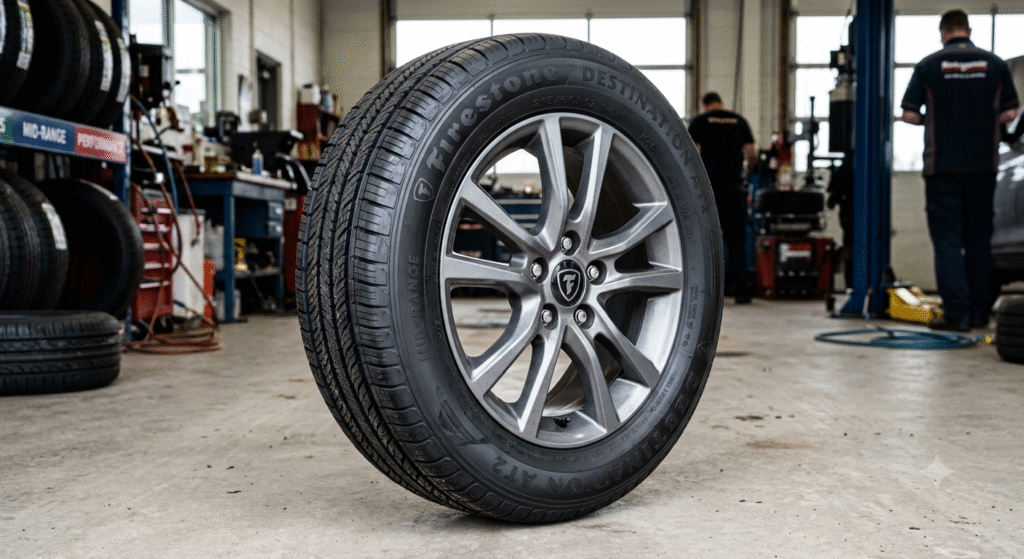
Mid-range splits into two families. There are second brands owned by premium manufacturers, which inherit technology from the parent company, and there are large independents that have simply chosen to compete in the middle of the market. Both are worth your money, and they behave slightly differently.
Household Names: Second Brands Owned by Premium Manufacturers
These are the quiet bargains. The parent company designs the compound, runs the testing and often builds the tyre in the same plant as its flagship products, then sells it under a separate badge at a lower price.
| Brand | Owned by | Best known for |
|---|---|---|
| Firestone | Bridgestone | Balanced all-rounders for small and mid-size family cars |
| Kleber | Michelin | Long tread life and low running costs, strong all-season range |
| Uniroyal | Continental | Wet weather specialists, the RainSport and RainExpert lines |
| Fulda | Goodyear | Quiet, comfort-biased touring tyres at sensible money |
| Sava | Goodyear | Value-first option with genuine European engineering behind it |
Independent Giants Worth Shortlisting
These makers are enormous in their own right, supply tyres to car manufacturers as original equipment, and consistently finish mid-pack or better in European magazine tests, often ahead of far pricier rivals.
| Brand | Origin | Where it stands out |
|---|---|---|
| Hankook | South Korea | OE fitments on European cars, strong dry handling and value |
| Kumho | South Korea | Aquaplaning resistance and keen pricing across common sizes |
| Falken | Japan (Sumitomo) | Sporty steering feel, popular on hot hatches and SUVs |
| Toyo | Japan | Durability, 4x4 and SUV ranges, long tread life |
| Nexen | South Korea | Quiet running and low rolling resistance on commuter sizes |
| Vredestein | Netherlands (Apollo) | All-season and winter performance well above its price |
| Nokian | Finland | Cold weather and all-season expertise, excellent in the wet |
Premium comparisons in this article refer to Michelin, Continental, Bridgestone, Goodyear and Pirelli. If you want the full tier-by-tier rundown, we’ve covered it separately in our guide to the best tyre brands in the UK, and there’s a marque-specific breakdown in our piece on the best tyres for BMW models.
A note on brand ownership
Ownership doesn’t guarantee identical performance. A second brand usually runs proven, slightly older technology rather than the parent’s newest compound. That’s exactly why it’s cheaper, and exactly why it’s still a safe buy.
Key Performance Categories That Actually Matter
Tyre marketing throws a lot of adjectives around. In practice there are four measurable areas that decide whether a tyre is right for your car, and mid-range products perform differently in each.
Wet and Dry Grip
Dry grip is where the gap between tiers is narrowest. On a dry road, almost any modern tyre from a known maker will stop a family car respectably. Wet grip is where the money shows.
In independent testing, the spread between the best and worst tyres of the same size braking from 50mph on a wet surface is routinely over 10 metres, which is two full car lengths. Good mid-range tyres usually land within two to four metres of the premium leaders. Ultra-budget tyres are the ones sitting at the far end of that spread, still travelling at speed when a better tyre has already stopped.
Cornering behaviour matters too. Mid-range tyres tend to lose grip a little earlier than premium ones, but they generally do it progressively, which is far easier to catch than a sudden let-go.
Fuel Efficiency and Rolling Resistance
Rolling resistance is the energy your engine wastes flexing the tyre as it rolls. It accounts for a meaningful slice of fuel use, and the label rating gives you a direct comparison.
Mid-range tyres typically rate B or C for fuel efficiency, premium often A or B, budget frequently D or E. Over a year of ordinary mileage the difference between a C and an E is real money, and on an electric car it shows up as lost range rather than fuel. EV drivers should treat a good rolling resistance rating as a headline feature, not a footnote.
Tyre Life and Durability
This is the category where mid-range quietly wins the argument. A decent mid-range touring tyre will often return 25,000 to 35,000 miles on a front-wheel-drive family car driven normally. Ultra-budget tyres frequently give up between 12,000 and 20,000 miles because the compound wears faster and the casing distorts sooner.
Replace a budget set twice in the time a mid-range set lasts once and the saving disappears entirely, along with the safety margin. Our article on how long tyres last and how to spot wear covers what shortens tyre life beyond simple mileage.
Cabin Noise and Comfort
Road noise comes from the tread pattern drumming and from the casing transmitting vibration into the suspension. Premium tyres spend enormous effort on tuning this. Mid-range tyres from Japanese and Korean makers have closed the gap markedly, and several are now quieter than mid-tier European rivals.
If refinement matters to you, look for a noise class of A or B on the label, and for tyres described as touring or comfort rather than sport.
How the three tiers typically compare
| Category | Budget | Mid-range | Premium |
|---|---|---|---|
| Wet braking | Longest stopping distances | Close to premium | Class leading |
| Dry handling | Adequate, vague at the limit | Consistent and predictable | Sharpest response |
| Fuel rating | Often D-E | Usually B-C | Frequently A-B |
| Expected mileage | 12,000-20,000 | 25,000-35,000 | 30,000-40,000+ |
| Cabin noise | Noticeably louder | Good to very good | Quietest |
| Cost per mile | Often the worst | Usually the best | Middle |
Figures are typical ranges from published European group tests and real-world UK usage, not guarantees. Individual models vary widely within every tier.
Best Mid-Range Tyres by Driving Need
There is no single best mid-range tyre, only the best one for how you actually drive. Pick the category that describes your week.
Best for Everyday Commuting
If most of your miles are motorway and A-road at steady speeds, prioritise rolling resistance and tread life over outright grip. Look at touring ranges from Kleber, Nexen and Hankook, and check for a B rating or better on fuel.
A commuter tyre earns its money slowly. Two extra years of service and a slightly better fuel rating will outweigh a small difference in cornering feel you’d never notice on the M6.
Best for Wet Weather and British Rain
Given how much of the UK year is damp, wet performance is arguably the single most important criterion for most drivers. Uniroyal built its reputation here, with the RainSport and RainExpert families designed specifically around aquaplaning resistance and wet braking. Kumho and Falken also perform strongly in the wet for the money.
Look for a wet grip rating of A or B, wide circumferential grooves that channel water away, and plenty of tread depth. Aquaplaning risk climbs sharply once tread drops below about 3mm, long before the legal limit.
Best All-Season Options
All-season tyres make a lot of sense in Britain, where full winter tyres are overkill in most regions but cold, wet mornings are guaranteed. They carry the 3PMSF snowflake marking and stay flexible below 7°C, where a summer tyre starts to harden and lose grip.
Vredestein, Nokian and Kleber all offer strong mid-range all-season ranges, and Goodyear-owned brands are competitive here too. The trade-off is a small loss of dry-weather sharpness and slightly faster wear in a hot summer, in exchange for never swapping tyres and never being caught out by a frost.
Best for SUVs and EVs
Heavier vehicles are harder on tyres, and electric cars are harder still. Instant torque scrubs the tread faster, extra battery weight raises the load on the casing, and the absence of engine noise makes tyre roar much more obvious in the cabin.
For an SUV or EV, three things matter more than usual:
- Correct load index. Never fit a tyre with a lower load rating than the vehicle handbook specifies, and check whether XL (extra load) or HL construction is required.
- Low rolling resistance. On an EV this converts directly into range.
- Noise class. A quiet tyre transforms an electric car’s refinement.
Toyo, Falken and Hankook all have credible SUV and EV-suitable mid-range ranges, and several are sold with EV-specific reinforced constructions.
Match the tyre to the job
| Your driving | What to prioritise | Mid-range brands to shortlist |
|---|---|---|
| Motorway commuting | Fuel rating B+, long tread life, low noise | Kleber, Nexen, Hankook |
| Wet and winter roads | Wet grip A-B, deep water channels | Uniroyal, Kumho, Falken |
| Year-round, no tyre swaps | 3PMSF snowflake marking, all-season compound | Vredestein, Nokian, Kleber |
| SUV or 4x4 | Correct load index, reinforced sidewall | Toyo, Falken, Hankook |
| Electric vehicle | Low rolling resistance, noise class A-B, XL/HL rating | Hankook, Nexen, Goodyear second brands |
| Spirited B-road driving | Dry handling, steering response | Falken, Toyo, Kumho |
Whichever you choose, fitting all four to the same specification is far more important than the badge. Mixing brands or tread patterns across an axle upsets braking balance, and our team covers why during every home tyre fitting appointment.
Mid-Range vs Premium vs Budget: The Real Cost
Most people compare tyres by the price on the invoice. That’s the wrong number. The number that matters is what each mile of tread costs you, and on that measure the cheapest tyre on the shelf is often the most expensive one to own.
Cost Per Mile, Not Price Per Tyre
Here’s the same size compared across the three tiers using realistic UK prices and typical service life.
| Tier | Price per tyre | Typical life | Cost per mile | Cost over 60,000 miles |
|---|---|---|---|---|
| Budget | £45 | 18,000 miles | 0.25p | About £600 (13 tyres) |
| Mid-range | £70 | 30,000 miles | 0.23p | About £560 (8 tyres) |
| Premium | £105 | 38,000 miles | 0.28p | About £660 (6 tyres) |
Illustrative worked example based on a common 205/55 R16 fitment and typical UK pricing. Your own figures will vary with driving style, alignment and mileage, but the shape of the result is consistent.
Mid-range comes out cheapest per mile, and it does so while giving you far better wet braking than the budget option. You also visit the fitter less often, which matters if you value your time. Our breakdown of mobile tyre fitting costs in the UK sets out what fitting adds on top of the tyre price.
The Safety Margin You're Actually Buying
Stopping distance is the part of this decision that can’t be undone later. Braking hard on a wet roundabout, the difference between a good mid-range tyre and a cheap import can be several metres, and several metres is the difference between a near miss and a claim.
There’s a second, less obvious safety gap. Cheap tyres are more prone to sidewall failure and structural damage from potholes and kerbs, and they age less gracefully. TyreSafe publishes regular UK research on tyre condition and its role in road casualties, and it’s worth reading before deciding that £25 a corner is a saving. If you’ve ever kerbed a wheel, our guide to tyre sidewall damage explains why that area can’t be repaired.
When Premium Is Genuinely Worth the Extra
Mid-range isn’t always the answer. Step up to premium when:
- Your car is fast and heavy. Performance saloons, large SUVs and anything with serious power benefits from the extra structural engineering.
- You do track days. Sustained high-speed heat cycling is exactly what premium construction is built for.
- The manufacturer specifies an OE-marked tyre. Some cars are tuned around a specific tyre, and markings like MO, AO, * or N-spec exist for a reason.
- You drive very high annual mileage at speed. The longer life and stability can justify the premium.
- You want the absolute shortest wet stopping distance. If that’s your priority, buy it and don’t apologise.
Outside those cases, spending premium money on a family hatchback that pootles to the station is buying capability you’ll never use.
Where each tier makes sense
| Situation | Best value choice |
|---|---|
| Family hatchback, 10,000 miles a year | Mid-range |
| Older car worth under £3,000 | Mid-range |
| EV or hybrid on standard wheels | Mid-range with low rolling resistance |
| Performance car or track use | Premium |
| Large SUV or towing regularly | Premium or top-end mid-range with correct load index |
| Car being sold within months | Mid-range, never ultra-budget |
| Any vehicle at all | Never part-worn |
How to Read a UK Tyre Label
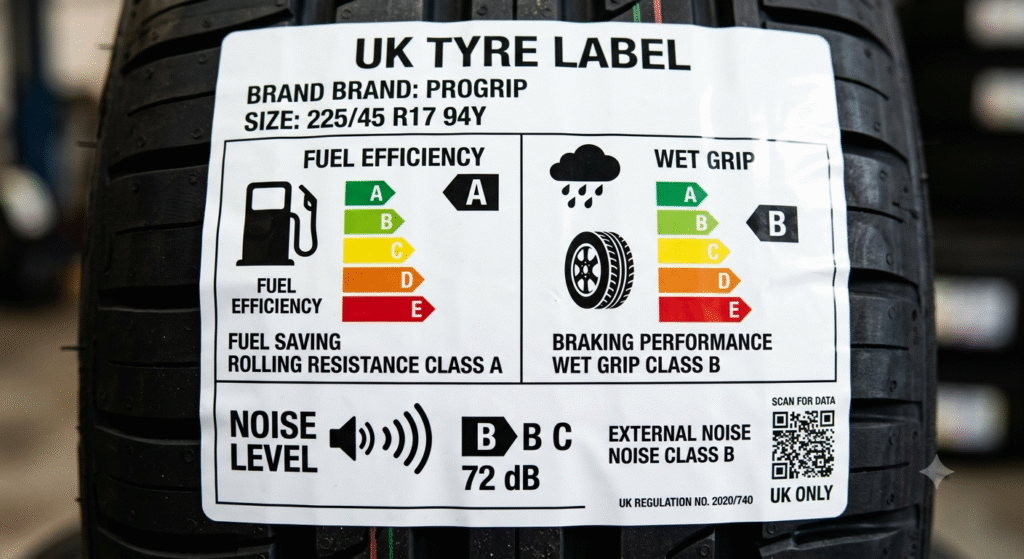
Every new tyre sold in the UK carries a standardised label covering three things: fuel efficiency, wet grip and external noise. It’s the only like-for-like comparison you get, and it’s free.
One important correction to a common myth: since May 2021 the scale runs from A to E, not A to G. The old F and G classes were merged out, so a modern E is not the same as an old E. You may still see older A-to-G labels on stock that predates the change. The rules are set out in GOV.UK tyre labelling guidance, and the RAC’s tyre label explainer is a good plain-English walkthrough.
Fuel Efficiency: The A-to-E Scale
This measures rolling resistance. A is best, E is worst. Each step is worth roughly a small but real slice of your fuel bill, and across a full set the gap between A and E adds up over a year. On an EV, read this as a range rating rather than a fuel rating.
Wet Grip: The Braking Safety Rating
This is the one to weight most heavily. It measures wet braking performance only, graded A to E. The difference between the top and bottom of the scale is measured in car lengths when braking from motorway-approach speeds in the rain.
For UK driving, treat B as your floor and A as the target. A mid-range tyre with an A wet grip rating is a better buy than a premium tyre with a C.
Noise: The Decibel Figure and Letter Class
External rolling noise is shown as a decibel value alongside a class of A, B or C, with A being quietest. Because decibels are logarithmic, a difference of three dB is roughly a doubling of sound energy, so the gap between a 68 dB and a 72 dB tyre is more noticeable than the numbers suggest.
What the label tells you at a glance
| Label section | Scale | What it measures | What to aim for |
|---|---|---|---|
| Fuel efficiency | A to E | Rolling resistance and energy loss | A or B, especially on an EV |
| Wet grip | A to E | Wet braking distance only | A or B, never below C |
| Noise | A to C plus dB value | External rolling noise | A or B for cabin comfort |
| Snowflake (3PMSF) | Present or absent | Certified severe snow performance | Present if buying all-season |
| Ice grip symbol | Present or absent | Ice braking on C1 car tyres | Only relevant for Nordic conditions |
What the label doesn't tell you
The label covers three parameters. It says nothing about dry handling, aquaplaning resistance at speed, steering feel, comfort or tread life. That’s why independent group tests are worth reading alongside it, and why two tyres with identical labels can feel completely different on the road.
Buying Guide and Maintenance Tips
Choosing the right tyre is half the job. Fitting the right size and then looking after it is the other half, and it’s where most of the value in a mid-range set is either protected or thrown away.
Finding Your Size on the Sidewall
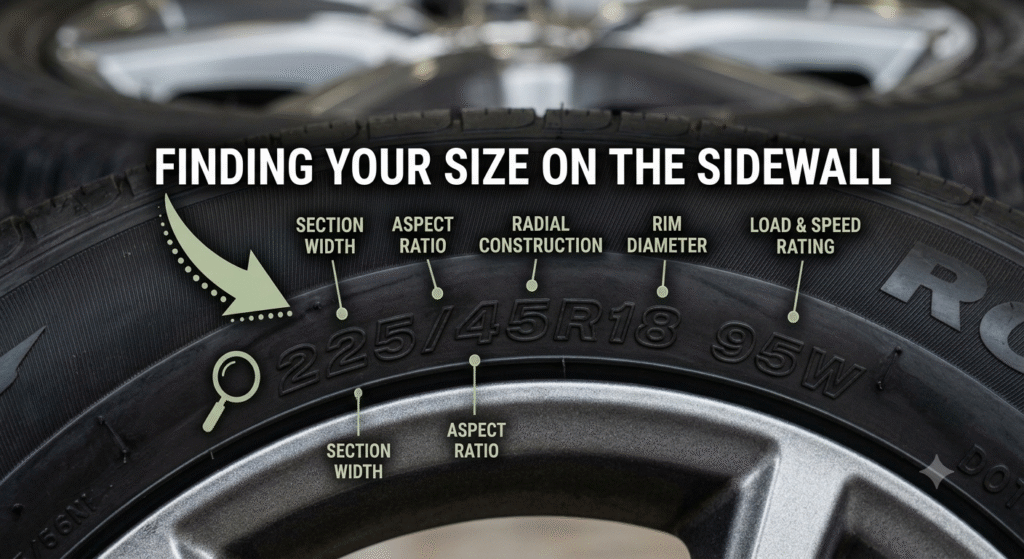
Everything you need is moulded into the tyre itself. A typical marking reads 205/55 R16 91V, and each part means something specific.
| Code | Meaning | Example: 205/55 R16 91V |
|---|---|---|
| 205 | Section width in millimetres | 205mm wide |
| 55 | Aspect ratio: sidewall height as a percentage of width | Sidewall is 55% of 205mm |
| R | Radial construction | Radial |
| 16 | Rim diameter in inches | Fits a 16in wheel |
| 91 | Load index, the maximum weight per tyre | 615kg per tyre |
| V | Speed rating, the maximum certified speed | Up to 149mph |
| XL / HL | Extra load or high load construction | Fit only if specified |
Cross-check the sidewall against the plate in your door shut or fuel filler flap, because a previous owner may have fitted a non-standard size. Never drop below the specified load index or speed rating.
When to Replace Your Tyres
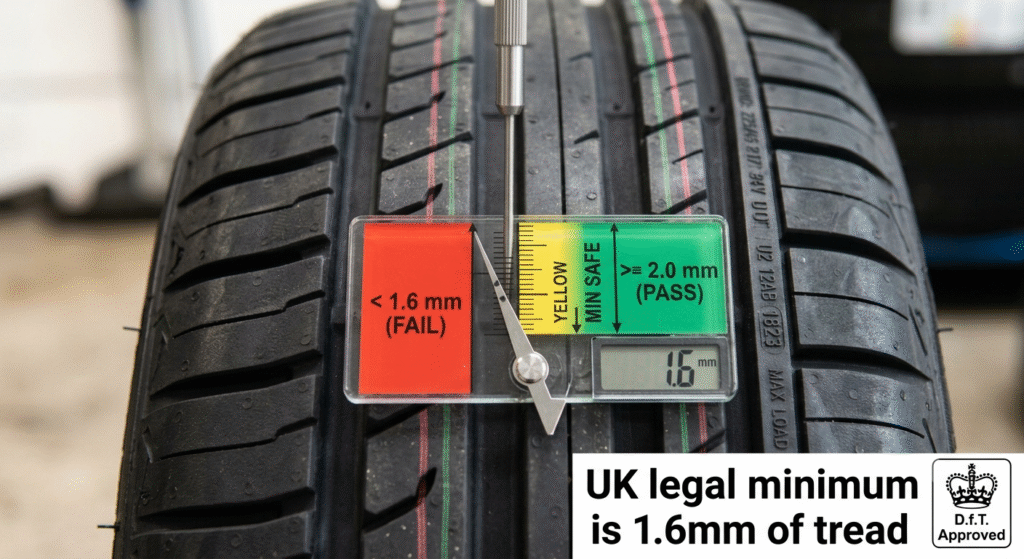
The UK legal minimum is 1.6mm of tread across the central three-quarters of the tyre, around its entire circumference. That’s the point at which you’re breaking the law, not the point at which the tyre is still doing its job. Wet performance falls away sharply below 3mm, which is where most safety organisations recommend replacing.
Replace sooner if you find:
- Bulges, blisters or cuts in the sidewall
- Cracking or crazing in the rubber, common on tyres over six years old
- Uneven wear across the tread, which usually means an alignment or pressure problem
- Persistent slow pressure loss
- Vibration through the wheel or seat at steady speed
Tyres also age out. Check the four-digit DOT date code on the sidewall: 2523 means the 25th week of 2023. Many manufacturers advise replacement at around ten years regardless of tread. If a tyre has already deflated on you, read our guide on whether you can drive on a flat tyre before moving the car.
Making a Mid-Range Set Last Longer
Mid-range tyres reward maintenance more than any other tier, because their value case depends on reaching the mileage they’re capable of.
- Check pressures monthly. Under-inflation is the single biggest cause of premature wear and of blowouts. Set them cold, to the figures on the door plate, not the maximum on the sidewall. Our tyre pressure guide has the detail.
- Get the alignment checked. A single pothole can knock the tracking out and shave thousands of miles off a set. Our explainer on wheel alignment vs balancing covers the difference.
- Balance the wheels when fitting. Unbalanced wheels cause vibration and scalloped wear. It’s part of our wheel balancing and valve replacement service.
- Rotate where the handbook allows. Fronts wear faster on most cars.
- Replace the valve with the tyre. Rubber valves perish, and a failed valve ruins a good tyre.
- Drive smoothly. Hard acceleration and late braking are the fastest way to convert tread into dust.
There’s more in our roundup of the most useful tyre maintenance tips and our checklist for preparing tyres before a long road trip.
Mistakes That Waste Money on Mid-Range Tyres
A good tyre choice can still be undone by how it’s bought and fitted. These are the errors we see most often on the roadside.
| Mistake | Why it costs you |
|---|---|
| Buying part-worn tyres | Unknown history, hidden internal damage, and far less tread for the money |
| Mixing brands across an axle | Uneven grip and braking balance, especially in the wet |
| Fitting a lower load or speed rating | Can invalidate insurance and overload the casing |
| Replacing only one tyre on an axle | Different grip levels either side pulls the car under braking |
| Ignoring the DOT date on 'new' stock | A tyre stored five years has already used part of its life |
| Skipping alignment after fitting | Can destroy a new set within 10,000 miles |
| Chasing the lowest price online only | Fitting, balancing, valves and disposal are often extra |
One more worth stating plainly: a slow puncture is not something to ride out. Driving on a deflating tyre destroys the internal structure and turns a repairable puncture into a new tyre. If you’re stuck, our emergency mobile tyre replacement and roadside tyre fitting services come to you.
Final Verdict and Quick Recommendations
For the overwhelming majority of UK drivers, mid-range is not a compromise. It’s the correct answer. You keep most of the wet braking performance of a premium tyre, you get tread life that beats budget rubber by a wide margin, and you spend less per mile than either alternative.
The one rule worth holding to: never let price alone choose the tyre. Read the wet grip rating first, check the load index second, then compare prices among the tyres that pass both tests.
Cheat Sheet: Pick Your Priority
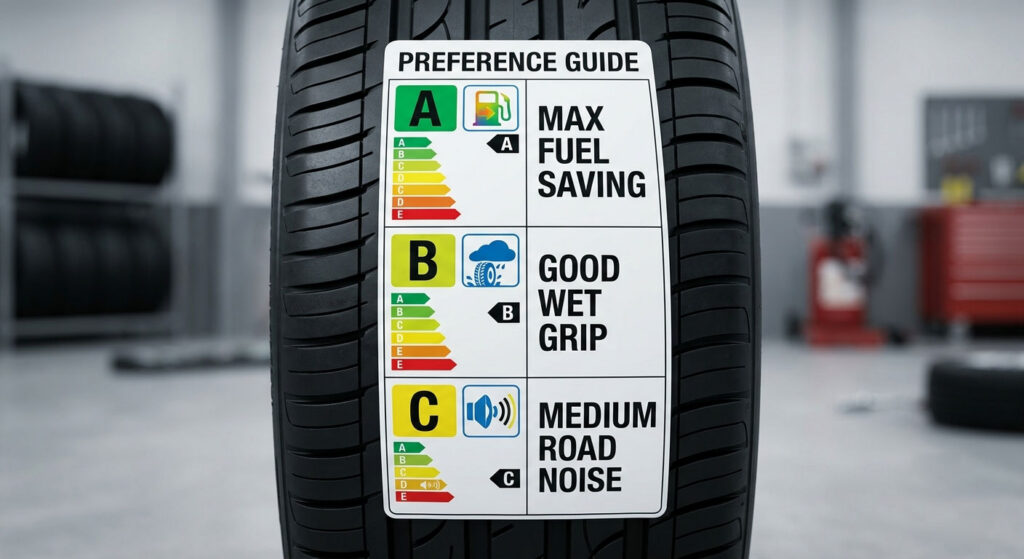
| If your priority is... | Buy this | Typical spend per tyre |
|---|---|---|
| Lowest cost per mile | Mid-range touring tyre with a B fuel rating | £60 - £75 |
| Wet weather confidence | Mid-range wet specialist, A or B wet grip | £65 - £85 |
| Never changing tyres seasonally | Mid-range all-season with 3PMSF marking | £70 - £95 |
| Quietest cabin | Comfort-biased mid-range, noise class A-B | £70 - £90 |
| Maximum EV range | Low rolling resistance mid-range, XL where required | £75 - £100 |
| Outright grip and handling | Premium, not mid-range | £100+ |
| Spending as little as possible | Still mid-range, bought in a sale | £55 - £65 |
Our practical recommendation
If you want one shortlist to take to the fitter: Hankook, Kumho, Falken, Toyo, Uniroyal, Kleber and Firestone. Compare the specific model available in your size, weight the wet grip rating heavily, and buy the best of what’s in stock.
We fit mid-range and premium tyres at homes, workplaces and roadsides across the UK, including London, Birmingham, Manchester, Leeds, Bristol and Glasgow. The full list is on our mobile tyre service areas page, and we also offer same day fitting, next day fitting and Sunday appointments.
Frequently Asked Questions
Yes. Mid-range tyres from established manufacturers meet the same UK and European type approval standards as premium tyres, and in independent group tests they typically finish within a few metres of premium products on wet braking. The meaningful safety gap is between mid-range and ultra-budget tyres, not between mid-range and premium.
Check the wet grip rating on the label and aim for A or B.
There isn’t one winner, because performance varies model by model and size by size. The brands that consistently perform well for the money are Hankook, Kumho, Falken, Toyo, Uniroyal, Kleber, Firestone and Nexen.
Compare the specific model in your size rather than the badge, and weight wet grip most heavily.
For a common family car size such as 205/55 R16, expect roughly £60 to £90 per tyre fitted in the UK. Larger diameters, low-profile sizes, run-flats and SUV fitments cost more.
If a quote looks dramatically cheaper than that, check whether fitting, balancing, a new valve and old tyre disposal are included.
Close to it. A good mid-range touring tyre commonly returns 25,000 to 35,000 miles on a family car, against roughly 30,000 to 40,000 for premium. Budget tyres often manage only 12,000 to 20,000.
Alignment, pressures and driving style affect the result more than the brand does.
Many are, provided you check three things: the load index meets the vehicle’s requirement including any XL or HL specification, the fuel efficiency rating is A or B to protect range, and the noise class is A or B because EVs make tyre roar much more audible.
Several mid-range makers now sell EV-specific constructions.
It’s legal to run different brands on different axles, provided both tyres on the same axle match in size, construction and tread pattern. It isn’t ideal, because grip levels differ front to rear and that changes how the car behaves under hard braking.
If you can only afford two, fit the new pair to the rear axle and never mix across a single axle.
It’s the standardised grading for fuel efficiency and wet grip, where A is best and E is worst. The scale changed in May 2021: it previously ran A to G, and the F and G classes were merged out, so an older label isn’t directly comparable to a new one.
Noise is graded separately as A, B or C alongside a decibel figure.
No. Part-worn tyres come with no reliable history, may have internal damage that isn’t visible, and give you far less usable tread. Per millimetre of tread, they’re frequently more expensive than a new mid-range tyre.
A new mid-range tyre is almost always the better buy at that budget.
At least monthly, and before any long journey. Check them cold, using the figures on the door plate or fuel flap rather than the maximum printed on the sidewall.
Under-inflation is the leading cause of premature wear, higher fuel use and blowouts.
For most of the country they’re a sensible compromise. Summer tyres begin to lose grip below about 7°C, and full winter tyres are more than most UK drivers need. An all-season tyre carrying the 3PMSF snowflake marking covers both without seasonal swaps.
If you live somewhere regularly snowbound or at altitude, dedicated winter tyres are still better.
Key Takeaways
If you’re choosing tyres this week, work in this order:
- Read the size, load index and speed rating from your door plate.
- Filter for a wet grip rating of A or B.
- Filter for a fuel efficiency rating of A or B if you cover high mileage or drive an EV.
- Compare mid-range models from established makers within that shortlist.
- Buy a full set of four where budget allows, or a matched pair on the rear axle.
- Have the wheels balanced and the alignment checked at fitting.
- Set the pressures cold and check them monthly afterwards.
Quick Buying Checklist
✓ Size matches the door plate
✓ Load index equal to or above the specified figure
✓ Speed rating equal to or above the specified letter
✓ Wet grip rating A or B
✓ Fuel rating A or B where possible
✓ DOT date code under two years old
✓ All four tyres matched, or matched in pairs per axle
✓ Balancing, valves and disposal included in the quote
Final Thoughts
Mid-range tyres are the least glamorous purchase in motoring and one of the smartest. They exist because the engineering that makes a tyre safe is largely mature, and paying a premium mostly buys performance at the very edge of what a car can do.
Buy from a maker you can name, read the wet grip rating before the price, fit four that match, and keep the pressures right. Do that and a mid-range set will out-perform, out-last and out-value almost anything else on the shelf.
If you’d rather not spend a Saturday at a garage, we bring the workshop to you. Book mobile tyre fitting at home, compare our affordable mobile tyre fitting prices, or get in touch with our team for a quote on your size.