Best Winter Tyres UK 2026: Ranked, Priced and Matched to Your Car
Every October the same argument starts again in car parks and WhatsApp groups up and down the country. One driver swears winter tyres transformed their commute; another insists they are a continental obsession that makes no sense on a mild, wet island where proper snow arrives twice a decade.
Both are half right, and the reason is that most people are arguing about snow when they should be arguing about temperature. A winter tyre is not a snow tyre. It is a cold tyre, and Britain has a great deal of cold without having very much snow.
This guide covers the lot. What a winter tyre actually is and how it differs from the tyres on your car now. How to read a sidewall and find the one marking that proves a tyre is certified for winter. Fifteen tyres ranked across budget, mid-range and premium with current prices. Which tyre suits which car, SUV and van. When to fit them, when to take them off, and how to store them. And, honestly, when a set is not worth your money at all.
Here’s what this guide covers:
Table of content:
- What a winter tyre actually is
- How to identify a genuine winter tyre
- What the tyre sidewall is
- How to read your tyre sidewall
- Do you really need winter tyres in the UK?
- How we chose these tyres
- Best 5 budget winter tyres and prices
- Best 5 mid-range winter tyres
- Best 5 premium winter tyres
- Recommended winter tyres by car brand
- Winter tyres for SUVs, 4x4s and vans
- When to fit them and how to store them
- Fitting your winter tyres at home
- Winter tyre questions answered
Quick Answer
A winter tyre is not a snow tyre — it is a cold tyre. Its compound stays flexible below 7°C, where a standard summer tyre hardens and stops several metres later even on dry tarmac. A genuine one carries the three-peak mountain snowflake (3PMSF) on the sidewall.
- Best premium winter tyre: Continental WinterContact TS 870 — a repeat winner in UK group tests.
- Best mid-range: Falken Eurowinter HS02 — the steadiest snow performance for the money, and the tier most UK drivers should shop in.
- Best budget: Sailun Ice Blazer Alpine EVO-1 — the best-reviewed properly certified tyre under £80.
- When to fit: October to March, or whenever the average daily temperature settles below 7°C.
- Who actually needs them: anyone driving rural, northern or high ground through winter, and any rear-wheel-drive car. Low-mileage southern city drivers are usually better served by all-season tyres.
What Is a Winter Tyre, and How Is It Different?
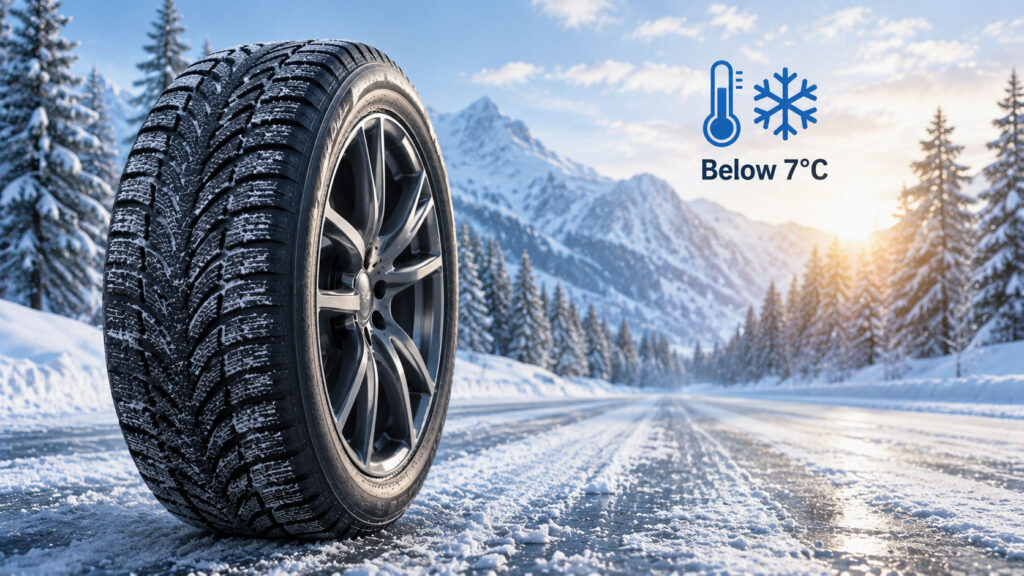
A winter tyre — often sold as snow tyres, though cold weather tyres would be the more accurate label — is built to keep working when the road is cold. Everything about it, from the rubber recipe to the depth of the grooves and the thousands of tiny slits cut across the tread blocks, exists to solve one problem a standard summer tyre cannot: rubber goes hard when the temperature drops, and hard rubber does not grip.
A standard or summer tyre is optimised for warm, dry and wet tarmac. It uses a firmer compound that resists wear at high road temperatures and gives crisp steering on a July motorway. Ask that same compound to work at 3°C on a frosty morning and it behaves rather like a hockey puck.
The 7°C Rule: Why Cold Matters More Than Snow
Seven degrees Celsius is the figure the whole winter tyre argument turns on. Below roughly that temperature, the silica and polymer blend in a summer tyre begins to stiffen and lose its ability to key into the road surface. A winter compound stays pliable much further down the scale, which is why it out-brakes a summer tyre on a cold but perfectly dry road with no ice in sight.
That is the point most drivers miss. You do not need snow on the ground to benefit. A damp, dark, 4°C morning on a rural A-road is exactly the condition a winter tyre is designed for, and the UK produces roughly four months of those a year.
What Actually Changes Inside the Tyre
Three engineering changes separate a winter tyre from the tyres most people run all year:
- A softer, silica-rich compound that stays flexible in the cold instead of glazing over.
- Sipes — hundreds of fine slits cut into each tread block. They open under load and bite into snow, slush and frost like thousands of tiny edges.
- Deeper, wider grooves that clear slush and standing water rather than skating on top of it.
Winter vs Summer vs All-Season at a Glance
Aspects
Winter tyre
Summer tyre
Best temperature range
Snow and slush
Cold wet braking
Warm dry handling
Wear in summer heat
When to run them
All-season tyres sit between the two, they are a genuinely sensible compromise for a lot of British drivers, and they are a different decision from this one — worth reading up on separately before you commit to two sets of wheels.
How to Identify a Winter Tyre
This is where a lot of money gets wasted. Plenty of tyres look wintry — aggressive blocks, deep channels, a name with ‘ice’ or ‘snow’ in it — without being certified for winter use at all. The sidewall is the only place that tells you the truth.
The Three-Peak Mountain Snowflake (3PMSF) Is the Marking That Counts
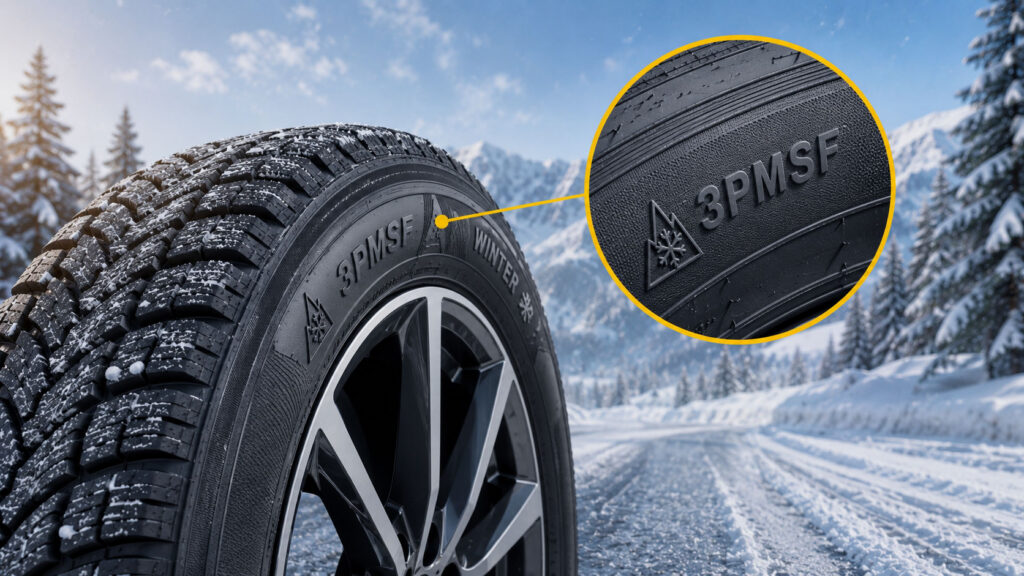
The 3PMSF (Three-Peak Mountain Snowflake) symbol is a small pictogram of a mountain with three peaks and a snowflake inside it. It is not decoration and it is not a marketing badge. A tyre can only carry it after passing a standardised snow traction test against a reference tyre, so it is the one marking on the sidewall that has been independently tested and certified for severe snow performance.
Why 'M+S' On Its Own Proves Nothing
M+S stands for mud and snow, and it appears on a great many tyres that have never been near a snow test. In Europe M+S (Mud and Snow) the marking is essentially self-declared by the manufacturer with no mandotory winter performance testing.
On snow, a 3PMSF tyre will provide significantly better braking, acceleration, and rubber flexibility in freezing temperatures than an M+S only tyre.
Winter Tyre Markings Decoded
3PMSF snowflake
M+S
Ice grip symbol
Studded / studdable
XL or Extra Load
Alpine name (Alpin, Blizzak, WinterCraft)
What Is a Tyre Sidewall?
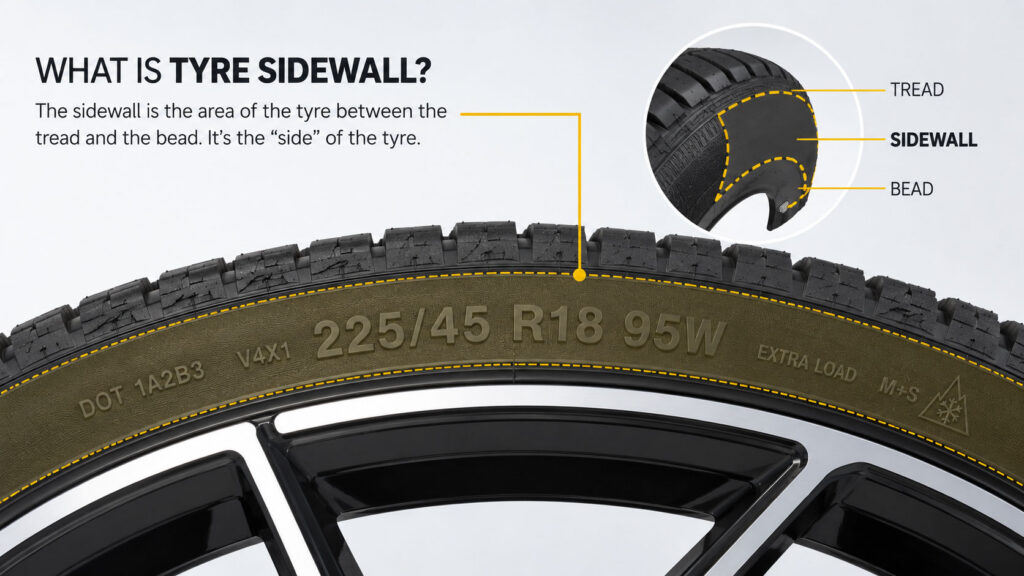
The sidewall is the vertical face of the tyre — the part between the wheel rim and the edge of the tread. It carries no tread pattern and never touches the road under normal driving, which leads people to assume it is the least important part of the tyre. It is closer to the opposite.
What the Sidewall Actually Does
Three jobs, all of them structural:
- It carries the load. Flexible cords running through the sidewall support the entire weight of the vehicle as the tyre rotates.
- It absorbs impact. Every pothole, kerb and expansion joint is soaked up by sidewall flex before it reaches your suspension.
- It carries the legal information. Size, load index, speed rating, manufacturing date and the winter markings are all moulded into it.
Because it is a load-bearing structure rather than a rubber surface, sidewall damage cannot be repaired — a bulge or a cut there means the tyre is finished, which our guide to tyre sidewall damage covers in detail.
Why Winter Puts Extra Strain on the Sidewall
Cold months are hard on sidewalls for reasons that have nothing to do with snow. Air contracts as temperatures fall, so pressures drop by roughly 1–2 PSI for every 10°C — and an under-inflated tyre flexes far more in the sidewall than it should. Add potholes hidden under standing water and kerbs obscured by slush, and winter becomes the season when sidewalls take their heaviest punishment.
Checking pressures monthly through the cold months is the cheapest insurance available. Our tyre pressure guide explains how to find the correct figure for your vehicle rather than guessing from the number printed on the tyre itself.
How to Read a Tyre Sidewall
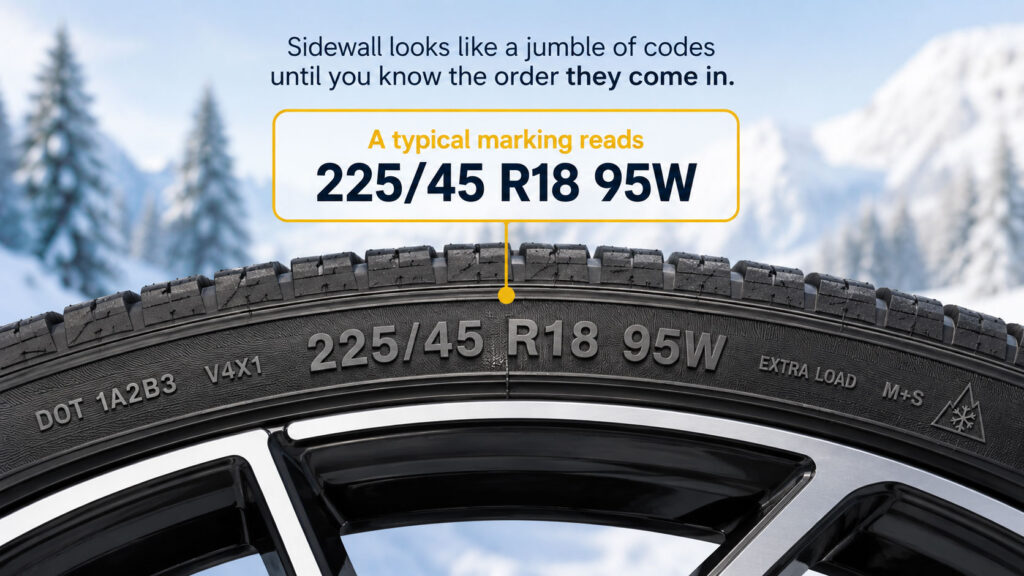
A sidewall looks like a jumble of codes until you know the order they come in. A typical marking reads 225/45 R18 95W, and every element of that string is telling you something you need before you buy a winter tyre.
225
225 mm across
45
Sidewall is 45% of 225 mm
R
18
Rim diameter in inches
Fits a 18-inch wheel
95
690 kg per tyre
W
Up to 168 mph
Where the Winter Marking Code Exist in Tyre
The 3PMSF snowflake and any M+S lettering are moulded separately from the size string, usually a little further round the sidewall and often in smaller type. On some tyres they sit close to the brand name, on others near the DOT code. Wipe the sidewall clean and work your way round the tyre rather than expecting to find everything in one place.
The Date Code Matters More on Winter Tyres Than Anything Else
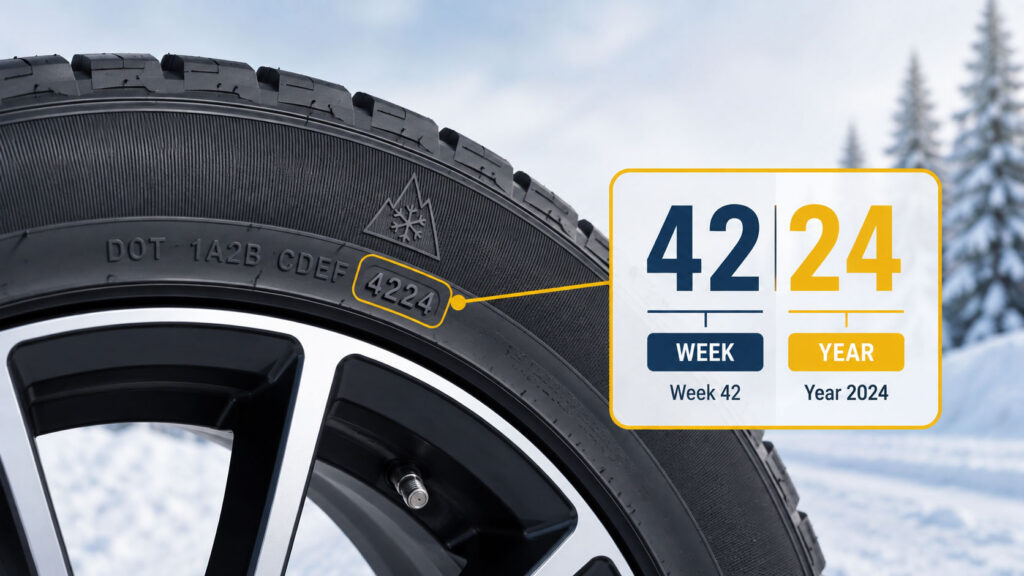
Find the four digits at the end of the DOT string. The first two are the week of manufacture and the last two are the year, so 4224 means week 42 of 2024. Winter tyres are the category where this matters most, because a soft winter compound hardens with age even sitting in a warehouse. A five-year-old winter tyre with full tread has already lost a meaningful slice of the cold-weather grip you are paying for.
Ask for stock manufactured within the last two years, and be sceptical of any deal that seems unusually good on a discontinued model. If you are storing a set between seasons, note the date codes then too — most manufacturers suggest replacing winter tyres at around six years regardless of tread, which is earlier than the ten-year figure often quoted for summer rubber.
Do You Actually Need Winter Tyres in the UK?
An honest answer: many drivers do not, and a significant minority genuinely do. Where you live and how you drive matters far more than the calendar.
The Highway Code guidance on driving in adverse weather is clear that vehicles must be fit for the conditions, but the UK sets no legal requirement to fit winter tyres — unlike much of mainland Europe. That leaves it as a judgement call, so here is a straight one.
Your situation
This Scenario Can Happen
On a cold, wet road a winter tyre stops a family car several metres shorter than a summer tyre at the same speed. Several metres is the difference between a near miss and an insurance claim. Add snow or packed frost and the gap stops being a matter of metres and becomes a matter of whether the car moves or stops at all.
Smarter Advice
If you drive 6,000 gentle urban miles annually in the south, in that situation a quality all-season tyre with the snowflake marking 3PMSF is the smarter call, and our guides to budget tyres and mid-range tyres cover where that money is better spent.
How We Chose These Winter Tyres
A recommendation is only worth the reasoning behind it, so here is ours in full — including what we deliberately do not do.
The Five Filters Every Tyre Had to Pass
3PMSF certification
A record in independent group tests
Real UK size availability
Published label data across the range
A UK distributor and a claimable warranty
Where the Evidence Comes From
We do not run our own laboratory. What informs these picks is published group testing — the annual Auto Express winter tyre tests, the Auto Bild winter programmes, and the TÜV and ADAC assessments that most European manufacturers are judged against — read alongside aggregated multi-test data rather than any single result.
The second input is first-hand. We fit winter tyres to cars, vans, light commercials, 4×4 and SUV fitments across the UK every season, and we see which ones come back looking tired after two winters and which ones do not. Test data tells you how a tyre brakes when it is new. Fitting the same models year after year tells you how they age.
Why the Same Premium Names Keep Appearing
It is a fair question, and the honest answer is that a handful of manufacturers genuinely do keep winning. The Continental WinterContact TS 870 has taken consecutive wins in UK winter group tests. The Bridgestone Blizzak 6 has won the majority of shared wet braking comparisons it has appeared in. The Michelin Alpin range consistently records the highest predicted mileage of the group. Those are measured outcomes, not brand loyalty.
How to Check Any of This Yourself
You should not have to take our word for it, and there are four checks that take about five minutes:
- Look up the label figures for your exact size, not the model in general — wet grip and fuel ratings shift between fitments.
- Search the model name on an independent tyre testing site and read the group test it appeared in.
- Confirm the 3PMSF snowflake is present before you pay for anything.
- Ask whoever is fitting them to read you the label rating and DOT date code off the actual tyre.
We will do that last one without being asked. If a tyre we are carrying does not suit your driving, we would rather say so and fit something else than sell you the wrong set — talk to our support team and we will go through the label figures for your size before you commit to anything.
Best 5 Budget Winter Tyres (With Approximate Prices)
Budget here means Tier 3 — established second-tier manufacturers rather than nameless imports. Cheap winter tyres carry a reputation the brands below have largely outgrown, but the non-negotiable filter still applies: every tyre listed holds the 3PMSF marking. What you give up at this level is not legality or basic safety; it is the last few metres of braking on ice, and some tread life.
Winter tyre prices below are indicative fitted costs for a common 205/55 R16 and move with size, season and stock.
What You Give Up at This Price
Two things, mainly. Ice braking is where budget winter tyres fall furthest behind — the compound science at the very cold end is expensive and it shows. Tread life is the second: expect roughly three to four winter seasons rather than five. Neither makes these tyres a bad buy, but if you regularly drive on genuinely icy roads, this is not the tier for you.
Best 5 Mid-Range Winter Tyres
This is the tier most UK drivers should be shopping in. Mid-range winter tyres come from manufacturers with real testing programmes — several are second brands owned by premium groups — and they typically land within a couple of metres of the class leaders on snow while costing a third less.
The Vredestein Wintrac Pro+ and Toyo Observe S944 are both worth adding to your shortlist if your size is short on stock — either would sit comfortably in this group.
Best 5 Premium Winter Tyres
At the top of the market you are buying the shortest stopping distances on snow and ice, the strongest wet grip and aquaplaning resistance, and tread life that often runs to six or seven seasons. If you drive something heavy, fast or rear-wheel drive, or you simply cannot afford to be stuck, this is where the money is well spent.
Recommended Winter Tyres by Car Brand
The right winter tyre is decided by the car, not the badge on the tyre. Weight, power delivery and which wheels are driven all change what the tyre has to do. The table below gives a sensible starting point for common UK cars, along with the tier each recommendation belongs to.
Recommended Winter Tyres for SUVs, 4x4s and Vans
Heavier vehicles change the maths. Extra mass means more heat, more sidewall flex and longer stopping distances, and four-wheel drive helps you set off without helping you stop. An SUV on summer tyres is still an SUV that cannot brake on frost.
Winter tyres for vans follow the same logic with one extra constraint: a working vehicle carries load all day, so the casing has to be rated for it. Everything below is chosen with that in mind.
Load Index Warning
On vans and light commercials, matching or exceeding the load index in your handbook is a legal requirement, not a recommendation. An under-rated tyre can invalidate your insurance after an incident. Check whether your vehicle needs XL or reinforced construction before you order anything, and confirm the figure on the plate in the door shut rather than trusting the tyres already fitted — a previous owner may have got it wrong.
When to Fit Winter Tyres, When to Take Them Off, and How to Store Them
The simplest rule in the UK is the one built around temperature rather than dates: fit them when the average daily temperature settles below 7°C, and take them off when it settles back above. In practice that gives most of the country a fairly predictable window.
Late September
Mid-October to early November
November to February
Late March to mid-April
Through summer
Winter Tyre Storage Done Properly
- Wash off road salt and brake dust before storing — salt attacks rubber and alloy alike.
- Mark each tyre with its position (NSF, OSR and so on) so you can rotate correctly next season.
- Store loose tyres stacked flat or in bags; tyres still on wheels can hang or stack.
- Keep them cool, dark and dry. Sunlight and ozone from nearby electrical equipment both degrade rubber.
- Drop the pressure slightly on stored wheels, then reset it properly at refitting.
Balancing is worth doing at every changeover rather than every other one. Wheels that sat all summer can develop flat spots and lost weights, and an unbalanced wheel scallops fresh tread within a few thousand miles — which is exactly why our wheel balancing and valve replacement is part of every fitting rather than an optional extra. If the car has been pulling to one side, our explainer on wheel alignment versus balancing will tell you which of the two you need.
Already Have Your Winter Tyres? We'll Fit Them. Need Them? We Stock Them.
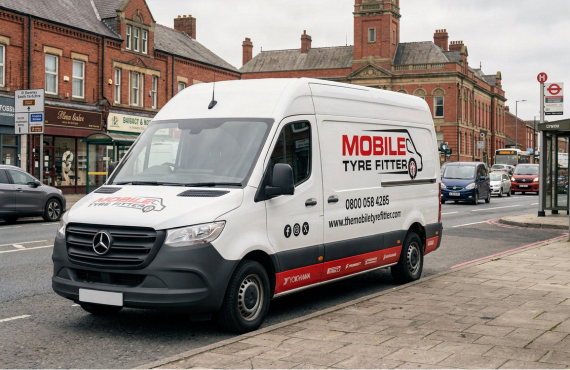
One of the reasons drivers put off the seasonal changeover is the logistics of it — a morning in a waiting room, a set of tyres to transport, and a garage booking that never quite fits around work. That is the problem mobile tyre fitting at your home was built to solve.
Two Ways We Can Help
You already bought the tyres. Plenty of drivers pick up a winter set online or keep one from last year. We come to your driveway, kerbside or workplace car park, fit them to your existing wheels, balance every corner and fit fresh valves. Same day appointments are usually available if you catch us early, and next day tyre fitting covers you if you cannot.
You still need the tyres. We hold budget, mid-range and premium winter stock for cars, vans, light commercials, 4×4 and SUV fitments, and we can usually source a specific model quickly. You get one price covering the tyre, the fitting, balancing, valves and disposal — quoted before we set off, with no hidden fees added at the roadside.
When the Weather Has Already Beaten You
Winter is also the season when things go wrong at the worst moment. A blowout on a slush-covered motorway slip road, a flat outside a client’s office, a shredded sidewall from a pothole you never saw. Our emergency mobile tyre replacement and emergency roadside tyre fitting services run 24/7, so an urgent 24-hour callout is a phone call rather than a long wait on the hard shoulder for a recovery truck.
If you need it dealt with immediately, we run same day mobile tyre fitting across our coverage area and Sunday appointments for the weekends when everywhere else is shut. Rapid response matters most in the cold months, and a fast roadside repair beats standing on a verge in the dark. Our breakdown of emergency mobile fitting versus a garage sets out the difference in practice, and what mobile tyre fitting costs in the UK shows you what a fair total looks like before you book.
We cover most of the country, including the northern and Scottish cities where winter tyres earn their keep — Edinburgh, Glasgow, Aberdeen, Inverness, Newcastle, Harrogate, Leeds, Manchester, Preston and Birmingham among them. The full list is on our mobile tyre service areas page, or contact our support team for a quote on your size.
One Stop, Whichever Way You Come to Us
Supply and fitting, or fitting alone. Booked in advance for a last-minute changeover, or called out urgently when a tyre has already failed. Either way it is one appointment, one price and one visit — and you never have to leave the house.
Frequently Asked Questions About Winter Tyres
Key Takeaways
If you are buying winter tyres this season, work in this order:
- Check the sidewall for the 3PMSF snowflake — M+S alone is not enough.
- Read your size, load index and speed rating from the plate in the door shut.
- Pick the tier that matches your roads: budget for mild cities, premium for ice and hills.
- Match any original-equipment marking your car specifies (★, MO, AO, N-code).
- Buy a full matching set of four wherever the budget allows.
- Check the DOT date code and refuse anything over two years old.
- Have every wheel balanced and fresh valves fitted at changeover.
- Reset pressures cold once they are on, then check monthly through winter.
Quick Winter Tyre Checklist
- ✓ 3PMSF snowflake on all four tyres
- ✓ Size and load index match the handbook
- ✓ DOT date code under two years old
- ✓ Four matching tyres, or matched pairs per axle
- ✓ Balanced and torqued at fitting
- ✓ Pressures set cold before driving off
- ✓ Summer set cleaned, marked and stored properly
Final Thoughts
Winter tyres are not about surviving a blizzard. They are about the ordinary cold, wet, dark months that make up a third of the British driving year, and the several metres of braking distance you get back on every one of those mornings.
Choose the tier that matches the roads you actually drive, insist on the snowflake, fit four rather than two, and keep the pressures right. Do that and the set will do exactly what you bought it for. When the changeover comes round, we can bring the workshop to you — see how our mobile tyre fitting works or read our tyre maintenance tips to get more life out of whichever set you choose.