Emergency Mobile Tyre Fitting vs Garage: Which One Actually Gets You Moving Again?
When a tyre lets go, you really only have two ways out: get the car to a garage, or get a fitter to the car. On paper they finish the same way — a fresh tyre bolted onto your wheel. In an emergency, they behave nothing alike.
The gap shows up in exactly the things that matter while you are stood on a verge: how quickly help arrives, whether the car can even be driven anywhere, what the day costs once recovery and lost hours are counted, and how long you spend stood near live traffic.
This guide puts the two side by side on convenience, speed, cost, scope of work and safety — and it is honest about the jobs where a garage is still the right call.
Quick Answer: Mobile Fitting or Garage?
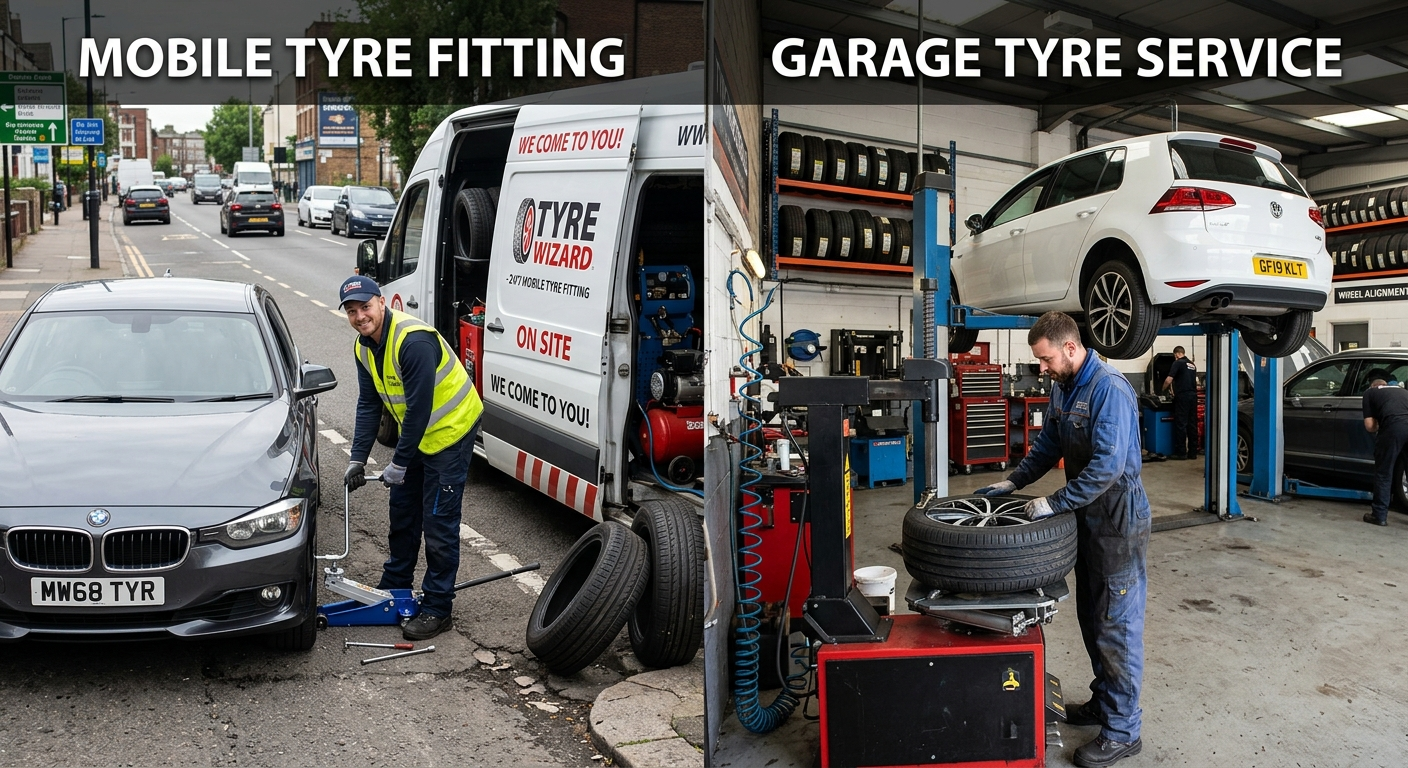
Quick Answer: For a sudden puncture, a blowout, or any tyre that leaves the car unsafe to drive, emergency mobile tyre fitting is almost always the better option. A fitter travels to wherever you have stopped, usually arrives within 90–120 minutes, works at any hour, and you avoid a recovery bill altogether.
A garage is the better choice for planned work — particularly when a tyre change needs to be combined with wheel alignment, suspension checks, brakes or an MOT, all of which need a ramp.
Here’s what this comparison covers:
Table of content:
At a Glance: Mobile Fitting vs Garage
| Factor | Emergency Mobile Fitting | Garage Visit |
|---|---|---|
| Where the work happens | Wherever the car has stopped | You must get the car there |
| Typical wait | Around 90–120 minutes | Next free booking slot |
| Out-of-hours cover | ✅ 24/7, weekends, bank holidays | ❌ Usually closed |
| Car must be drivable | ❌ No | ✅ Yes |
| Recovery truck needed | Rarely | Often, if the tyre is destroyed |
| Time off work | None | Half a day is common |
| Wheel balancing | ✅ On-site | ✅ Yes |
| Wheel alignment | ❌ No | ✅ Yes |
| Ramp / suspension work | ❌ No | ✅ Yes |
1. Convenience and Location
Mobile Fitting: The Workshop Comes To You
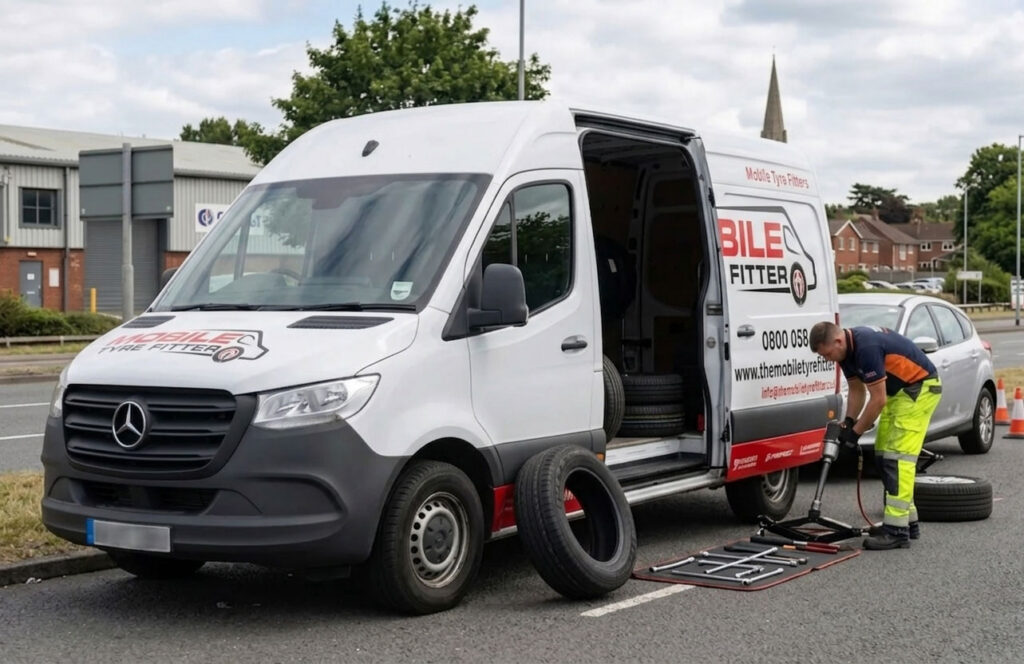
Mobile fitting turns the usual arrangement inside out. Instead of the car travelling to the equipment, the equipment travels to the car. A stocked van carries the tyres, a hydraulic tyre changer, an electronic wheel balancer and a calibrated torque wrench, and the job is completed wherever your vehicle happens to be standing.
In practice that means a driveway, a supermarket car park, an industrial unit, a lay-by or a hard shoulder. You do not move the car, beg a lift, or write off a morning. Plenty of drivers book tyre fitting at home or at the office and simply carry on with whatever they were already doing — something we cover in more depth in our guide to having tyres fitted on your own driveway.
Garage Visit: You Bring the Car To the Workshop
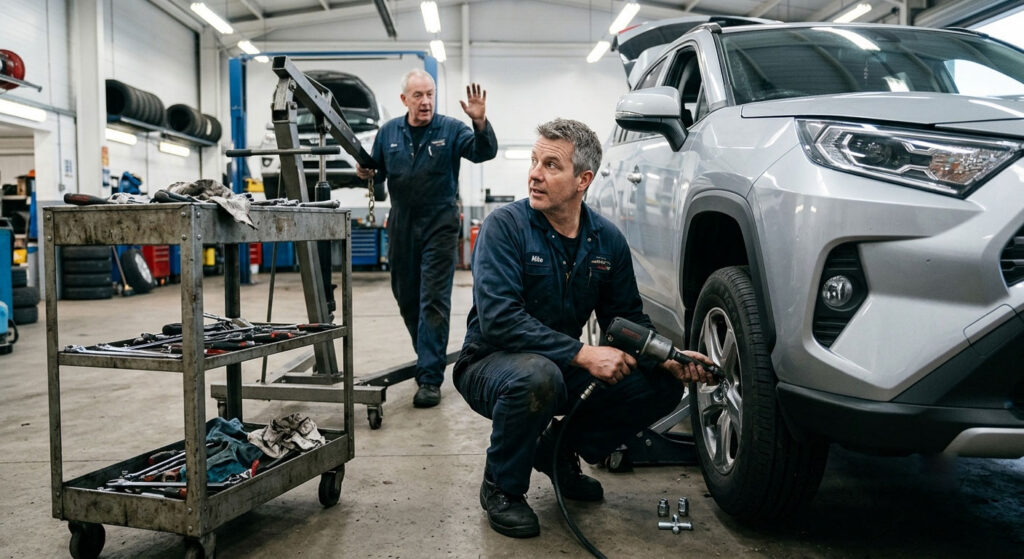
A garage works the other way round. The machinery is bolted to the floor, so the vehicle has to come to it. That is perfectly fine when the car is roadworthy and you have a free morning. It stops being fine the moment the tyre is destroyed.
A car sitting on a shredded tyre or a bare rim cannot safely or legally be driven to a garage. At that point the ‘cheaper’ garage route quietly acquires a recovery truck — and with it a bill, and a wait.
The Deciding Question
Ask yourself one thing: can the car safely be driven right now? If the answer is no, a garage is not really an option — it is a recovery job followed by a garage visit. Before you gamble on limping there, read our guide on whether you can drive with a flat tyre.
Convenience Compared
| Scenario | Mobile Fitting | Garage |
|---|---|---|
| Flat on the driveway | Fitter comes to you | Drive or tow it in |
| Blowout on a dual carriageway | Fitter attends the scene | Recovery first |
| Tyre change while you are at work | Done in the car park | Book time off |
| Slow puncture, car still drivable | Works well | Works well |
2. Emergency Availability and Speed
Emergency Response: What Happens When You Call
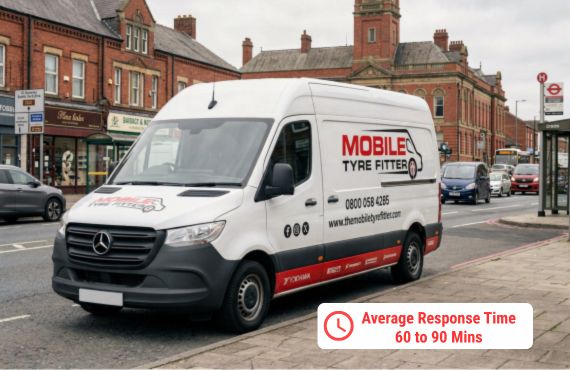
An emergency call-out is built around a single goal — getting a fitter and the correct tyre to a stranded driver quickly. You give your location and tyre size, the nearest van is dispatched, and most drivers are seen inside 90 to 120 minutes. Because the vans run around the clock, a Tuesday lunchtime and a Sunday at 2am look much the same operationally.
That matters more than it first sounds. Tyres do not fail during office hours as a courtesy. They fail on the school run, on the way back from a night shift, and on motorways at midnight. Our emergency roadside tyre fitting service exists precisely because that is when garages have the shutters down.
Standard Garage: Opening Hours and the Booking Queue
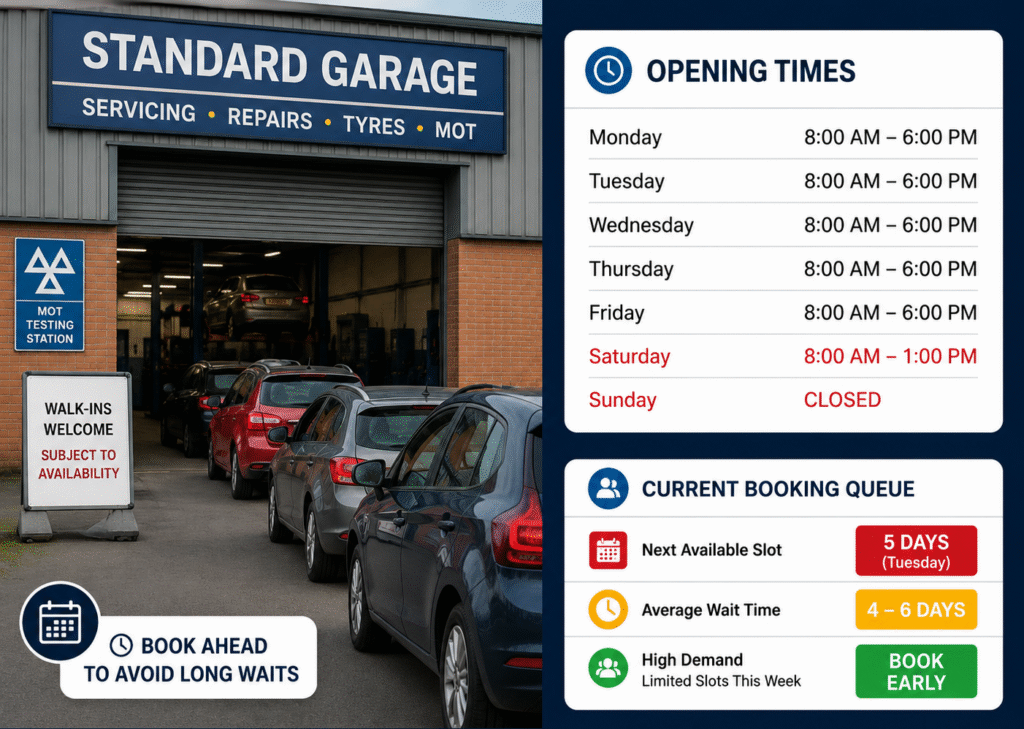
Garages run on appointments and opening hours. Most close in the early evening, many do not open on Sundays, and a busy workshop may have nothing free until tomorrow — or later in the week. If your tyre goes at 7pm on a Saturday, you are realistically waiting until Monday morning.
Fast-fit chains soften this, but you still have to reach one under your own steam, and you may still queue behind everyone else who had the same idea on the same wet Saturday.
Speed Compared
| Situation | Mobile Fitting | Garage |
|---|---|---|
| Weekday, working hours | ✅ ~90–120 min, at your location | Same day if a slot is free |
| Evening or overnight | ✅ Available | ❌ Closed |
| Sunday or bank holiday | ✅ Available | ❌ Mostly closed |
| Car is undrivable | ✅ Fitter attends | ❌ Recovery, then wait for a slot |
If the failure happens at the weekend, Sunday tyre fitting is routine rather than a favour, and same day fitting is usually achievable for anything reported in the morning.
Expert Insight
The delay that costs drivers the most time is rarely distance — it is missing information. Have your registration, tyre size and precise location ready when you ring and you can take a meaningful chunk off the wait.
Quick Answer: Mobile fitting wins outright on emergency speed, mainly because it deletes the two slowest steps in the process: moving the car, and waiting for a workshop slot.
3. Cost Comparison
Upfront Costs: Comparing Like With Like
Judge the two on sticker price alone and a garage often looks cheaper per tyre. A mobile call-out prices in the fitter’s travel, the van and its equipment, and the fact that you are being seen now rather than whenever a slot happens to open.
That is a real difference and it is fair to acknowledge it. But the sticker price is only half the story — and it is the half that actually appears on the invoice.
True Overall Cost: The Bill You Never See
The garage route carries costs that never show up on the garage’s own invoice, because somebody else charges you for them:
- Recovery or towing — if the tyre is destroyed, the car has to be transported to the workshop.
- Lost time — a half-day off work, or a job you could not attend.
- Taxis and lifts — getting home and back again while the car sits in a bay.
- Further damage — limping in on a flat can wreck the rim, and sometimes the suspension with it.
Where the Money Actually Goes
| Cost | Mobile Fitting | Garage |
|---|---|---|
| Tyre and fitting | Quoted upfront | Quoted upfront |
| Wheel balancing | ✅ Included | Usually included |
| Recovery or tow | ✅ Not needed | ❌ Often required if undrivable |
| Lost work time | ✅ None | ❌ Half a day is typical |
| Rim damage from limping in | ✅ Avoided | ❌ Possible |
Quick Answer: Which Is Cheaper?
Quick Answer: Mobile fitting can look dearer per tyre, yet it frequently works out cheaper overall once recovery and lost hours are added up. For a genuine emergency it is usually the cheaper of the two options, not the more expensive one.
If budget is the deciding factor, our affordable mobile tyre fitting covers everything from budget rubber to premium brands, and it is worth comparing which tyre brands are worth the money before you commit to a set.

4. Scope of Services
Mobile Fitting: What a Van Can Do at the Kerb
A modern mobile unit handles considerably more than an emergency swap:
- Emergency puncture and blowout replacement
- Supply and fitting of new tyres across budget, mid-range and premium
- On-site wheel balancing and valve replacement
- Removal and disposal of the old tyre
- Locking wheel nut removal, provided the key is available — and if it is not, here is what to do when the locking wheel nut key is lost
- Pressure and tread checks across your remaining tyres
Garage: What Genuinely Needs a Ramp
Some work simply cannot be done on a driveway, and it is worth being clear about which:
- Four-wheel laser alignment and tracking
- Suspension and steering repairs
- Brake work
- MOT testing and fault diagnostics
- Full servicing
Where a Garage Genuinely Wins
It is worth being straight about this rather than pretending mobile fitting does everything. If a pothole has destroyed your tyre and knocked the tracking out, a mobile fitter will get you safely mobile again — but the alignment still needs a ramp afterwards. The same applies to damaged suspension, a buckled alloy, or a car that is due an MOT anyway.
Alignment and balancing are routinely confused, and they are not the same job at all. Our guide to wheel alignment vs wheel balancing explains where each is needed, and why only one of them can be done at the kerb.
Who Can Do What
| Job | Mobile Fitter | Garage |
|---|---|---|
| Emergency tyre replacement | ✅ Yes | ⚠️ Car must reach them |
| Wheel balancing | ✅ Yes | ✅ Yes |
| Valve replacement | ✅ Yes | ✅ Yes |
| Puncture repair (where repairable) | ✅ Yes | ✅ Yes |
| Wheel alignment / tracking | ❌ No | ✅ Yes |
| Suspension and brakes | ❌ No | ✅ Yes |
| MOT and servicing | ❌ No | ✅ Yes |
5. Equipment and Quality: Is a Mobile Fitter as Good?
The Objection Most Drivers Raise
The most common worry about mobile fitting is that a van cannot possibly match a workshop. It is a fair question, and the answer is more reassuring than most people expect.
What Is Actually in the Van
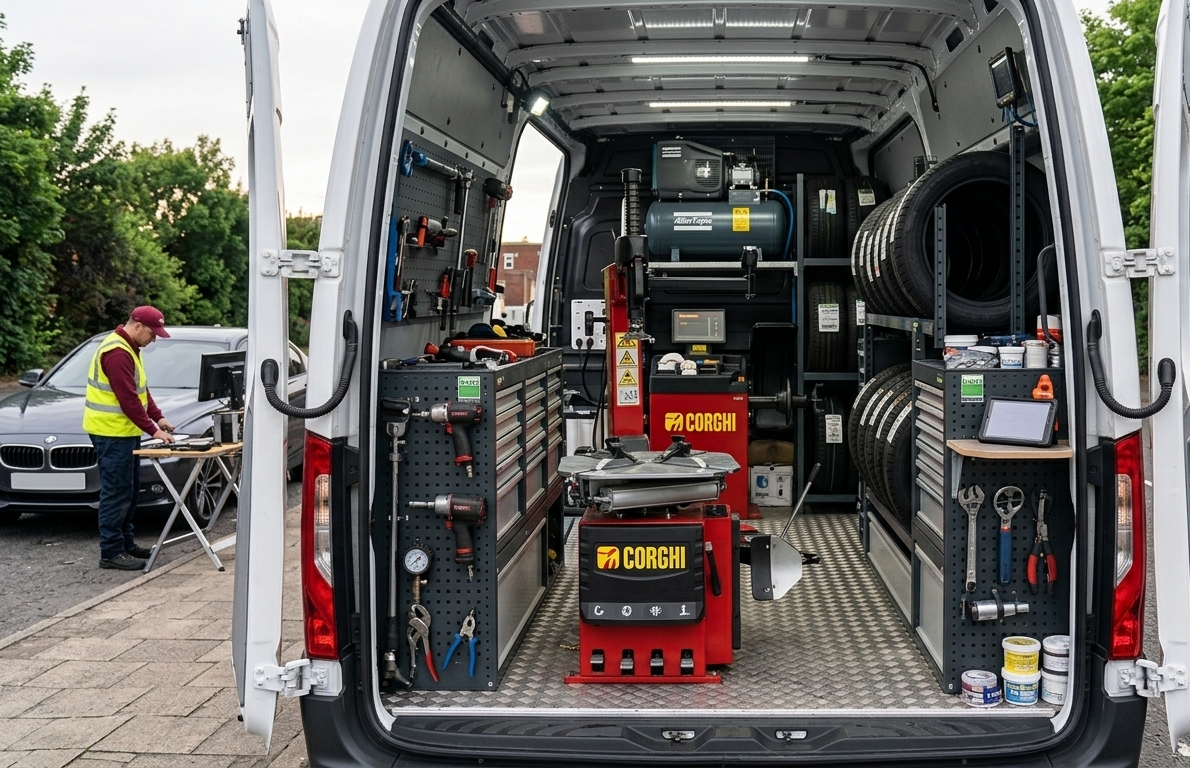
A properly equipped mobile unit carries the same core machinery as a tyre bay: a hydraulic tyre changer to break the bead and mount the new tyre, an electronic wheel balancer, and a calibrated torque wrench so the nuts go back to the manufacturer’s figure rather than ‘tight enough’.
Balancing is the part drivers worry about most, and it is done on-site, wheel by wheel, exactly as it would be indoors. An unbalanced wheel announces itself through vibration in the steering at speed — so it is not something that can quietly be skipped and hoped away.
Quick Answer: Is the Quality the Same?
Quick Answer: For tyre replacement, balancing, valves and repairs, a mobile fitter’s equipment is equivalent to a garage’s. The meaningful difference is the ramp — not the tyre machine.
6. Safety
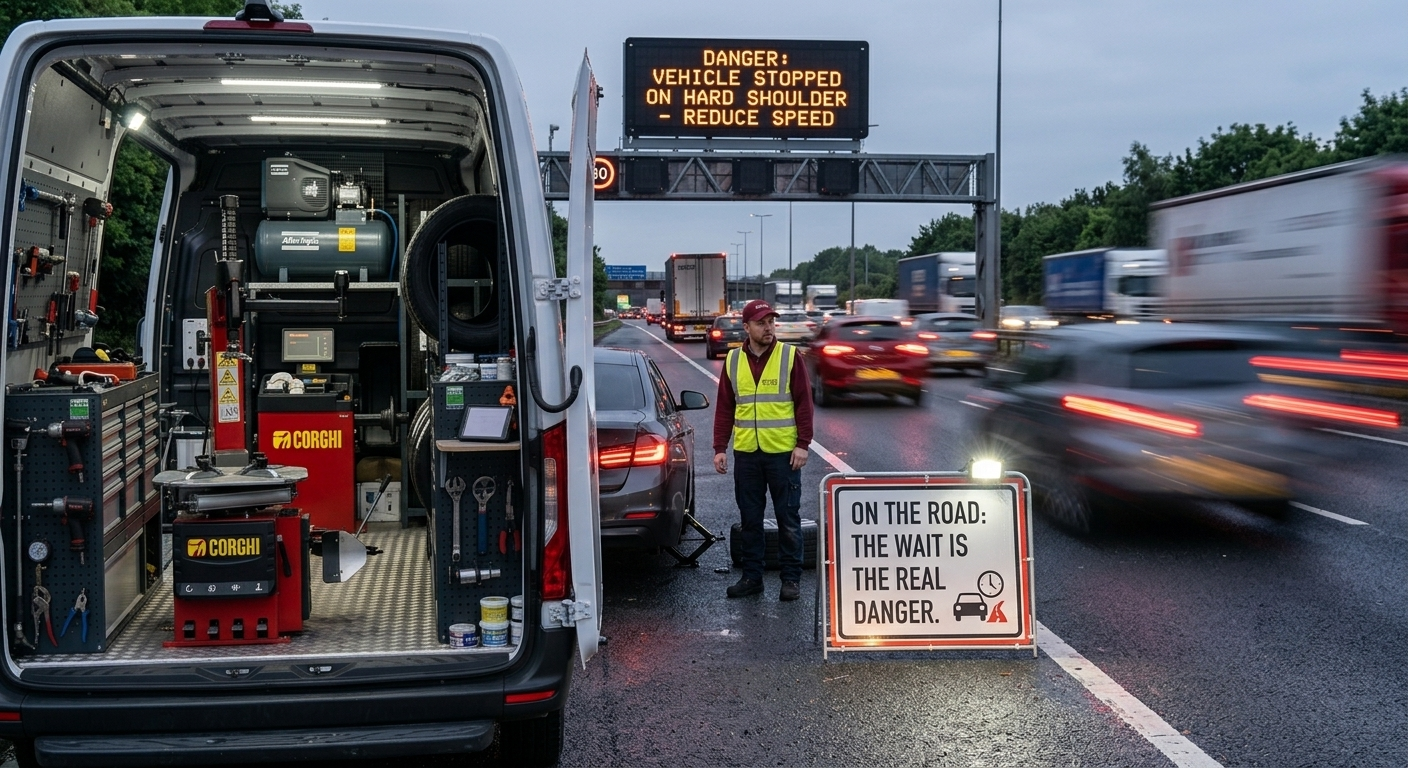
On the Road: The Wait Is the Real Danger
The most dangerous part of a tyre failure is usually not the failure itself. It is the time spent stationary beside moving traffic afterwards.
If you have stopped on a hard shoulder or a fast A-road, the order of priorities is: get everyone out on the side away from traffic, get behind a barrier if one exists, and leave the hazard lights on. Guidance from National Highways is consistently to put distance between people and live lanes and wait there — not beside the car, and certainly not crouched on the traffic side attempting a wheel change.
Why Safety Favours the Mobile Option
A mobile fitter shortens the single most hazardous window in the whole episode: the wait. The van comes to you, and the work is carried out by somebody trained to operate at the roadside, with the right hi-vis, vehicle positioning and equipment.
The alternative — wrestling a spare onto the car yourself on a live carriageway — is how a bad day turns into a serious one. If you do intend to fit your own spare, do it only somewhere genuinely safe, and read how to change a tyre first so you are not learning on the verge.
The Danger of Driving On a Damaged Tyre
The other temptation is to ‘just make it to the garage’. Driving on a flat destroys the tyre’s internal structure within a very short distance, and will usually take the wheel rim with it. What was a repair becomes a replacement; what was a replacement becomes a replacement plus a new alloy.
Sidewall damage is a hard stop — it cannot be safely repaired, however small it looks, because the sidewall is structural. Our guide to tyre sidewall damage explains why, and our emergency tyre burst guide covers what to do in the first few seconds of a blowout.
The Legal Position
In the UK the minimum legal tread depth for cars is 1.6mm across the central three-quarters of the tyre, right around its circumference. Drop below that and you risk a fine of up to £2,500 and three penalty points per tyre, according to TyreSafe. Four illegal tyres is, in theory, enough to end a licence.
Most safety bodies advise replacing well before the legal minimum, at around 3mm, because wet braking distances lengthen sharply below that. Not sure where yours stand? Here is how to check your tread depth in a couple of minutes.
Roadside Safety Checklist
| Step | Done? |
|---|---|
| Hazard lights on | ✅ |
| Car as far from live traffic as possible | ✅ |
| Everyone out on the non-traffic side | ✅ |
| Behind a barrier where one exists | ✅ |
| Registration, tyre size and location to hand | ✅ |
| Help called | ✅ |
7. So Which Should You Actually Choose?
Match the Situation to the Service
Neither option is universally ‘better’. The right answer depends almost entirely on the state of the car and the clock. Use this as a quick decision guide:
| Your situation | Best option | Why |
|---|---|---|
| Blowout, car undrivable | Mobile fitting | No recovery needed |
| Puncture at 11pm | Mobile fitting | Garages are shut |
| Flat in the work car park | Mobile fitting | No time off needed |
| Stranded on a motorway | Mobile fitting | Fitter attends the scene |
| Tyre plus alignment after a pothole | Mobile first, garage after | Ramp needed for tracking |
| Full set of four, no rush | Either | Compare price and convenience |
| Suspension noise as well | Garage | Needs a ramp |
| MOT already due | Garage | Bundle the work |
The Verdict
For anything that counts as an emergency — a car you cannot safely drive, a failure outside opening hours, or a driver stranded at the roadside — mobile fitting is the faster, safer and frequently cheaper answer. For planned work that needs a ramp, the garage keeps its place, and no honest mobile fitter would claim otherwise.
Most drivers end up using both over the life of a car. The skill is simply knowing which number to reach for on the day. If you would rather not gamble on a garage being open, our emergency mobile tyre replacement runs 24/7, and you can check whether we cover you on our service areas page.
Frequently Asked Questions
Not necessarily. The price per tyre can be slightly higher, because the fitter and the equipment travel to you. But the garage route regularly adds costs of its own — recovery, taxis, and half a day of lost work. Once those are counted, an emergency mobile call-out is often the cheaper of the two.
Yes. Mobile vans carry an electronic wheel balancer and balance every wheel on site, exactly as a workshop would. An unbalanced wheel gives itself away immediately through vibration in the steering at speed, so it is not a step that can be skipped without you noticing.
They will, and those jobs are prioritised over pre-booked appointments. Stop as far from the live lanes as you safely can, get everyone behind the barrier, and ring with your junction number or the nearest marker post so the fitter can find you without hunting.
Anything that needs a ramp. Wheel alignment, suspension and steering repairs, brake work, MOTs and servicing all remain garage jobs. Tyre replacement, balancing, valve work and repairs are all fully mobile.
It is rarely worth it. A flat tyre is ruined within a short distance and the wheel rim usually suffers alongside it, turning a modest bill into a considerably larger one. If the car is not safe to drive, it is cheaper to have the fitter come to the car.
Typically within 90 to 120 minutes, depending on where you are and how busy the day happens to be. Genuine emergencies are placed ahead of booked appointments in the queue.
Yes. Mobile fitting operates 24 hours a day, including weekends and bank holidays — which is precisely the window in which most garages are closed and most drivers get caught out.
For a roadside emergency, yes. For a booked fitting at home or at work, no — provided the fitter can reach the vehicle and the locking wheel nut key has been left somewhere accessible, such as the glovebox.
Key Takeaways
Emergency mobile tyre fitting vs a garage, in short:
- If the car cannot safely be driven, mobile fitting is the only option that does not start with a tow.
- Mobile fitters typically reach you in 90–120 minutes, at any hour, on any day.
- Garages are cheaper per tyre on paper, but often dearer once recovery and lost time are counted.
- Balancing, valves and replacement are done to the same standard either way.
- Alignment, suspension, brakes and MOTs still need a garage ramp.
- The longer you stand at the roadside, the greater the risk — speed of response is a safety issue, not just a convenience one.
Final Thoughts
The honest answer to ‘mobile or garage?’ is that they are not really competitors — they solve different problems. A garage is a workshop you drive to. A mobile fitter is a workshop that drives to you. In an emergency, that single difference decides almost everything: the wait, the risk, and very often the final bill.
The best outcome, of course, is never needing either in a hurry. Regular pressure checks, a monthly look at the tread, and replacing tyres before they reach the legal limit remain the surest way to avoid a roadside emergency altogether — our tyre pressure guide and our tyre maintenance tips are a sensible place to start.
And if a tyre has already let you down, you do not need to move the car at all. Get in touch and we will bring the workshop to you.