Should You Really Replace Tyres in Pairs, or Is One Enough?
The honest answer sits somewhere in between, and it depends on numbers most drivers are never shown. How much tread is left on the tyre that is staying. Which axle it lives on. Whether the car sends power to two wheels or four. This guide works through all of it, separates what the law demands from what manufacturers merely prefer, and gives you the tread figures to make the call yourself rather than taking anyone’s word for it.
Here’s what this guide covers:
Table of content:
- The short answer, in plain English
- Why tyres are replaced in axle pairs
- What UK law actually says (and the myth to ignore)
- How big a tread gap is too big?
- Which axle should the new pair go on?
- 4×4, AWD and SUV: when all four have to go
- When replacing just one tyre is genuinely fine
- The cost question: is one tyre really the saving?
- Run-flats, EVs, winter tyres, vans and light commercials
- What should happen once the new pair is on
- Frequently asked questions
The Short Answer, in Plain English
Change tyres in pairs, across the same axle, whenever the tyre staying on the car has noticeably less tread than the new one. Different grip levels on the left and right of one axle pull the car sideways under hard braking, blunt wet-weather cornering and wear the new tyre out faster. As a working rule, if the surviving tyre is at 3mm or below, replace both. Above roughly 5mm, a single tyre is usually acceptable. On four-wheel-drive vehicles, check the handbook – many require all four.
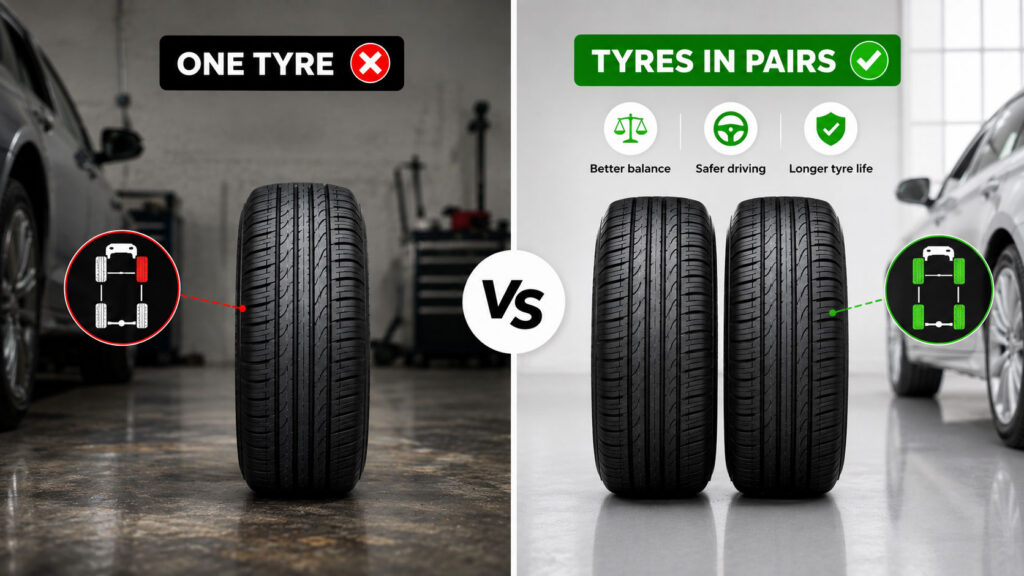
Tyres are fitted in axle pairs because braking, steering and grip are shared side to side, not wheel by wheel. The moment one side of an axle grips harder than the other, the car stops behaving symmetrically – and it shows up exactly when you least want it to, under emergency braking on a wet road.
That said, “always buy two” is lazy advice. The decision is genuinely driven by the tread left on the tyre that is staying, so start there. Measure it, or have it measured, before you agree to anything.
Decision Table: Replace One or Two?
Tread left on the surviving tyre
Sensible action
Why
6mm or more (near new)
One tyre is fine
Grip difference is small; match brand, pattern and size
4mm to 6mm
One tyre, but match it carefully
Acceptable gap if the same model is available
3mm to 4mm
Replace both – borderline
Wet braking is already falling away noticeably
Below 3mm
Replace both
Grip imbalance becomes a real safety issue
Below 1.6mm
Replace both immediately
Below the legal limit; three points and a fine per tyre
Key Rules For Buying a New Tyres
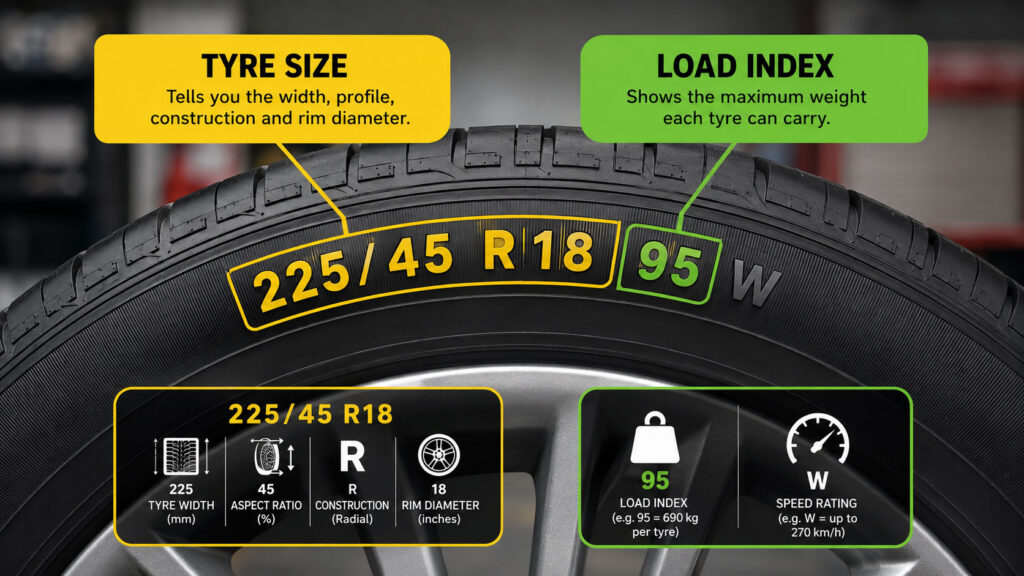
Whatever you decide, the two tyres on one axle must always share the same size, construction, load index and speed rating. That part is not a preference – it is the baseline every other decision is built on.
Why Tyres Are Replaced in Axle Pairs
First, what actually counts as an axle pair?
An axle pair is simply the two wheels facing each other across the car – nearside front and offside front, or nearside rear and offside rear. Almost every car, van and light commercial on UK roads has two axles, so four tyres arranged as two pairs. When a fitter talks about replacing “in pairs”, they mean both wheels on the same axle, never one front and one rear.
What a tread mismatch does to braking
Tread exists to move water out from under the tyre. A deep tread clears a great deal; a shallow one clears far less, and the difference is dramatic in the wet. Kwik Fit’s own testing at the MIRA proving ground found wet braking performance was between 15 and 30 per cent better on tyres with 7mm of tread than on the same tyres worn to 2mm.
Now picture that gap split across a single axle. Under heavy braking the deeper-tread side bites, the worn side skates, and the car yaws towards the side with more grip. On a dry road you might not notice. On a wet roundabout with a car behind you, you will.
Expert Experience
A car brakes in a straight line only when both tyres on an axle slow down at the same rate. Anything that breaks that symmetry – tread depth, compound, pattern, pressure – steers the car for you at the worst possible moment.
What it does to steering and cornering
Tyre carcasses differ between brands and even between patterns from the same maker. Mixing them across an axle produces subtly different sidewall stiffness and cornering forces on each side. The result is a car that understeers or oversteers unpredictably – it turns in more sharply one way than the other, and the steering never quite settles at motorway speed.
What it costs you beyond the tyres themselves
This is the part most guides skip. A mismatched axle does not only affect the drive; it quietly wears other components:
- The newer tyre scrubs away faster as it takes a disproportionate share of the work, so you buy it twice.
- Different rolling radii feed slightly different wheel speeds to the ABS, traction control and stability systems.
- Uneven load through the hub bearings and axle shaft adds wear that costs far more than a second tyre.
- On a car with an open differential the imbalance shows up as a persistent pull you will keep chasing with alignment checks.
If a pull has already appeared, it is worth reading our guide to wheel alignment versus balancing before you spend money on the wrong fix. And if the tyre that failed shows cracking or a bulge rather than simple wear, our guide to sidewall damage explains why that tyre is finished regardless of tread.
What UK Law Actually Says – and the Myth Worth Ignoring
There is a persistent claim online that fitting two different tyres to the same axle is illegal and an automatic MOT failure. That is not accurate, and believing it leads people to make decisions for the wrong reasons. Here is the actual position.
Fitting scenario
Legal position
Practical view
Radial and cross-ply on the same axle
Illegal
Banned outright under regulation 26
Cross-ply rear with radial front
Illegal
Specifically prohibited by the same regulation
Different tyre sizes on one axle
MOT failure
Must match across the axle
Any tyre below 1.6mm tread
Illegal
3 penalty points and a fine, per tyre
Different brands, same axle
Legal
Permitted, but not recommended by makers
Different tread patterns, same axle
Legal
Legal; may be recorded as an MOT advisory
Different tread depths, same axle
Legal
Legal until 1.6mm, but the safety issue is real
Wrong Perception About Mix Brand Tyres
Mixing brands or patterns on one axle is not against the law and will not, on its own, fail an MOT. What is genuinely illegal is mixing tyre construction types – radial with cross-ply – which is set out in regulation 26 of the Road Vehicles (Construction and Use) Regulations 1986. In practice nearly every modern car tyre is radial, so most drivers will never trip over that rule. The reason to fit matching pairs is performance and safety, not the threat of prosecution – and that is a better reason anyway.
Expert Opinion
UK tyre safety charity TyreSafe makes the same distinction: the legal minimum of 1.6mm is a limit, not a target, and grip falls away long before a tyre reaches it. Most tyre engineers suggest replacing at around 3mm rather than running to the legal floor.
How Big a Tread Gap Is Too Big?
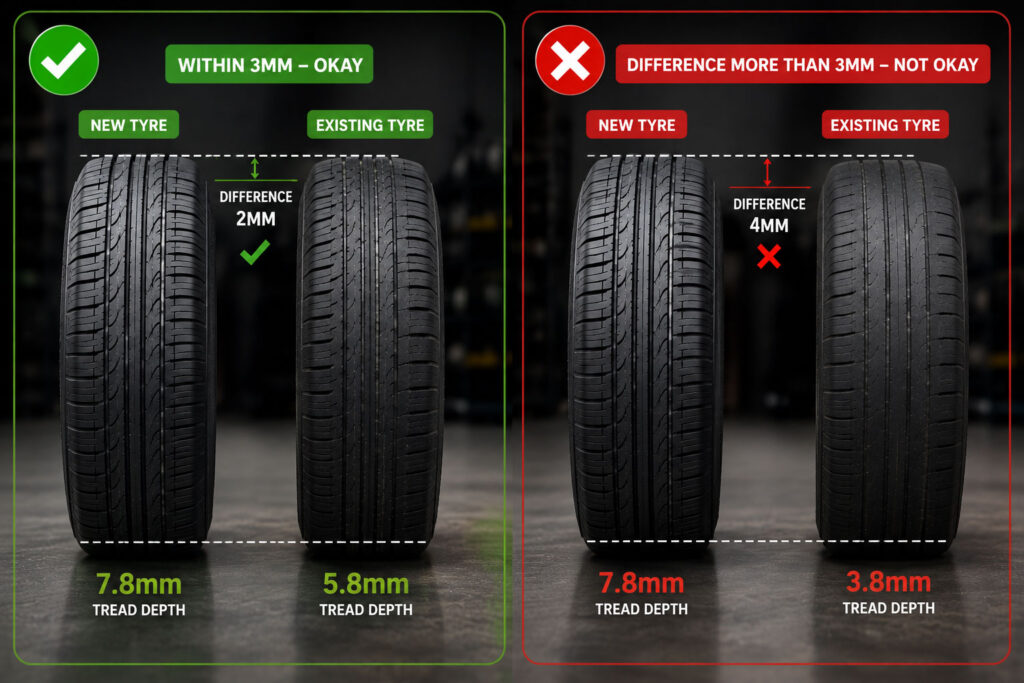
The widely used trade rule of thumb is 3mm. If the tyre staying on the car has 3mm or less, fit two. Above that, a single tyre is defensible provided everything else matches. Some manufacturers tighten this considerably and specify a maximum difference of 2mm between the two tyres on an axle, which is worth checking in your handbook.
Measuring it properly
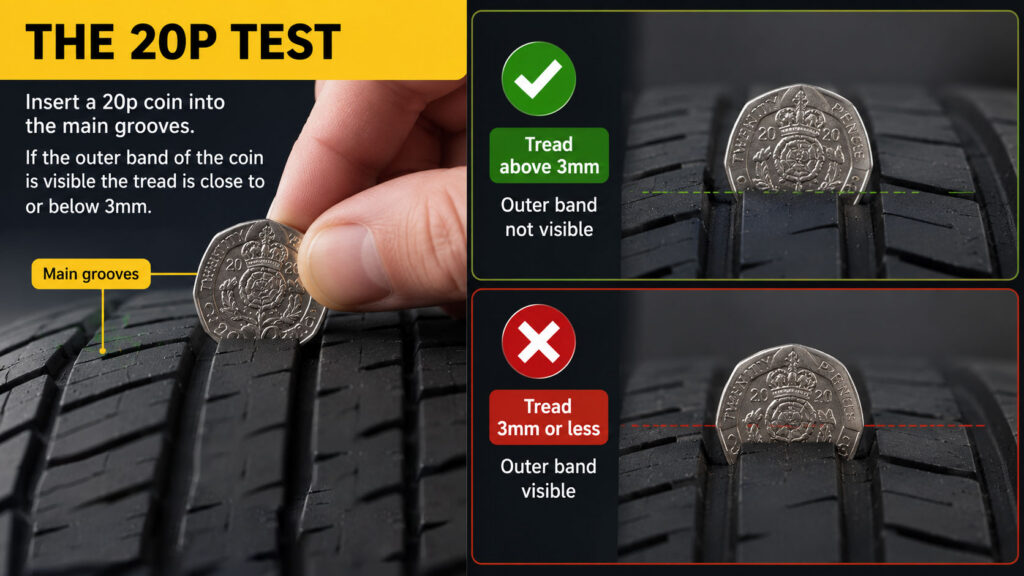
A tread depth gauge costs very little and removes all the guesswork. Failing that, the 20p test gives you a rough answer: insert a 20p coin into the main grooves, and if the outer band of the coin is visible the tread is close to or below 3mm. Our walkthrough on checking tread depth at home covers the method and the spots on the tyre people usually forget to measure.
Quick Tip
- Measure in three places across the width – inner, centre and outer edges.
- Measure both tyres on the axle, not just the damaged one.
- Check the four-digit date code too; a deep tread on a ten-year-old tyre is still an old tyre.
- Note any uneven wear pattern – that points at alignment or pressures, not just the tyre.
If the wear looks lopsided across the tread, read our guide to how long tyres last and how to spot wear, because fitting a fresh pair onto a car with a suspension or alignment fault simply destroys the new tyres in the same way.
Which Axle Should the New Pair Go On?
When only two tyres are being replaced, the new pair goes on the rear axle. This surprises people, especially front-wheel-drive owners who assume the driven wheels deserve the best rubber. The logic is about what happens when grip finally runs out.
If the front loses grip first, the car understeers – it pushes wide, which is unnerving but broadly recoverable by easing off. If the rear loses grip first, the car oversteers and can spin, which most drivers cannot correct at speed. Keeping the deeper tread at the back keeps the rear planted. This is the standing recommendation from Michelin and it applies regardless of which wheels are driven.
Where the New Pair Goes, by Drivetrain
Vehicle type
New pair goes on
Note
Front-wheel drive
Rear axle
Yes, even though the front does the work
Rear-wheel drive
Rear axle
Protects traction and stability together
All-wheel drive
Check handbook
Often all four are required
4×4 with locking diff
Usually all four
Rolling radius must stay matched
Vans and light commercials
Rear axle
Especially important when loaded
Two Exceptions Worth Knowing
- Staggered fitments, where the manufacturer specifies different sizes front and rear – common on performance cars and some SUV models.
- Vehicles designed with directional tyres at one end and asymmetric at the other, where swapping is not possible.
4x4, AWD and SUV: When All Four Have to Go
Four-wheel-drive systems constantly compare how fast each wheel is turning. A tyre with less tread has a fractionally smaller rolling circumference, so it spins slightly faster to cover the same ground. On a two-wheel-drive car that difference is harmless. On a 4×4 or AWD system the transmission reads it as permanent slip and works continuously to correct something that cannot be corrected.
Sustained over months, that quietly cooks centre differentials, viscous couplings and multi-plate clutch packs – repairs that run into four figures and dwarf the price of a full set of tyres.
Important Reminder
Many 4×4 and SUV handbooks state a maximum permitted tread difference across the vehicle, often quoted in millimetres or as a percentage of rolling circumference. Check yours before buying a single tyre. Where the handbook is silent and the remaining tyres are well worn, four is the safe answer.
- Part-time 4×4 driven mostly in two-wheel drive: a pair is often acceptable, but confirm in the handbook.
- Permanent AWD with a centre differential: all four is usually specified.
- Haldex-type on-demand systems: tolerances are tight; check before assuming a pair will do.
- Any 4×4 or SUV: match load index and speed rating exactly, since these vehicles are heavier than they look.
When Replacing Just One Tyre Is Genuinely Fine
Plenty of guides refuse to admit this, but there are clear situations where a single tyre is the right and sensible purchase. Buying two when one will do is money wasted, and we would rather say so.
A Single Tyre Is Reasonable When All of These Are True
- The tyre staying on the axle has 5mm or more of usable tread.
- You can source the identical brand, model and tread pattern.
- The size, load index and speed rating match exactly.
- Both tyres are of similar age – check the four-digit date code on the sidewall.
- The vehicle is two-wheel drive, or the handbook permits a pair on your 4×4.
- Neither tyre shows uneven wear that hints at an alignment or suspension fault.
Fail any one of those and the balance tips back towards a pair. The most common failure is the second point – a tyre model discontinued or simply not stocked, leaving you matching a close cousin rather than a twin.
Important Tip
If your car is only a year or two old and still on its original tyres, a single replacement is usually straightforward because the fitment is current and easy to source. Tell us the registration when you call and we will confirm whether an exact match is available before anything is ordered, then fit it through our at-home tyre fitting service without you leaving the house.
The Cost Question: Is One Tyre Really the Saving?
One tyre obviously costs less today. Whether it costs less per mile is a different question, and it is the one worth asking. A new tyre paired with a worn one wears faster, so you often find yourself buying that side again months later – at which point you have bought three tyres to cover the life of two.
Consideration
Buying one
Buying a pair
Cost today
Lower
Roughly double
Cost per mile
Often higher
Usually lower
Wet braking balance
Compromised
Even across the axle
Wear rate of the new tyre
Accelerated
Normal
Next replacement
Sooner, and staggered
Both together, predictable
Best suited to
Near-new tyre on the axle
Worn tyre on the axle
There is also a middle path people forget: buying a pair does not mean buying premium. A quality matched pair from the budget end of the market or the mid-range bracket often delivers better real-world safety than one premium tyre sitting next to a worn one. Matching matters more than badge. If you want to weigh up the options properly, our rundown of tyre brands compared sets out where the money actually goes, and our breakdown of what mobile tyre fitting costs in the UK covers the fitting side.
A Word on Part-Worn Tyres
Buying a part-worn tyre to “match” an existing one is a false economy. You cannot verify its internal condition, its age, or what it has been through, and matching tread depth on the outside tells you nothing about the casing underneath. For the sake of a modest difference in price it is not a gamble worth taking on the only four contact patches holding the car to the road.
Run-Flats, EVs, Winter Tyres, Vans and Light Commercials
Run-flat tyres
Run-flats have reinforced sidewalls and behave differently from conventional tyres in almost every respect. Mixing a run-flat with a standard tyre on the same axle produces genuinely unpredictable handling, and on cars fitted with run-flats from the factory it may also interfere with the tyre pressure monitoring strategy. Replace run-flats in pairs, with run-flats. Our explainer on how run-flat tyres work covers what they will and will not do for you.
Electric vehicles
EVs are heavier than equivalent petrol cars and deliver torque instantly, so they chew through tread faster and less evenly. That makes matched pairs more important, not less. Many EVs also run manufacturer-specified tyres with particular rolling resistance, load ratings and noise-damping foam – fitting a mismatched tyre alongside one of those undoes the engineering and can dent your range.
Winter and all-season tyres
Never mix seasonal types across one axle. A winter compound alongside a summer one gives you two quite different grip curves on the same axle, and the gap widens as the temperature drops – precisely when you need predictability most. Seasonal tyres are ideally changed as a full set of four; if budget forces a pair, keep each axle internally matched. Our guide to the best winter tyres for UK conditions goes into the compounds in detail.
Vans, light commercials, 4x4 and SUV
Working vehicles carry weight, and weight magnifies every imbalance. Vans and light commercials often run reinforced or C-rated tyres with a higher load index, and pairing one of those with a standard car tyre is unsafe once the vehicle is loaded. The same applies to 4×4 and SUV fitments, where the load index matters as much as the size. Match the axle, match the rating, and confirm both against the plate or handbook rather than against the tyre currently fitted – which may itself be wrong.
What Should Happen Once the New Pair Is On
Fitting the tyre is only part of the job. A pair fitted without the finishing work will feel worse than the tyres they replaced, and drivers often blame the tyre when the cause is elsewhere.
See Checklist After Installed New Pair
- Both wheels balanced on site – an unbalanced new tyre vibrates through the wheel from about 50mph.
- New valves fitted, or the TPMS sensor service kit renewed where one is present.
- Pressures set to the vehicle plate figure, not to whatever the old tyres were running.
- Wheel nuts torqued to the manufacturer’s specification, never by feel.
- Alignment checked if the old tyres showed uneven shoulder wear.
- The old tyres taken away for licensed recycling.
Balancing and valves are routine parts of a proper fit rather than optional extras – our page on wheel balancing and valve replacement explains why both matter. Treat new rubber gently for the first hundred miles or so while the release agents wear off the tread and the tyre beds onto the rim. If you are weighing up where to have the work done, we compare mobile fitting against a garage visit in a separate guide.
Expert Insight
Pressures deserve more attention than they get. Two tyres at the correct pressure and two at 6psi low recreates the very imbalance you paid to remove. Our tyre pressure guide sets out the right figures and how often to check them.
Frequently Asked Questions
No. There is no law requiring you to buy two tyres at once. What the law does require is that both tyres on an axle share the same construction type and size, and that every tyre has at least 1.6mm of tread across the central three quarters. Replacing in pairs is a safety and performance recommendation, not a legal duty.
It is not. Mixing brands, tread patterns or tread depths on one axle is legal in the UK. What is illegal is mixing construction types – a radial alongside a cross-ply – under regulation 26. Legal and advisable are different things, though: matched pairs brake and corner more predictably, particularly in the wet.
Yes, and in that situation it is the sensible choice. If the tyre remaining on that axle has 5mm or more of tread and you can obtain the same brand, model, size, load index and speed rating, one tyre is perfectly reasonable. The awkward cases are older cars where the original model has been discontinued.
Side does not matter in the way axle does – there is no rule about nearside or offside. What matters is that the pair on that axle is as closely matched as possible, and that the axle carrying the deeper tread overall is the rear one. If a single new tyre would leave the rear axle weaker than the front, the fitter may move wheels around to correct that.
Because of how a car behaves when grip finally runs out. Worn rears let go before worn fronts do, and a rear that lets go first produces oversteer – a spin most drivers cannot catch. Understeer from the front is far easier to recover. Keeping the better tread at the back is the safer failure mode, whichever wheels are driven.
The common trade guideline is that a difference of more than about 2mm to 3mm across an axle is too much. Some vehicle manufacturers specify tighter limits, and four-wheel-drive vehicles are stricter again. If in doubt, measure both tyres in three places and compare the lowest readings rather than the best ones.
Only for specific reasons. Different sizes on one axle will fail, as will mixed construction types or any tyre below 1.6mm. Different brands or tread patterns alone will not fail the test, though a tester may record an advisory. An advisory is worth acting on rather than filing away for next year.
Frequently, yes. All-wheel-drive systems are sensitive to differences in rolling circumference between wheels, and a worn tyre alongside a new one is read as continuous slip. That can damage the centre differential or coupling over time. Check the handbook – many state a maximum permitted tread difference across the vehicle.
You should not. Run-flats have reinforced sidewalls and a quite different stiffness to conventional tyres, so pairing the two on one axle gives inconsistent handling and braking. If your car came with run-flats, replace them with run-flats in pairs unless you are converting the whole vehicle to conventional tyres and carrying a spare wheel.
They are a poor idea. You cannot see internal damage, verify the age, or know whether the tyre has been run flat or kerbed hard. Matching tread depth on the surface tells you nothing about the casing beneath it. Given tyres are the only thing connecting the car to the road, a new matched pair is money far better spent.
Mismatched tyres that remain legal will not usually invalidate a policy on their own. Illegal tyres are a different matter – if a tyre is below 1.6mm or fitted contrary to the construction rules, an insurer may argue the vehicle was not roadworthy following a claim. Keeping tyres legal and matched removes the argument entirely.
Yes – that is exactly what we do. Our vans carry the stock, the balancer and the torque equipment, so a matched pair can be fitted on your driveway or in a workplace car park while you carry on with the day. Give us the size from the sidewall or the registration and we will confirm availability before the van sets off.
Key Points
- Replace in pairs when the surviving tyre is at or below 3mm – that is the number that decides it.
- Both tyres on an axle must share size, construction, load index and speed rating.
- Mixing brands or patterns is legal; mixing radial with cross-ply is not.
- When only two are fitted, the new pair belongs on the rear axle, whichever wheels are driven.
- 4×4, AWD and SUV owners should check the handbook – all four is often specified.
- One tyre is genuinely fine when the other has 5mm or more and an exact match is available.
- A matched budget pair usually beats one premium tyre next to a worn one.
- Balancing, valves, pressures and torque are part of the job, not extras.
One Stop, Wherever the Car Is
If you already have tyres – bought online, sitting in the garage, or supplied through an insurer – The Mobile Tyre Fitter will come out and fit them for you, balanced and torqued properly at your home, your workplace or the roadside. If you have not bought yet, we carry budget, mid-range and premium stock for cars, vans, light commercials, 4×4 and SUV fitments at competitive prices, and we will quote the tyre, the fitting, the balancing and the callout as one figure with no hidden charges.
Same-day and next-day fitting are both available, the line is answered 24/7 for urgent and last-minute work, and roadside callouts get a rapid response, including out on the motorway network. A 24-hour line means an emergency at midnight is handled exactly like a booking at midday. One call, one visit, one bill – contact our support team with your registration or tyre size and we will do the rest.