Can Tyres Affect Fuel Consumption? Yes, and Fixing Them Can Save You £150 a Year
You are filling up more often than you used to, but nothing about your driving has changed. Same commute, same car, same right foot. So where is the extra fuel going?
Very often, the answer is sitting at the four corners of your car. Tyres are the only part of your vehicle that actually touches the road, and on every single mile they decide how hard your engine has to work. Get them wrong and you pay for it at the pump quietly, week after week, without ever seeing a warning light.
Work it through and the numbers get uncomfortable. A driver covering the UK average of 8,000 miles a year can waste roughly £150 a year in fuel simply by running soft tyres on a poor label rating. That is a tank and a half, gone, for nothing.
This guide shows the maths behind that figure, explains exactly how tyres affect fuel consumption, and lists the checks that put the money back in your pocket. No jargon, no guesswork.
Here’s what this guide covers:
- Do tyres really change your fuel consumption?
- What bad tyres actually cost you, in pounds
- Rolling resistance explained in plain English
- Tyre pressure: the five-minute fuel saving
- Reading the fuel efficiency rating on the tyre label
- Brand, range and size: how tyre choice moves your MPG
- Worn tread, alignment and balance
- Cars, vans, 4x4s, SUVs and electric vehicles
- Your fuel-saving tyre checklist
Do Tyres Really Change Your Fuel Consumption?
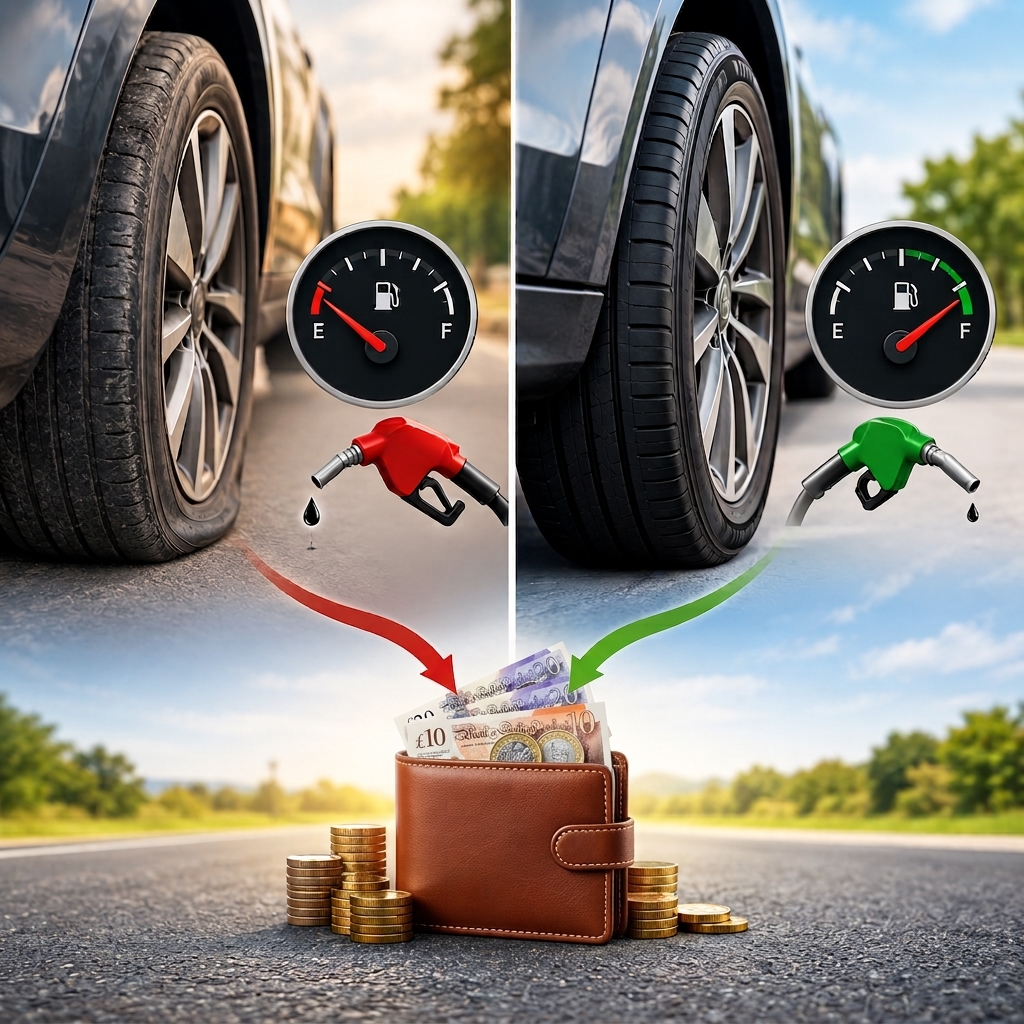
Yes, and by more than most drivers expect. Tyres affect fuel consumption mainly through rolling resistance, which is the energy your engine loses flexing rubber against the road surface. Around a fifth of the fuel a car burns goes into overcoming it. Low pressure, a poor fuel efficiency rating, the wrong tyre size or wheels that are out of line each add a little more on top.
The useful part is that almost all of it is fixable, and most of it costs nothing but five minutes at an air pump. Here is the quick picture before we go deeper.
Tyres around 6 psi below the recommended pressure
Roughly 3% more fuel burned
A-rated versus E-rated tyres on the EU label
Up to about 7.5% difference across a full set
Rolling resistance overall
Around 1 tank in every 5 you buy
Wheels out of alignment
Constant scrub, extra drag and faster wear
Wider or heavier tyres than the car was designed for
Small but permanent increase in consumption
Correct pressure, correct size, good label rating
The best real-world MPG your car can give
None of these numbers are dramatic on their own. Stack two or three of them together, though, and you are easily throwing away a tank of fuel a year without knowing it.
What Bad Tyres Actually Cost You, in Pounds
Percentages are easy to shrug off, so here it is in money. The figures below assume a petrol car covering 8,000 miles a year, the UK average, returning 40 mpg, with petrol at around £1.62 a litre. That comes to roughly 909 litres and a yearly fuel bill near £1,473.
Tyres 6 psi below the recommended pressure
About 3%
Around £44
E-rated tyres instead of A-rated
About 7.5%
Around £110
Both problems at the same time
About 10.5%
Around £155
Correct pressure and a good label rating
Nothing extra
£0 wasted
Drive more than average and the gap widens fast, because the waste is a percentage of everything you buy. Find your own mileage below.
5,000 miles
Around £920
Up to £95
8,000 miles (UK average)
Around £1,473
Up to £155
12,000 miles
Around £2,209
Up to £230
20,000 miles
Around £3,682
Up to £385
Two honest caveats. Fuel prices move, so treat these as a snapshot rather than a promise, and nobody is claiming every driver is losing the full amount. But if you have not checked your pressures in six months and you took whatever tyres the garage fitted last time without looking at the label, you are very likely somewhere on this table.
Rolling Resistance Explained in Plain English
A tyre is not a solid wheel. Every time it rolls, the part touching the road squashes flat, then springs back into shape a fraction of a second later. That constant flexing turns a little of your fuel into heat instead of forward motion. That wasted energy is rolling resistance, and it never stops while the wheels are turning.
How much of your fuel is actually spent on tyres?
Enough to notice. Michelin puts it at roughly one tank of fuel in every five on average, which is the same ballpark as the 20% figure the tyre industry generally quotes. Think of it this way: out of every five fill-ups you pay for, one of them is spent purely on keeping four pieces of rubber rolling.
You cannot get rid of rolling resistance, because a tyre has to grip to keep you safe. What you can do is stop making it worse than it needs to be.
Why does a soft tyre drink more fuel?
When pressure drops, the tyre sags. A bigger patch of rubber presses into the road, the sidewalls bend further on every rotation, and the whole tyre runs hotter. Your engine has to push harder to achieve exactly the same speed.
- More of the tread drags along the road instead of rolling over it
- Sidewalls flex further, which wastes energy as heat
- Steering feels heavier and the car responds more slowly
- The shoulders of the tread wear out early, so you buy tyres sooner
- The risk of a sudden failure at motorway speed goes up sharply
That last point matters more than the fuel saving. Air escapes slowly rather than fast, so a tyre can be well down on pressure while still looking perfectly normal from the driver’s seat. A tyre running hot and soft is the classic recipe for a blowout, which is why a few basic tyre maintenance habits pay for themselves twice over.
Tyre Pressure: The Five-Minute Fuel Saving Most Drivers Skip
If you only take one thing from this article, take this one. Tyre pressure is the single biggest fuel factor you personally control, and correcting it takes less time than queuing for a coffee.
UK charity TyreSafe reports that tyres sitting just 6 psi below the recommended pressure can push fuel consumption up by around 3%, and that under-inflation costs British drivers hundreds of millions of pounds a year in wasted fuel. The same softness also shortens tyre life, so you lose twice.
2 to 3 psi low
Around 1% more fuel, slightly faster shoulder wear
6 psi low
Roughly 3% more fuel and about 10% shorter tyre life
10 psi or more low
Heavy steering, poor braking and a real risk of rapid deflation
Over-inflated
Harsh ride, centre tread wear and less grip in the wet
Exactly as the manufacturer states
Best balance of MPG, grip and tyre life
Tyre pressure versus fuel consumption: the full chart
The industry works to two slightly different sets of numbers here, and it is worth knowing both. TyreSafe puts a 6 psi drop at roughly 3% extra fuel. Long-standing US Department of Transportation research comes out a little higher, at about 0.3% for every 1% of pressure lost. The direction is identical either way, so the table below uses the higher figures to show the worst case.
10% low (roughly 3 psi)
About 2%
Around £29
20% low (roughly 6 psi)
About 4%
Around £59
30% low (roughly 9 psi)
About 6%
Around £88
40% low (roughly 12 psi)
About 8%
Around £118
The catch is that you cannot see any of it. A tyre can be a quarter down on pressure and still look completely normal from the driver’s seat, which is why a gauge beats a glance every single time.
Does high tyre pressure affect fuel consumption?
It does, slightly, and on paper it works in your favour. A harder tyre flexes less, so rolling resistance drops and MPG creeps up. It is still a bad trade.
Over-inflated tyres ride harshly, wear out down the middle of the tread and sit on a smaller contact patch, which means less grip and longer stopping distances in the wet. You would be swapping a percent or two of fuel for safety and tyre life, and buying replacements sooner than the saving is worth. The manufacturer’s figure is the figure.
Cold weather quietly lets your pressure down
Air contracts as it cools. A set of tyres that was spot on in September can be several psi down by December without a single puncture, which is why fuel economy often seems to fall off a cliff in winter. Check monthly, check before any long run, and check when the temperature swings. Our complete tyre pressure guide walks through the whole routine, and there is a separate checklist for getting tyres ready for a long road trip.
Where do you find the correct pressure for your vehicle?
Three reliable places: the vehicle handbook, the sticker inside the driver’s door frame, or the label behind the fuel filler flap. Most vans and light commercials list two figures, one unladen and one for a full load. Running laden pressures when the van is empty makes the ride bouncy; running unladen pressures when it is loaded burns fuel and cooks the tyre.
Reading the Fuel Efficiency Rating on the Tyre Label
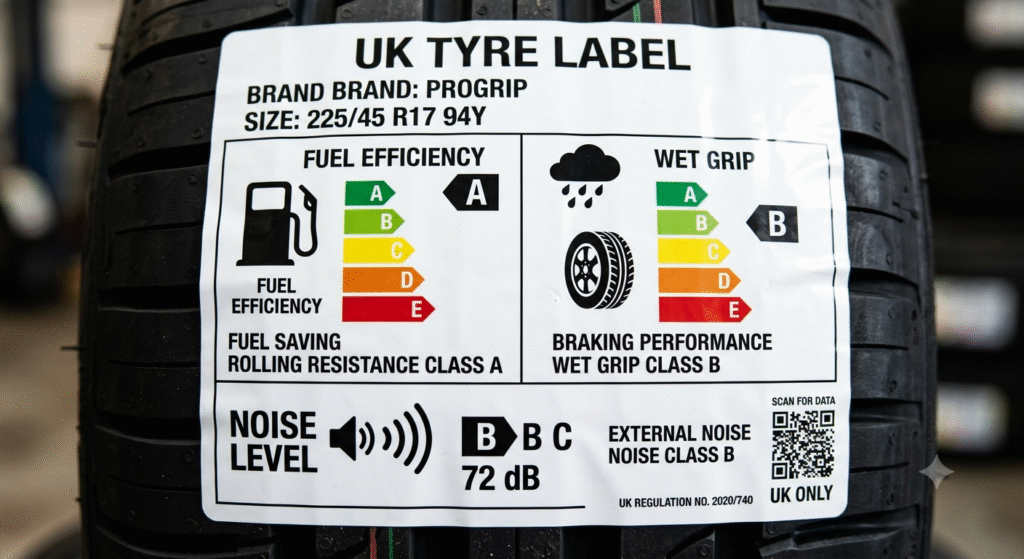
Every new tyre sold in the UK carries a label with three ratings: fuel efficiency, wet grip and noise. The fuel efficiency letter is simply a rolling resistance score, graded from A down to E. A is the most economical, E is the thirstiest.
The gap is not trivial. Continental notes that an A-rated tyre can save roughly 0.5 litres per 100 km compared with an E-rated one, which works out at somewhere near a 7.5% efficiency improvement across a full set. On a car covering 12,000 miles a year, that is real money.
A
Lowest rolling resistance available
High-mileage motorway commuters and EVs
B
Very close to A in daily driving
Mixed town and motorway use
C
Solid middle ground
Everyday family cars
D
Noticeably thirstier over a year
Low-mileage or occasional-use cars
E
Highest rolling resistance
Rarely the right choice for a daily driver
Tyre fuel efficiency A vs C: what is the real difference?
This is the comparison most people actually face in a tyre shop, because A-rated tyres are relatively rare and C is very common. Working from the A-to-E spread above, each step down the scale costs roughly 0.125 litres per 100 km, so moving from a C to an A is about 0.25 litres per 100 km.
For our 8,000-mile-a-year driver that is around 32 litres, or roughly £52 a year. Across a set of tyres lasting four years the A-rated set quietly hands back over £200, which often covers most of the price difference between the two.
Should you always buy an A-rated tyre?
Not automatically. A tyre that saves fuel but takes several extra metres to stop in the rain is a poor trade, and the label grades wet grip separately for exactly that reason. Read both letters together. Plenty of mid-range tyres land on a B or C for fuel while scoring an A for wet grip, which is the sweet spot for most UK drivers. If budget is the deciding factor, our roundup of value-focused tyre options shows what you gain and give up, and our comparison of the major tyre brands puts the whole market side by side.
Brand, Range and Size: How Tyre Choice Moves Your MPG
Two tyres of the same size, fitted to the same car, can return noticeably different fuel economy. Manufacturers spend fortunes on compounds and tread patterns that cut rolling resistance without losing grip, and most premium brands now have a dedicated fuel-saving range.
You do not have to buy the eco range to do well. Any current premium or quality mid-range tyre in the correct size, kept at the correct pressure, will comfortably beat a worn or under-inflated set of anything.
Do wider tyres use more fuel?
Generally yes. A wider tyre weighs more, pushes more air aside and usually carries a grippier compound, all of which add rolling resistance. Going up a size for looks can cost you a few percent in MPG permanently, and it can upset the speedometer reading too. Sticking to the size on the door sticker is nearly always the economical answer, which is worth remembering when you are choosing tyres for a specific car.
What is the 3% rule for tyres?
If you do change size, the 3% rule is the guardrail. The overall rolling diameter of the new tyre should stay within 3% of the original, above or below. Stray outside that and your speedometer and odometer start reading wrong, which quietly distorts the MPG figure on your dashboard too.
It matters mechanically as well. Anti-lock braking and stability systems are calibrated around the original rolling diameter, so a tyre well outside the 3% window changes how those systems behave. Staying inside it keeps both your fuel readings and your safety kit honest.
Are part worn tyres a false economy?
Sometimes. A part worn tyre has less tread, which technically means slightly less rolling resistance, but you also have no idea how it was treated before it reached you, and you will be replacing it sooner. We covered the safety and value side properly in our guide to whether part worn tyres are safe.
Winter and all-season tyres in the wrong season
Winter compounds are soft by design so they stay flexible in the cold. Leave them on through a warm summer and they squirm, wear quickly and use more fuel. Swapping back in spring protects both your MPG and your tread. Our guide to the best winter tyres for UK conditions explains when the switch is genuinely worth it.
Worn Tread, Alignment and Balance
Fuel consumption is not only about which tyres you bought. It is also about the condition they are in and how straight they are pointing.
Does tread depth affect fuel consumption?
It does, but not in a way you should chase. A nearly bald tyre has slightly lower rolling resistance than a brand new one, so a worn set can read marginally better on paper. In the wet it is a different story entirely: less tread means longer stopping distances and a far higher aquaplaning risk. The UK legal minimum is 1.6 mm across the central three quarters of the tread, and most tyre professionals suggest replacing at 3 mm. Learn to check your tread depth properly and keep an eye on how long tyres normally last so nothing catches you out.
Misaligned wheels scrub away fuel and rubber together
When the wheels are not pointing exactly where the car is travelling, the tyres are constantly dragging sideways by a tiny amount. You feel it as a pull to one side or an off-centre steering wheel, and you pay for it in both fuel and tread. Potholes and kerb knocks are the usual culprits. If any of that sounds familiar, our guide on spotting the signs that you need a wheel alignment is the place to start.
Balancing and valves matter too
An out-of-balance wheel vibrates, and vibration is wasted energy plus uneven wear. A tired valve leaks air slowly and quietly undoes all your pressure checks. Both are quick jobs, and we cover them under wheel balancing and valve replacement.
Mixing old and new tyres
Fitting one new tyre alongside a badly worn partner gives you two different levels of grip and rolling resistance on the same axle. That is why there is a strong case for changing tyres in pairs. If your car came on run-flat tyres, keep it consistent, because mixing run-flats with standard tyres changes how the car behaves.
Cars, Vans, 4x4s, SUVs and Electric Vehicles
The principle is identical across every vehicle, but the thing that costs you most fuel changes depending on what you drive.
Cars
Pressure and the label rating
Seasonal pressure drops in winter
Vans and light commercials
Load pressures and heavy-duty tyres
Running unladen pressures with a full load
4×4 and SUV
Tyre weight and tread pattern
All-terrain patterns cost MPG on tarmac
Electric vehicles
Rolling resistance decides your range
Extra weight wears tyres faster
How much MPG will you lose with all-terrain tyres?
This is the most common 4×4 and SUV question, and the honest answer is that it depends on the tyre and the vehicle. All-terrain tyres are heavier, carry chunky open tread blocks and often a stiffer sidewall, and every one of those adds rolling resistance on tarmac. Owners commonly report losing somewhere in the region of 5% to 10% against a road-biased tyre, which is a couple of MPG on most vehicles.
If you genuinely go off road, that is a fair price for the grip. If your 4×4 or SUV spends its life on the motorway and the school run, a road tyre will be quieter, last longer and cost you noticeably less at the pump.
Electric drivers feel this most sharply. There is no fuel gauge to hide behind, so a soft or high-resistance tyre shows up as an immediate loss of driving range. The fix is exactly the same: correct pressure, correct size, sensible label rating.
Your Fuel-Saving Tyre Checklist
Nothing here is complicated. Do these five things and you will be getting the fuel economy your car was designed to give.
Tyre pressures, when cold
Monthly and before long trips
Removes the biggest single source of drag
Tread depth across all four tyres
Monthly
Keeps grip safe and spots uneven wear early
Uneven or one-sided wear
Monthly
Early warning of alignment problems
Fuel efficiency rating when buying
Every replacement
Locks in lower rolling resistance for years
Remove unnecessary weight and roof bars
Whenever you notice them
Less load means less work for the tyres
One extra tip that costs nothing: check pressures when the tyres are cold, before you have driven more than a mile or two. Hot tyres read high and you will end up under-inflating without realising.
Where The Mobile Tyre Fitter Fits In
If your pressures are right and your alignment is fine but the tyres themselves are simply past their best, no amount of checking will bring the fuel economy back. At that point new rubber is the answer.
The Mobile Tyre Fitter comes to you rather than the other way round. We fit tyres you have already bought, and if you have not bought any yet we carry stock across all the major brands at competitive prices with no hidden charges. One visit, one job, one price.
- Fitting at home, at your workplace or at the roadside
- Same-day and next day slots, plus 24/7 and 24-hour cover for urgent, last-minute and emergency call-outs
- Cars, vans, light commercials, 4x4s and SUVs all handled
- Wheel balancing and valve replacement done at the same visit
Already have the tyres sitting in your garage? We will fit them. Need them supplied as well? We will bring them. Either way you can book same-day mobile tyre fitting near you, arrange fitting at your home, or call on us for emergency roadside tyre fitting if a tyre lets go on the motorway. Check our mobile tyre service areas to see if we cover your postcode, look at what mobile tyre fitting costs in the UK before you decide, or simply contact our support team and tell us what you need. If it cannot wait until tomorrow, our next day tyre fitting and 24-hour cover mean you are never stuck for long.
Frequently Asked Questions
Usually yes, if the old ones were worn unevenly, running soft or a poor match for the car. A new tyre in the correct size with a good fuel efficiency rating rolls more easily and holds its pressure better.
Do not expect a miracle, though. The gain is normally a few percent, not double figures.
Tyres around 6 psi below the recommended pressure typically add about 3% to fuel consumption. Let them drop further and the figure climbs.
It also shortens tyre life by roughly a tenth, so the real cost is higher than the fuel alone.
Yes. Wider and larger tyres are heavier, push more air aside and generally carry grippier compounds, all of which increase rolling resistance.
Fitting the size the manufacturer specifies is almost always the most economical option.
In warm weather, yes. Winter compounds are soft so they stay flexible in the cold, and that softness costs fuel once temperatures rise.
In genuinely cold conditions they are the safer choice, so swap them back in spring rather than leaving them on all year.
It can. Misaligned wheels drag sideways slightly on every mile, which wastes fuel and scrubs tread away at the same time.
Signs to look for include the car pulling to one side, an off-centre steering wheel, or one edge of a tyre wearing far faster than the other.
Often, but not always. Premium brands invest heavily in low rolling resistance compounds, so their eco ranges usually score better on the label.
The reliable way to compare is to ignore the price and read the fuel efficiency letter and the wet grip letter on the tyre label.
Slightly. A worn tyre has marginally lower rolling resistance than a new one, so it can look better on paper.
It is not a saving worth having. Less tread means longer stopping distances in the wet and a much higher aquaplaning risk, and the UK legal minimum is 1.6 mm.
For a driver covering the UK average of 8,000 miles a year at around 40 mpg, correcting soft tyres and moving from an E-rated tyre to an A-rated one is worth roughly 150 pounds a year at current petrol prices.
Higher mileage means a bigger saving, because the waste is a percentage of everything you buy. At 20,000 miles a year the same two fixes are worth closer to 385 pounds.
Yes, and the effect is even more obvious because there is no engine noise or fuel gauge masking it. Rolling resistance directly reduces how many miles you get from a charge.
Electric vehicles are also heavier, so tyres wear faster and pressure checks matter more, not less.