The Checks That Decide If A Used Tyre
Is Safe
A part worn tyre can cost half of what a new one costs, and when the budget is tight that is a hard offer to ignore. The question drivers actually want answered is much simpler than the sales patter. Is this tyre safe, or am I buying somebody else’s problem?
The honest answer is that a used tyre can be perfectly safe. It is legal to buy one, sell one and fit one in the UK. The catch is that it has to pass a specific set of legal and physical tests first, and most of the part worn tyres on sale in this country do not pass them.
This guide gives you the checks in the order a professional fitter would run them. What the law demands of the seller, what inspectors keep finding when they open these tyres up, how to test a used tyre yourself before any money changes hands, and the point where walking away is simply the smarter call.
Here is what this guide covers:
- The short answer, in plain English
- What a part worn tyre actually is
- The 9 legal tests every used tyre must pass (With Images Proof)
- The tyre damage you cannot see from the front
- Do part worn tyres really save you money?
- Your before you buy inspection
- Fines, points and MOT rules
- Safer options when the budget is tight
- The opinion
- Common questions answered
The Short Answer, in Plain English
Yes, a part worn tyre can be safe. Second hand tyres are legal to sell and legal to fit, and a well chosen one will do its job without any drama. But safe and likely to be safe are two different things, and that gap is where drivers get caught out.
A used tyre only earns the word safe when three things are true at the same time. It carries the correct legal markings, the casing is completely sound, and there is enough tread left to make the purchase worth anything. Miss one of the three and you are not buying a tyre, you are buying a countdown.
What the Latest Inspections Actually Found
In August 2026 TyreSafe published the results of joint enforcement work carried out with Trading Standards teams and police vehicle examiners. The findings are worth sitting with for a moment.
- In Norfolk, officers inspected 191 part worn tyres offered for sale by seven businesses. Exactly one met the full legal safety and marking requirements.
- Sixty nine of those tyres, around 36 percent, were judged to be in a dangerous condition. Faults included nails pushed right through to the inside, cuts exposing the cord, weakened structure and repairs that should never have been signed off.
- A separate multi agency day of action in Lancashire checked 30 used tyres across three garages. None of them met the legal requirements, and not one carried the permanent marking the law demands.
Those numbers are not a reason to panic. They are a reason to inspect. A used tyre from a seller who marks, pressure tests and records what leaves the shop is a completely different product from one pulled off a scrap pile and rolled out onto the pavement.
What a Part Worn Tyre Actually Is
A part worn tyre is a tyre that has already served time on another vehicle, been taken off while it still had usable tread, and put back on sale for a second life. You will see the same product advertised as a used tyre, a second hand tyre or a budget swap. The name on the board changes, the rules do not.
Where Used Tyres Come From
- Vehicles that have been scrapped or written off after a collision.
- Lease and fleet cars where tyres are swapped early as a matter of company policy.
- Part exchange cars at dealerships, where a full set gets replaced to make the car easier to sell.
- Imports from countries with higher minimum tread limits, where a tyre is retired sooner than it would be here.
- Tyres taken off after a wheel size change or a suspension repair, often with plenty of life left.
The source matters far more than most buyers realise. A tyre removed from a two year old lease car after a wheel upgrade has a very different past to one recovered from a vehicle that was written off in a heavy kerb strike. From the outside, the two can look identical.
Part Worn, Second Hand or Remould: Knowing the Difference
Part worn
Must be marked PART WORN and pass every safety test before sale
Second hand
Remould or retread
Old unused stock
Why the Label on the Tyre Matters
You will see it written as part worn, part-worn and second hand on the same street, and the hyphen changes nothing at all. Some shops avoid the words on purpose, because the phrase triggers the legal marking duty in a buyer’s mind. If a tyre has been on a car before, it is a part worn tyre, whatever the sign says. That single point clears up most of the confusion around choosing between tyre brands on a limited budget.
The 9 Legal Tests Every Used Tyre Must Pass
(With Images)
The rules sit in the Motor Vehicle Tyres (Safety) Regulations 1994, and they land on the seller rather than the buyer. If a business supplies a used tyre that fails any one of these tests, it is committing an offence, whether or not it realised. Trading Standards guidance for businesses sets the same conditions out in full.
The Full Legal 9-Point Checklist
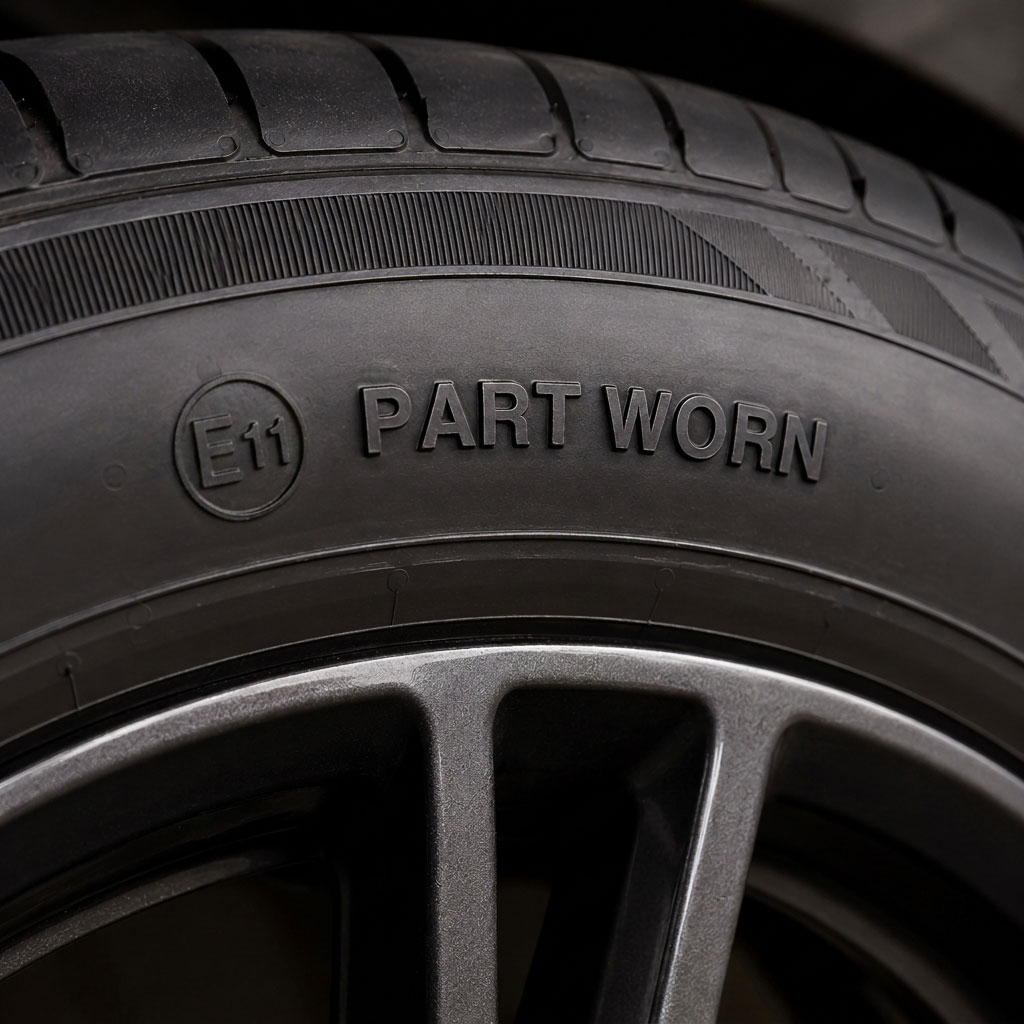
The PART WORN marking
Permanently marked PART WORN in capital letters, next to every approval mark. It cannot be hot branded, cut into the rubber, or applied as a sticker.
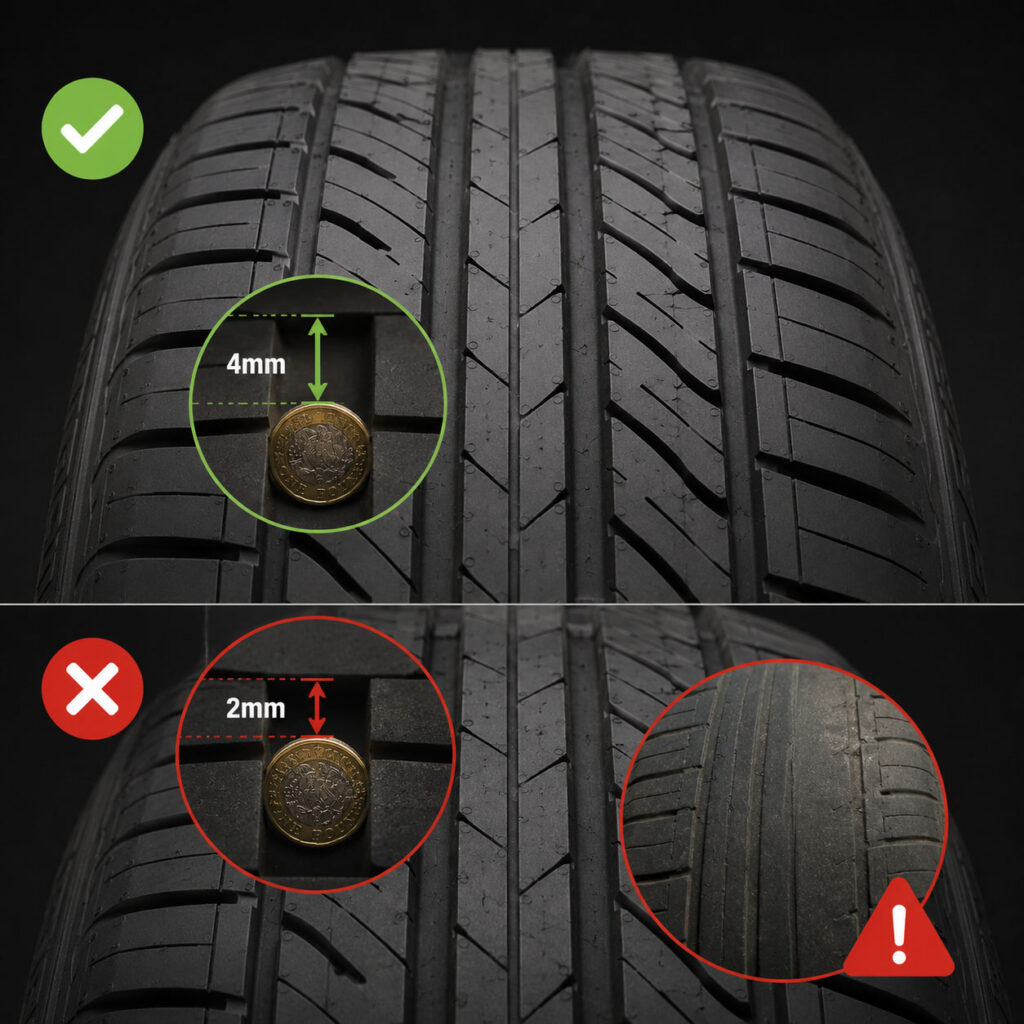
At least 2mm of tread
The grooves must be 2mm deep or more, across the whole tread. That is the lowest a shop may legally sell at, not a good buy. Once the tyre is on your car, your own legal limit is 1.6mm, so a 2mm tyre leaves you just 0.4mm of life. Aim for 4mm or more.
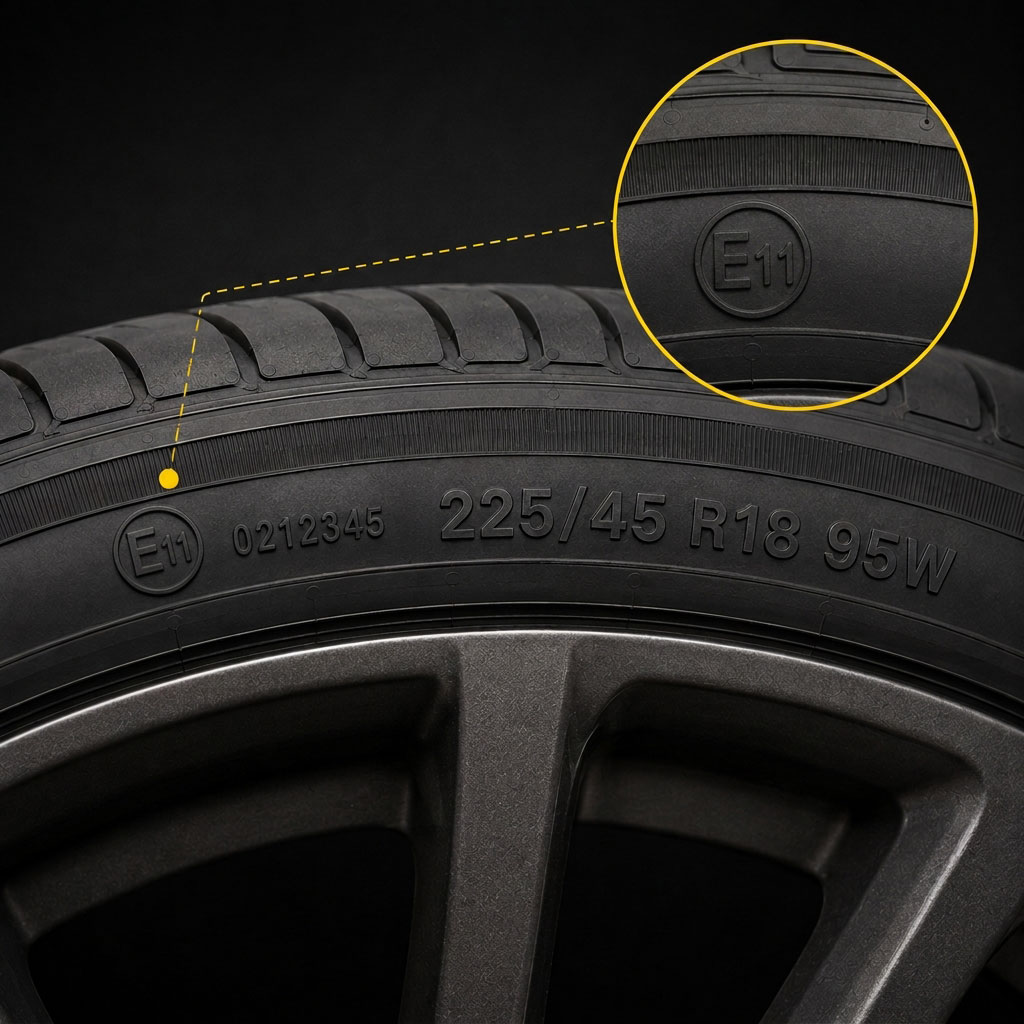
A valid approval mark
An E mark or equivalent, plus the size, load index and speed rating, showing the tyre was type approved for road use.
No serious cuts
No cut longer than 25mm, or 10 percent of the section width if that is greater, deep enough to reach the ply or cord.
No lumps, bulges or tears
Nothing caused by the structure separating or partly failing, inside or outside the tyre.
No exposed cord or ply
The reinforcing layers must be completely covered by rubber.
Sound repairs only
Any repair has to meet British Standard BS AU 159. Outside plugs on their own do not qualify.
A pressure test
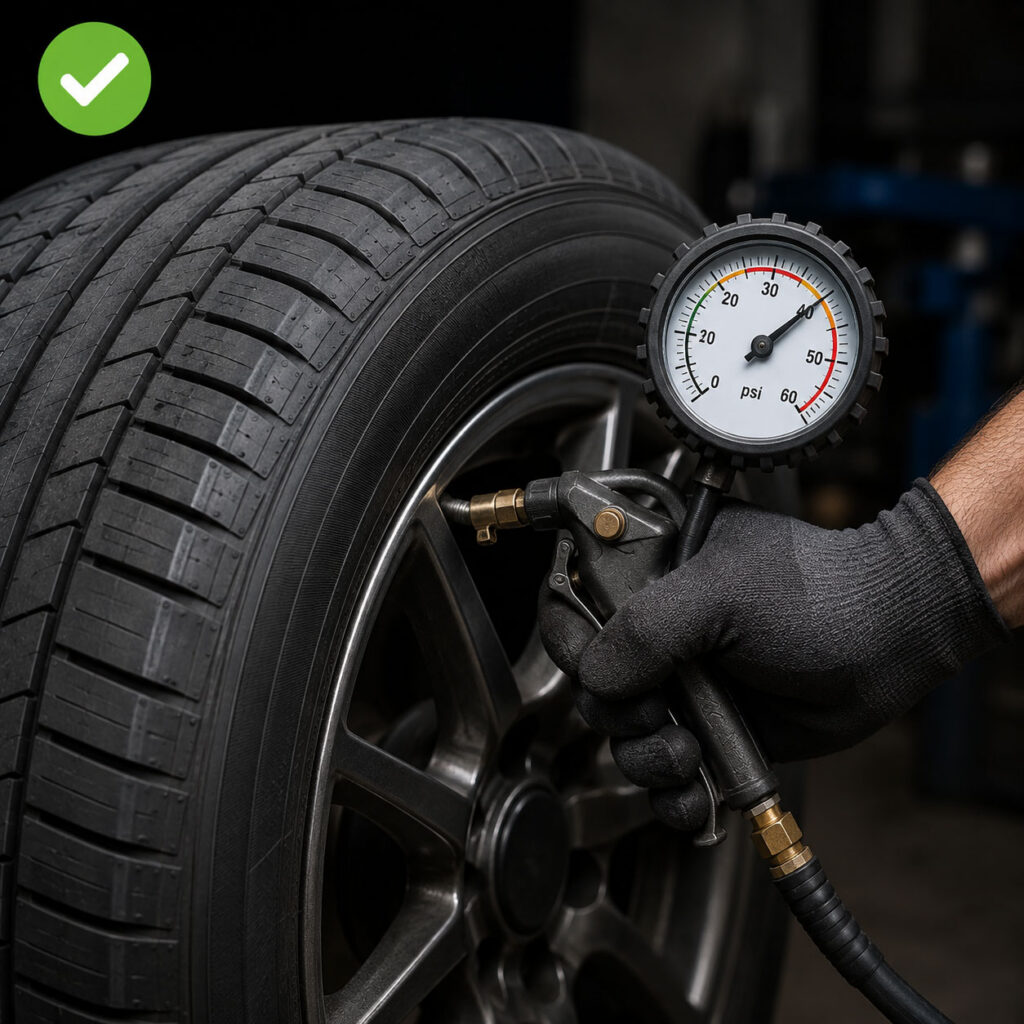
The tyre must be inflated to its maximum operating pressure and inspected in that state before it is offered for sale.
Retread markings
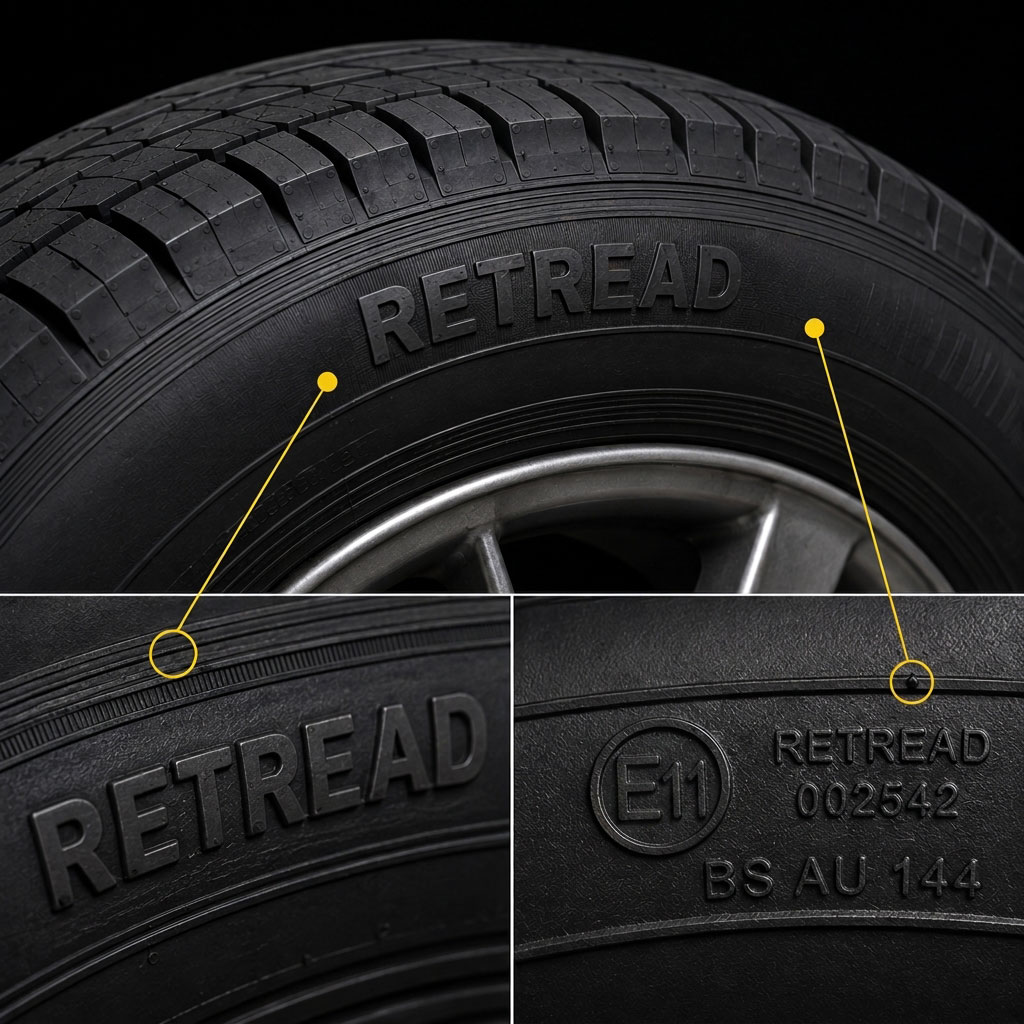
A retreaded tyre needs RETREAD in capitals plus BS AU 144 or ECE approval on the sidewall.
Checklist No. 1 - The PART WORN Marking
Checklist No. 2 - At least 2mm of tread Acceptable - But Preferable 4mm
Checklist No. 3 -A valid Approval Mark
Checklist No. 4 - No Serious Cuts
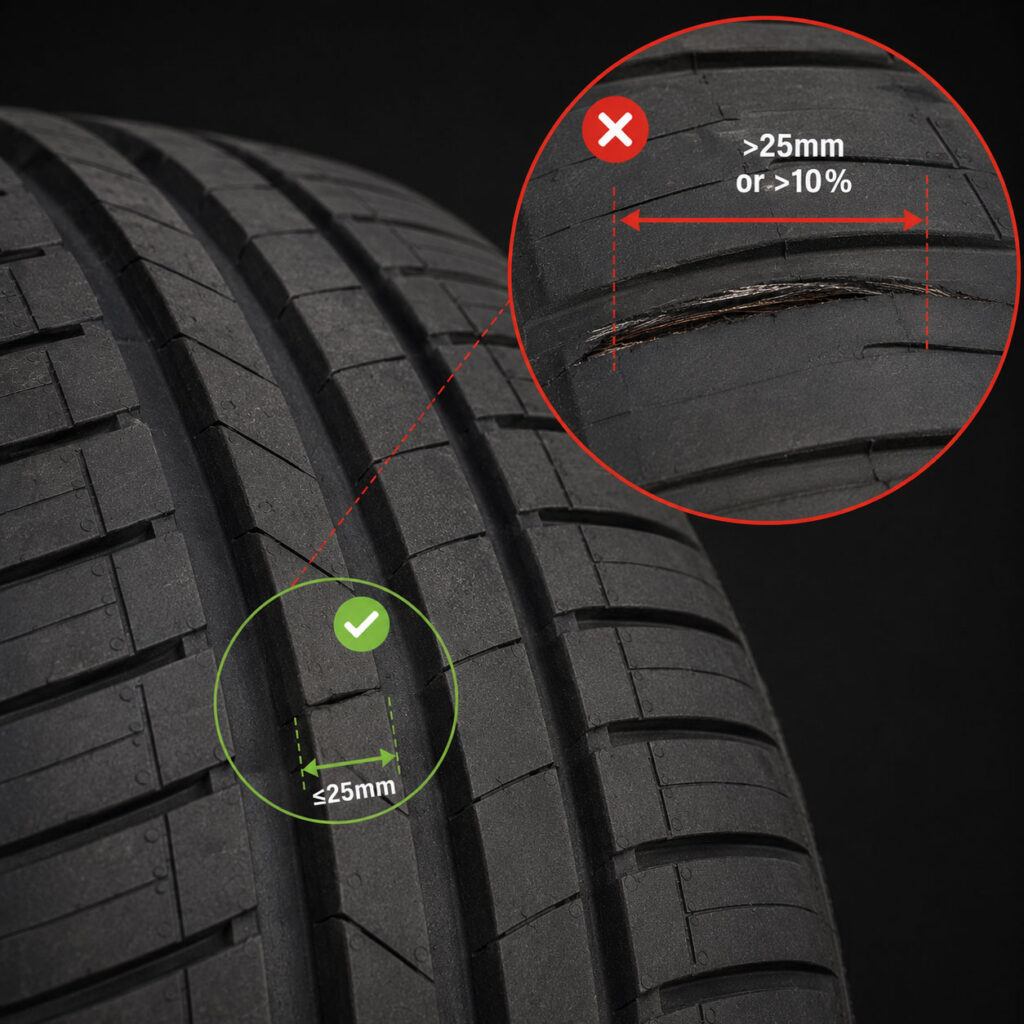
Checklist No. 5 - No Lumps, Bulges or Tears
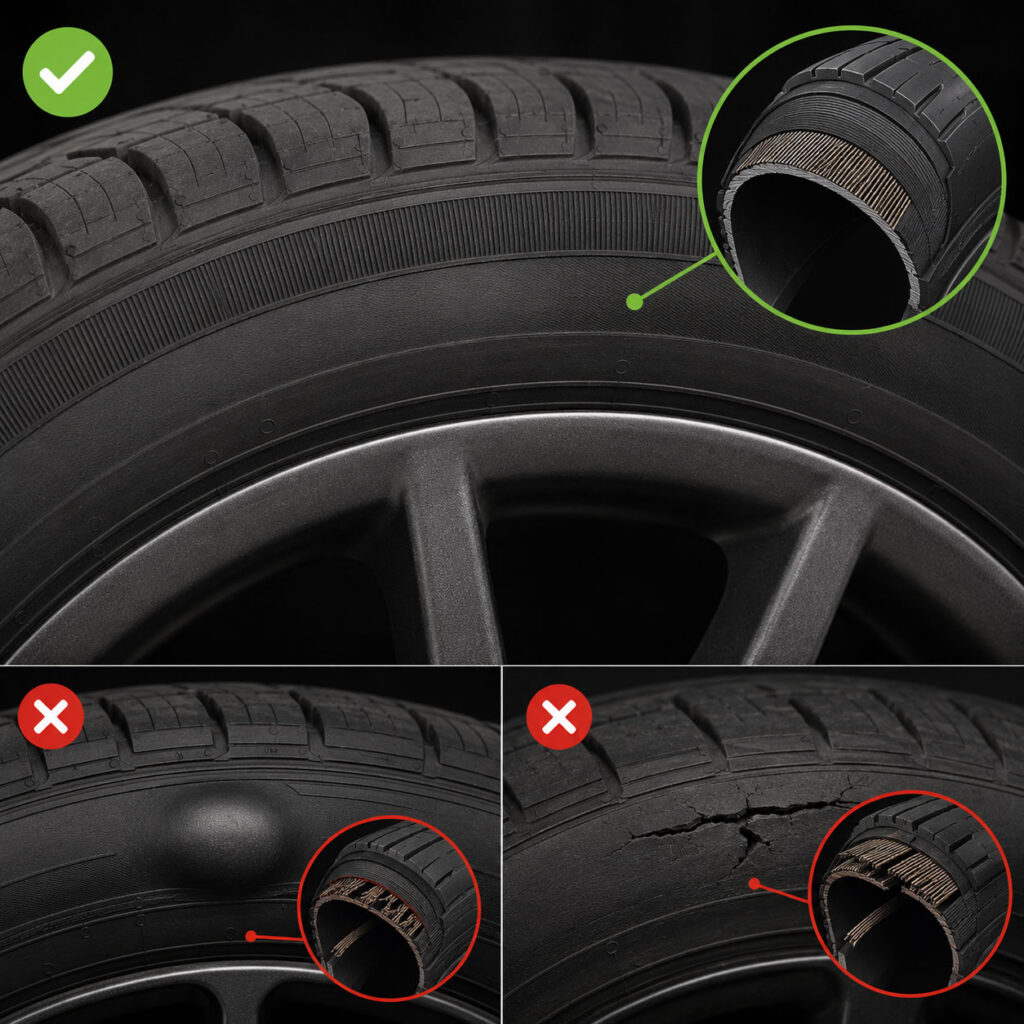
Checklist No. 6 - No Exposed Cord or Ply
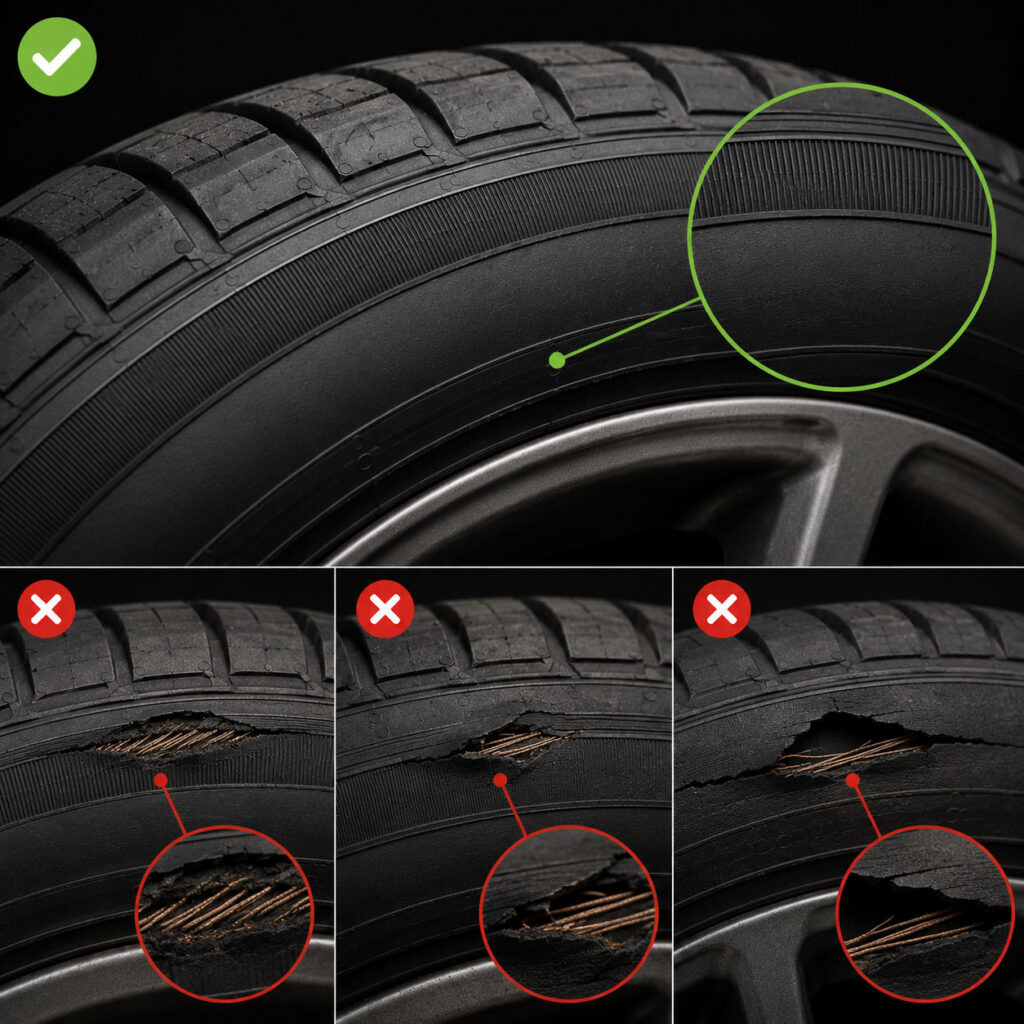
Checklist No. 7 - Sound Repairs only
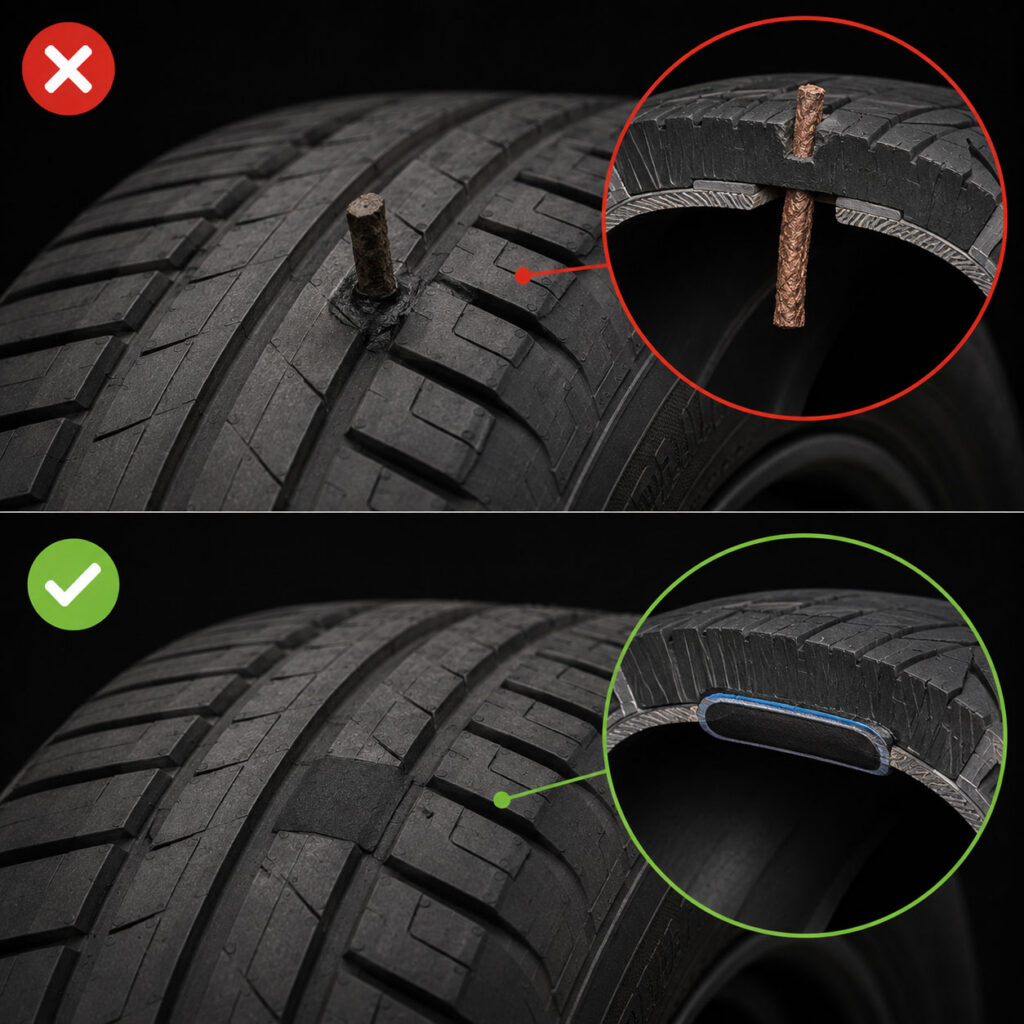
Checklist No. 8 - A Pressure Test
Checklist No. 9 - Retread Markings
Why 2mm is a Lowest Limit, Not a Safety Target
The 2mm figure trips up more buyers than anything else on this page. It is the lowest depth a shop is allowed to sell at. It is not the depth at which a tyre performs well, and it is not a recommendation.
The legal minimum for a car tyre in use on a UK road is 1.6mm across the central three quarters of the tread and around the whole circumference. So a tyre handed to you at exactly 2mm has 0.4mm of legal life in it. Depending on how you drive, that can be gone inside a few thousand miles.
Most tyre engineers suggest replacing at 3mm rather than running to the limit, because wet braking distances stretch out sharply once tread drops below that point. If you have never measured yours, our guide on how to check tyre tread depth takes about two minutes to work through with a 20p coin.
Tread Depth: What Each Measurement Really Means
8mm (new)
4mm to 5mm
3mm
2mm
1.6mm
Under 1.6mm
A Point Worth Repeating Again
Buying at 2mm means paying a fitting charge for a tyre that is already almost finished. Buying at 4mm or 5mm changes the maths completely. If a seller will not give you a measured figure in writing, assume the worst one.
The Tyre Damage You Cannot See from the Front
Tread depth is the easy part. It is the only thing anyone can measure in ten seconds, which is precisely why sellers point at it first. The faults that cause a tyre to let go without warning almost always sit somewhere you cannot see from the outside.
Damage That Hides Inside the Casing
- Impact breaks. A pothole or a kerb can snap the internal cords while the outside of the tyre still looks perfect. The bulge that gives it away often appears weeks later.
- Running underinflated. A tyre driven for months on low pressure cooks its own sidewall from the inside. The rubber is weakened long before anything shows on the surface.
- Objects removed before sale. A nail or screw pulled out leaves a hole straight through to the air chamber. If it was never sealed from the inside, water works its way into the steel belts.
- Outside only repairs. A plug pushed in from the tread face with no internal patch is not a legal repair under BS AU 159, and it will not hold under heat.
- Bead damage. Gouges left by careless fitting tools stop the tyre sealing properly against the rim, which shows up later as a slow, stubborn pressure loss.
Any one of these can end in a sudden failure at speed. Our breakdown of what sidewall damage really means covers what each mark on the rubber is telling you, and what to do if a tyre bursts while you are driving is worth reading before you ever need it.
Why Tyre Age — Really Matters
Rubber hardens as it ages, whether the tyre is being driven on or sitting in a stack behind a workshop. A ten year old tyre with 6mm of tread can grip noticeably worse in the wet than a three year old tyre with 4mm, because the compound has gone stiff and glassy.
The age is stamped on the sidewall as a four digit DOT code. The first two digits are the week, the last two are the year. 3224 means the tyre was built in week 32 of 2024. Manufacturers including Michelin and Continental advise a proper inspection from around five years old and replacement by ten, no matter how the tread looks.
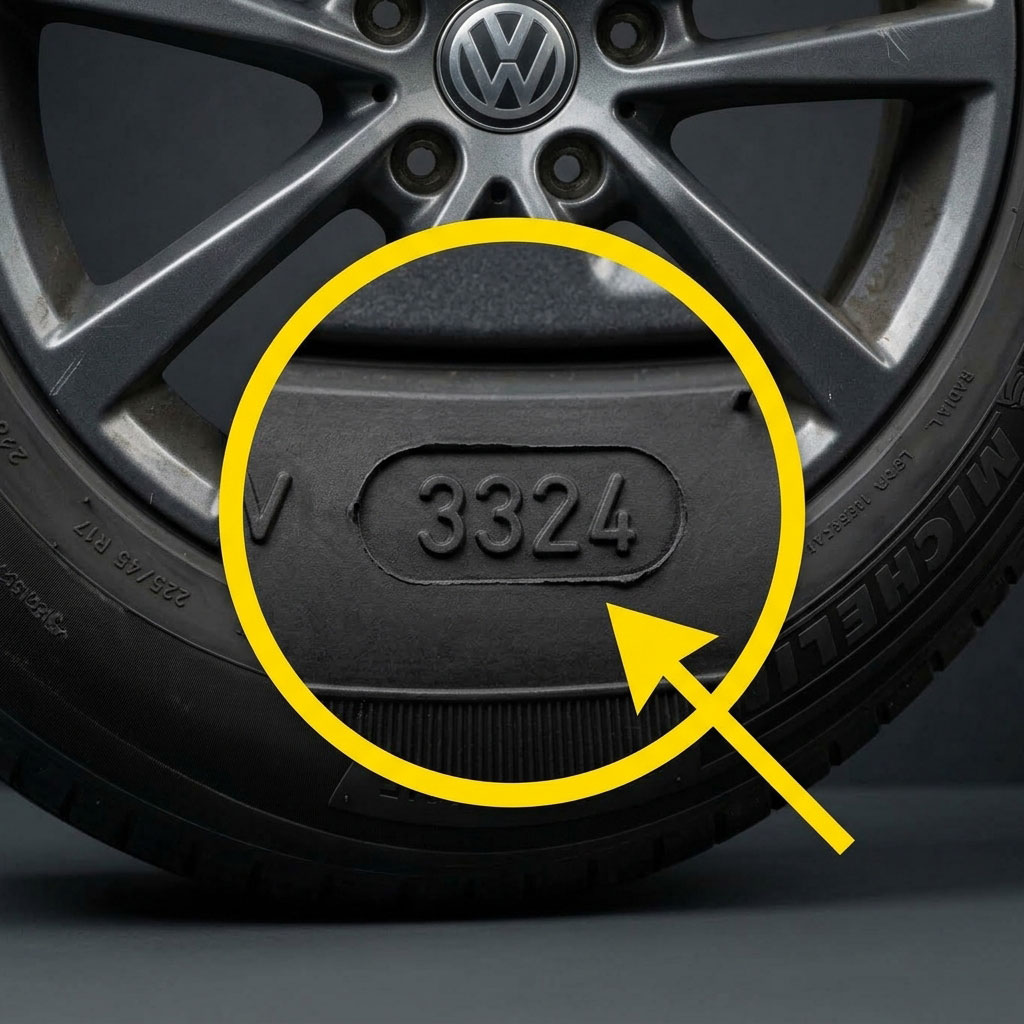
If you want the full picture on wear patterns and lifespan, our guide on how long tyres last and how to spot wear goes through it wheel by wheel.
Why History Matters More Than the Look
A new tyre comes with a known past. Nobody has overloaded it, nobody has driven it flat for two junctions, nobody has left it in direct sunlight for a summer. A used tyre comes with none of that certainty, and no paperwork that would tell you otherwise.
That is the real argument against part worn tyres, and it is not a scare story. It is simply the difference between a product you can check and a product you can only hope about. It applies just as much to run flat tyres, where the reinforced sidewall may already have been driven on while deflated without anyone recording it.
Do Part Worn Tyres Really Save You Money?
This is where the argument for used tyres usually falls apart, and it has nothing to do with safety. It is arithmetic.
Cost Per Usable Millimetre
The fair way to compare two tyres is not the number on the price board. It is what you pay for each millimetre of tread you can actually use before the tyre reaches the 1.6mm legal limit and has to come off again.
Typical fitted price
Usable tread above 1.6mm
Cost per usable millimetre
Realistic mileage before replacing
Wet grip and noise rating
Warranty
Fitting charges over 30,000 miles
Prices move around by region and by tyre size, so treat those figures as an illustration rather than a quote. The pattern holds anyway. On a cost per mile basis the used tyre is usually the more expensive choice, and you pay the fitting charge again far sooner. Our breakdown of what mobile tyre fitting costs in the UK shows how that second charge stacks up.
The Costs That Never Appear on the Receipt
- A longer wet stopping distance every single journey, which is the cost you only find out about once.
- A second fitting appointment months earlier than you planned, usually at short notice.
- The risk of an MOT advisory or failure turning into a retest fee.
- A possible argument with your insurer if a tyre is found to be illegal after a claim.
- The chance of the tyre failing on a motorway run, where a straightforward job becomes an urgent one.
None of that appears on a £35 receipt. All of it lands later. If value is the goal, our roundup of the best budget tyres in the UK is a more useful starting point than a stack of used rubber, and the mid range options often work out better value per mile again.
If you have decided a used tyre is the right call for your situation, do not buy it blind. Run this check in the shop, out loud, with the tyre in your hands. It takes about five minutes and it is the difference between a sensible purchase and a gamble.
The Quick 10 Point Check to Run even in the Shop
- Find the words PART WORN moulded into the sidewall in capitals at least 4mm tall. Not printed, not stuck on.
- Check the E mark, then confirm the size, load index and speed rating match what your vehicle handbook asks for.
- Read the four digit DOT date code and work out the tyre’s age before you look at anything else.
- Measure the tread in three places across the width, outer shoulder, centre and inner shoulder. One low reading tells you the tyre was on a car with an alignment fault.
- Run your hand slowly around both sidewalls, inside and out, feeling for lumps you might not see.
- Look into the tread grooves for fine cracking, and along the shoulder for any hint of cord.
- Ask to see the inside of the tyre with a torch. This is where poor repairs and impact damage show up.
- Check the bead area for scrapes and gouges left by fitting tools.
- Ask them to inflate it to full pressure and leave it standing for a few minutes while you carry on looking.
- Ask for a receipt listing the size, the date code and the measured tread depth.
Five Questions Worth Asking the Seller
- Where did this tyre come from?
- Has it ever been repaired, and can I see the patch from the inside?
- What tread depth are you writing on my receipt?
- Will you inflate and inspect it in front of me?
- What happens if it loses pressure within a month?
A seller who answers all five without hesitating is probably one of the good ones, and they do exist. A seller who gets irritated by the third question has already told you what you needed to know.
Signs to Walk Away From, No Discussion
- No PART WORN marking on the sidewall, or a stick on label doing the job instead.
- Tread sitting at or near 2mm.
- Any bulge, blister or wave in the sidewall.
- Cord or ply visible anywhere on the tyre.
- A repair in the shoulder or sidewall, which can never be repaired legally.
- A plug in the tread face with no patch on the inside.
- A date code more than ten years old.
- A load index or speed rating below what your vehicle requires.
- A seller who will not inflate the tyre for you.
What If One Is Already Fitted to Your Car?
Do not panic, and do not ignore it either. Get the tyre looked at properly by a qualified fitter, who can check the markings, the inside surface and the true tread depth. If it turns out to be non compliant, keep your receipt, and report the seller to Trading Standards through the Citizens Advice consumer helpline. Enforcement teams act on exactly this kind of report.
If the tyre is unsafe, get it changed before your next journey rather than after it. A same day roadside or driveway replacement removes the problem in under an hour, and changing a tyre yourself is only worth attempting if you have a full size spare and a safe place to work.
Fines, Points and MOT Rules
Once a tyre is on your car, its condition is your responsibility, not the seller’s. That is the part of the deal nobody explains on the forecourt.
What It Costs When a Tyre Is Illegal
Driving on a tyre below 1.6mm
All four tyres below the limit
A tyre with a cut, bulge or exposed cord
Selling an illegal part worn tyre
An insurance claim after a collision
The official government guidance on tyre safety and the law sets out the in use requirements in full, and they apply to every tyre on the vehicle regardless of whether it was bought new or used.
Will a Part Worn Tyre Pass an MOT?
Yes, provided it meets the in use rules on the day of the test. That means at least 1.6mm across the central three quarters, no cuts or bulges, no exposed cord, correct size and construction for the axle, and a valid speed and load rating.
What an MOT pass does not give you is twelve months of reassurance. It is a snapshot taken on one morning. A tyre sold to you at 2.5mm can pass in March and be illegal by August. It is also worth remembering that mixing tyre types across an axle is an automatic failure, which is one of the reasons changing tyres in pairs is normally recommended.
How to Report a Seller
If you have bought a used tyre with no marking, obvious damage or a bogus repair, report it through the Citizens Advice consumer service, which passes cases to your local Trading Standards team. The Norfolk and Lancashire operations described earlier began with exactly this kind of information from ordinary drivers.
Keep the Evidence
Photograph the sidewall, keep the receipt, and note the date and the shop address. Without those three things a complaint is very hard to progress, and with them it is straightforward.
Safer Options When the Budget Is Tight
Nobody chooses a used tyre for fun. It is a money decision, and money decisions deserve a proper comparison rather than a lecture. Here is what the alternatives actually look like.
New Budget Tyres Against Part Worn
Starting tread
Known history
EU label for wet grip, noise and fuel
Warranty
Cost per mile
Who carries the legal risk
A new budget tyre from a recognised maker gives you three or four times the usable tread for less than double the price. That is the whole argument in one line. Our guide to the tyre brands worth considering explains where the real differences sit between the tiers.
Ways to Longevity the Tyres You Already Have
- Check pressures at least monthly. Underinflation is the fastest way to destroy tread, and our tyre pressure guide has the correct figures for loaded and unloaded running.
- Get the alignment checked if the car pulls or the wear is uneven. The difference between alignment and balancing is worth understanding before you pay for either.
- Slow down for kerbs and potholes. Most impact damage happens at low speed and could have been avoided.
- Do not run the vehicle overloaded, especially on vans and light commercials where the rear axle takes the punishment.
- Check everything before a long run. Our long road trip tyre checklist takes ten minutes and saves a great deal of grief.
- Keep on top of the basics with our everyday tyre maintenance tips, which apply equally to cars, 4×4 and SUV models.
When Replacement Cannot Wait
If a tyre has failed the checks on this page, driving on it is not a risk worth carrying. That is the point where a mobile fitter usually beats a garage appointment, because the vehicle does not have to move at all.
The Mobile Tyre Fitter keeps new tyres in stock across all the leading brands, for cars, vans, light commercials, 4×4 and SUV models alike. A rapid response matters most when the car is already off the road, so fitters come to you, which covers fitting at home, at your workplace, or as a roadside call out where the vehicle has stopped. Motorway incidents are handled through the correct recovery route first, then fitted safely once the vehicle is off the live carriageway.
Booking is straightforward whether you need an emergency tyre replacement tonight, a same day fitting slot for a last-minute problem, or a next day appointment that fits around work. The service runs 24/7 with 24-hour availability, and wheel balancing and valve replacement is done at the same visit rather than as a separate trip.
Quotes are given up front with no hidden fees, so the figure you are told is the figure you pay. You can check the current mobile tyre fitting service areas to see whether a fitter covers your postcode, from London and Birmingham through to smaller towns, or get in touch for an immediate answer on availability.
The Opinion on Part Worn Tyres
Part worn tyres are not automatically dangerous. They are automatically unverified, and with a component that carries the entire weight of your vehicle on four contact patches the size of your hand, unverified is the part that should worry you.
Key Points
- Used tyres are legal in the UK, but only when the seller meets the Motor Vehicle Tyres (Safety) Regulations 1994 in full.
- The marking PART WORN must be moulded in capitals. If it is missing, the sale is already illegal.
- 2mm is the minimum a shop can sell at, not a safe target. The in use legal limit is 1.6mm.
- The most dangerous faults, impact breaks, bad repairs and hidden cord damage, are invisible from the outside.
- Recent Trading Standards operations in Norfolk and Lancashire found almost total non compliance across the shops they inspected.
- Per usable millimetre of tread, a used tyre normally costs more than a new budget tyre, not less.
- If you do buy one, insist on the marking, a measured tread figure in writing, an inflation test and a look at the inside.
Final Thoughts
The fairest way to answer the question is this. A part worn tyre bought from a careful, compliant seller, at 4mm or more, under six years old, with a clean inside surface, is a reasonable buy. A part worn tyre bought because it carried the lowest price on the wall, with no marking and no measurement, is a risk you are taking on behalf of everyone else on the road too.
If you are not certain which of the two you are looking at, treat that uncertainty as the answer. New rubber removes the question entirely, and a fast fitting appointment at your home or workplace usually costs less disruption than a second trip to a garage a few months later.
Part Worn Tyres: Frequently Asked Questions
Short, direct answers to the questions drivers ask most often about used and second hand tyres in the UK.
Yes. It is legal to sell, buy and fit part worn tyres in the UK, but only when the tyre meets the Motor Vehicle Tyres (Safety) Regulations 1994. Those rules cover markings, tread depth, structural condition, repairs and a pressure test.
The duty sits with the seller. If a shop supplies a used tyre that fails any of those conditions, it is committing an offence even if the buyer never noticed.
They can be, provided the tyre is fully compliant and structurally sound. The problem is how often that is not the case.
In a 2026 Trading Standards operation in Norfolk, only one of 191 used tyres inspected met the full legal requirements, and around 36 percent were classed as dangerous. A separate check in Lancashire found none of the 30 tyres inspected were compliant. Buy one only if you can verify it yourself.
By law it must have at least 2mm across the full breadth of the tread and around the entire circumference before it can be sold. That is the legal floor for the sale, not a recommendation.
For the purchase to make any financial sense, look for 4mm or more. The legal minimum while the tyre is in use on the road is 1.6mm, so a tyre bought at 2mm has very little life left in it.
Yes. The words PART WORN must be permanently and legibly applied in capital letters at least 4mm high, next to every approval mark on the sidewall.
It cannot be hot branded, cut into the rubber, or applied as a sticker. A missing marking is the single most common failure found during enforcement inspections, and it is an immediate reason to walk away.
Yes, as long as it meets the in use requirements on the day of the test. That means at least 1.6mm of tread across the central three quarters, no cuts, bulges or exposed cord, and the correct size, construction, load index and speed rating for the vehicle.
An MOT pass is a snapshot rather than a guarantee. A tyre that passes at 2.5mm can be illegal a few months later.
It depends entirely on the tread you start with. A used tyre fitted at 4mm has around 2.4mm of usable depth before it hits the 1.6mm limit, which for most drivers works out at roughly 8,000 to 12,000 miles.
A new tyre starting at 8mm gives around 6.4mm of usable tread, commonly 20,000 to 30,000 miles. Driving style, alignment and tyre pressures all change those figures.
Usually not. Judged on cost per usable millimetre of tread, a part worn tyre typically works out at roughly £13 to £19 per millimetre against £9 to £13 for a new budget tyre.
You also pay the fitting charge two or three times as often, and you give up the EU label ratings for wet grip, noise and fuel efficiency that make new tyres easy to compare.
You can, but the two tyres on the same axle must match in size, construction and load rating, and it is far better if they have similar tread depth. A big difference between left and right affects braking balance and stability.
Where possible, replace in pairs across an axle. Mixing tyre types across an axle is also an MOT failure.
Look for the four digit DOT code on the sidewall. The first two digits are the week of manufacture and the last two are the year, so 3224 means week 32 of 2024.
Manufacturers generally advise a proper inspection from around five years old and replacement by ten years, whatever the tread looks like, because the rubber compound hardens with age.
Have it inspected by a qualified fitter, who can check the markings, the true tread depth and the inside surface of the casing. If it is unsafe, replace it before your next journey rather than after it.
Keep the receipt and photograph the sidewall, then report the seller to Trading Standards through the Citizens Advice consumer service. Reports from drivers are what trigger enforcement operations.