Best EV Tyres UK (2026): Top Picks for Range, Grip and a Quiet Cabin
Your electric car was sold to you on a range figure. Then one winter morning you notice you are plugging in more often than you used to, there is a low hum at 50mph that was never there before, and the fitter has just told you the front tyres are down to 3mm at 18,000 miles.
None of that is a fault with the car. Nine times out of ten it is the tyres.
An electric vehicle asks far more of its rubber than any petrol car ever did. It carries several hundred kilos of battery, it delivers full torque the instant your foot moves, and it has no engine noise to hide road roar behind. Fit the wrong set and you pay for it three times over: in lost miles, in cabin noise, and in tyres that wear out long before they should.
This guide sorts out which EV tyres are genuinely worth fitting in 2026, what those odd markings on the sidewall actually mean, and where you can save money without losing range.
Quick Answer
For most UK electric cars in 2026, the Hankook iON evo is the strongest all-round summer choice, the Michelin e.Primacy is the one to pick when range matters more than anything else, and the Hankook iON FlexClimate is the most sensible year-round option for British weather. Whatever badge you end up with, two numbers decide the outcome: the fuel efficiency letter (hold out for an A or B) and the load index, which has to match what your car’s door sticker asks for. Get those right and the brand argument matters far less than the forums suggest.
What Makes an EV Tyre Different From a Normal One?
Walk into a tyre shop and ask this question and you will get one of two answers: either EV tyres are a con, or you absolutely must have them. Neither is true. The honest answer sits in the middle, and it comes down to physics rather than marketing.
An electric car puts a different set of loads through the contact patch, and a tyre built for a petrol hatchback simply was not designed around them. That is why tyres for electric vehicles exist as a separate category at all, rather than as a sticker on an old product.
Three Things Your EV Does That a Petrol Car Never Did
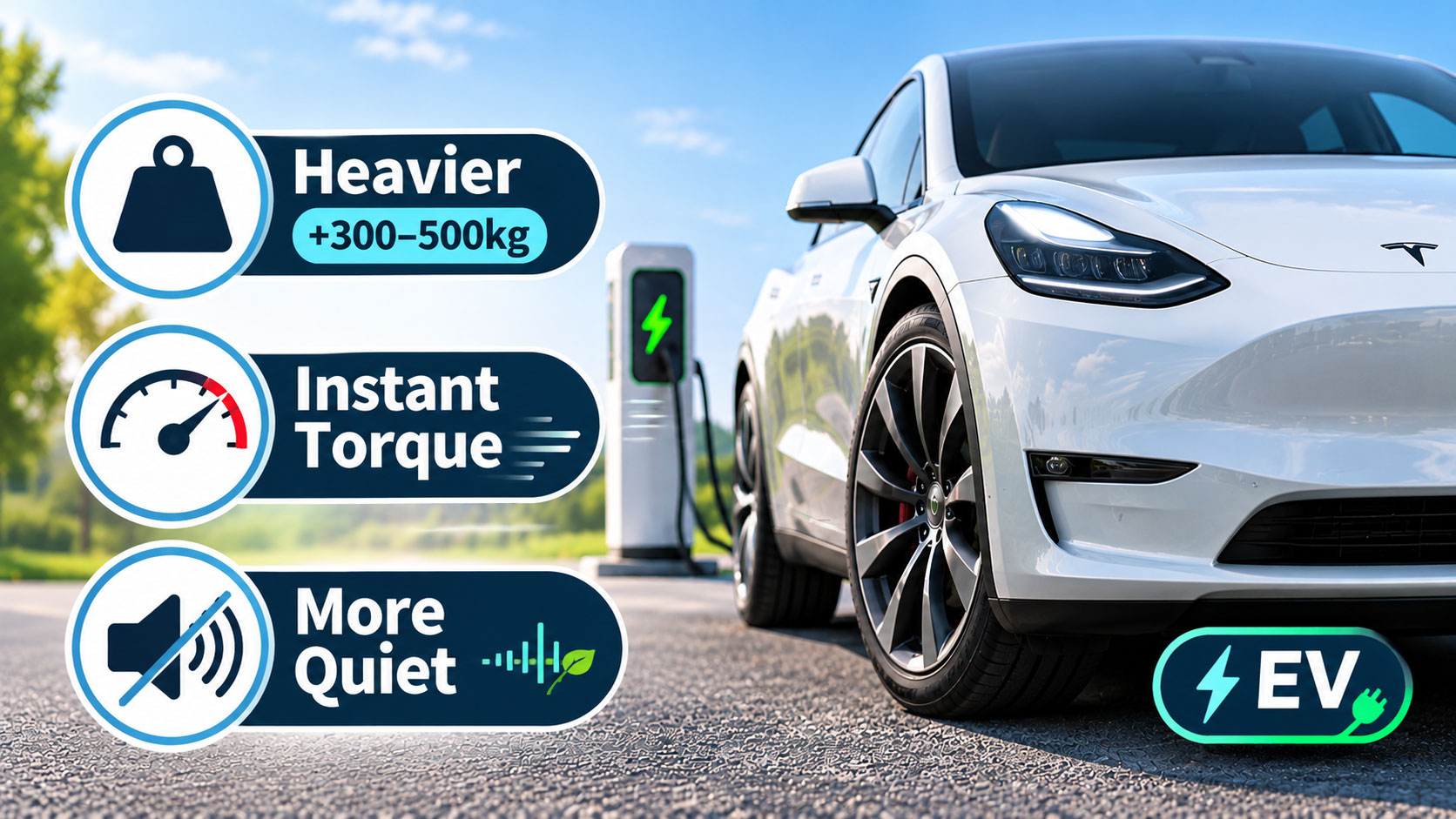
Start with weight. A battery pack adds roughly 300kg to 500kg over an equivalent petrol model, and every kilo of it presses down through four patches of rubber about the size of your hand. Then add torque: an electric motor delivers everything it has from a standstill, which is exactly the moment a tread block is most likely to scrub. Finally there is the silence. With no engine to mask it, tyre noise becomes the loudest thing in the car.
What your EV does
What the tyre has to handle
What happens with a standard tyre
Carries a heavy battery pack
Reinforced casing and a higher load index
Sidewalls flex and run hot, shoulders wear away early
Delivers full torque instantly
A harder-wearing tread compound
Tread scrubs off quickly, especially on the driven axle
Runs almost silently
A foam liner inside the tyre to kill cavity noise
Road roar and a low drone fill the cabin
Measures economy in miles per kWh
Very low rolling resistance
Several percent of your range disappears on every trip
Brakes using regeneration
Stable tread blocks under constant light braking
Feathered, uneven wear across the tread face
The Short Version
EV tyres are not a badge exercise. They are built stronger, quieter and freer-rolling, and an electric car genuinely benefits from all three. What they are not is compulsory, and that distinction saves people money further down this page.
What Do the EV Markings on a Tyre Actually Mean?
This is where most drivers get lost. There is no single official EV stamp, so every manufacturer uses its own name for the same idea. Once you know the shorthand, the sidewall stops being a puzzle.
Marking you will see
Who uses it
What it actually tells you
Elect
An EV-optimised version of an existing pattern: lower resistance, quieter, higher load
HL (High Load)
Industry-wide size code
A real size standard carrying more weight than XL at the same pressure
EV Ready / EV Compatible
Used by many brands
A marketing phrase, not a standard. Check the label and load index yourself
Markings change between model years and sizes. The letters on your current tyre are the fastest way to confirm what your car left the factory with.
Does an OE Marking Matter on an Electric Car?
Sometimes, yes. Carmakers work with a tyre maker during development, and the result carries a small code on the sidewall: T0 or T1 for Tesla, MO for Mercedes, star for BMW, and so on. Those versions are tuned around that specific car’s weight distribution and suspension.
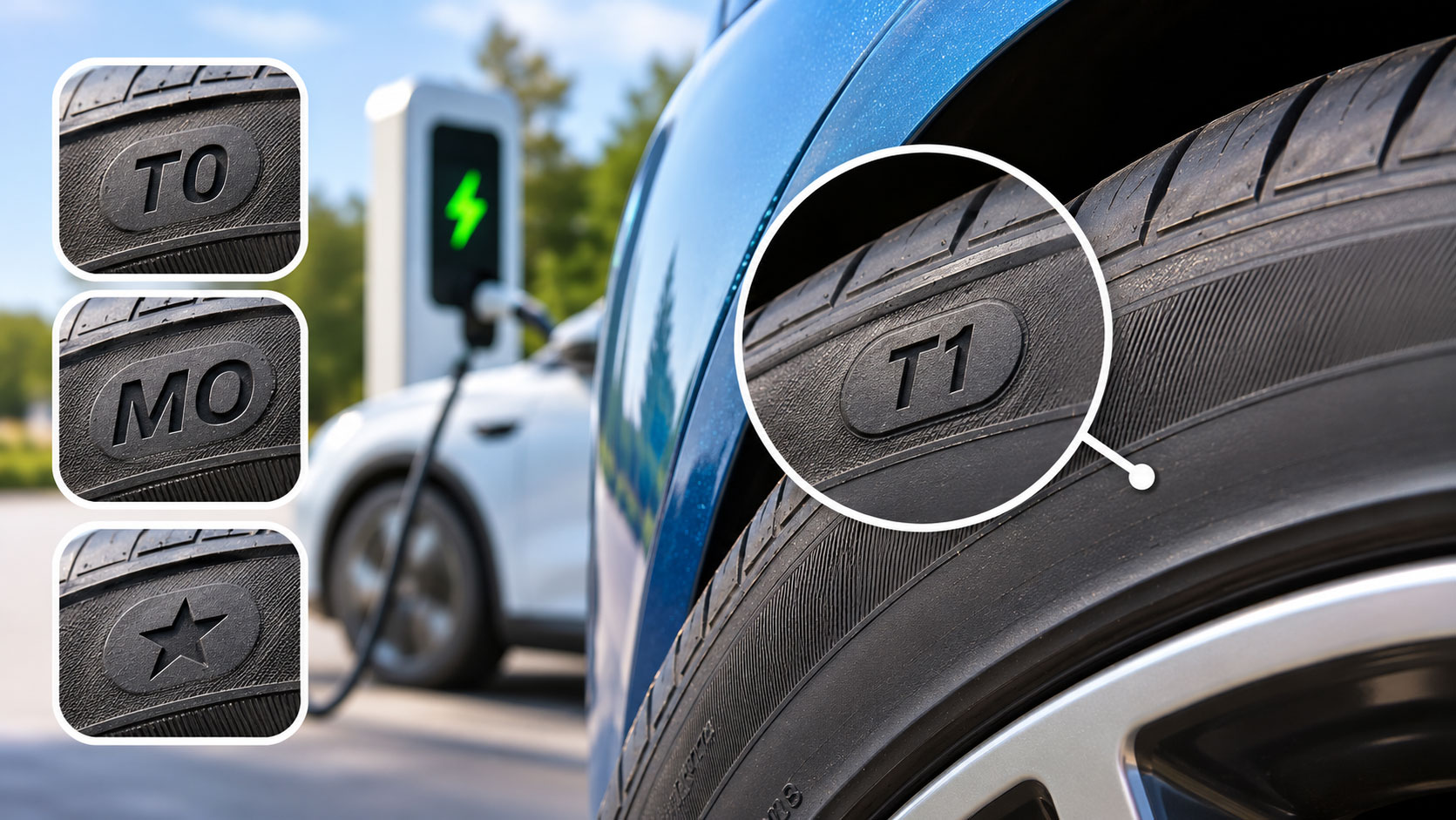
You are not obliged to buy them. A good non-OE tyre in the right size and load rating is perfectly legal and often cheaper. But if your car rides oddly or the range drops after a change, an OE-marked set is usually the quickest way back to how it felt when new. It is the same principle we cover in our guide to matching tyres to a specific car.
Do You Actually Need EV-Specific Tyres?
Legally, no. There is no rule in the UK that says an electric car must wear EV-branded rubber. What there is, however, is a load requirement, and that catches people out.
Your car’s door sticker lists a load index for each axle. Because EVs are heavy, that figure is often higher than you would expect for the size, and plenty of ordinary tyres in the same dimensions simply do not meet it. Fit one of those and you have an unsafe car, an MOT problem and an insurance headache waiting to happen.
So the real rule is simpler than the marketing: buy a tyre that meets the load index, scores well on the label, and ideally carries noise-reducing foam. If that tyre happens to have an EV badge on it, fine. If it does not, you have lost nothing. Auto Express makes the same case when it explains why EV-specific designs exist at all.
Where Drivers Waste Money
Two mistakes come up again and again. The first is paying premium EV prices for a tyre whose only EV credential is the sticker on the box. The second is going the other way and fitting a bargain set with a D or E fuel rating, then wondering why the winter range has collapsed. Both are avoidable in about thirty seconds of label reading, which we walk through further down this guide.
The Best EV Tyres for 2026
The shortlist below is built around tyres with real engineering behind them: brands that supply electric cars from the factory, publish consistent label data and show up well in independent testing. Independent EV tyre testing is worth a look if you want to compare raw scores yourself.
Treat it as a list to ask for rather than a strict order of merit. Availability in your exact size decides more than any ranking, and label ratings shift between sizes within the same model, so always confirm the letters printed for your fitment before you commit.
Top EV Tyre Picks at a Glance
What you need
Our pick
Why it earns the spot
Best all-rounder
Hankook iON evo
Purpose-built EV tyre that took the 2025 Auto Bild EV test win against seven rivals
Best for maximum range
Michelin e.Primacy
Consistently the lowest rolling resistance of any mainstream road tyre
Best all year round in the UK
Hankook iON FlexClimate
An all-season EV tyre with A-grade efficiency and genuine cold-weather certification
Best for a quiet cabin
Michelin Pilot Sport EV Acoustic
Foam liner bonded inside the tyre to kill the drone EVs expose
Best for EV SUVs
Hankook iON evo SUV
Scores 9.7 out of 10 at Tyre Reviews, the strongest EV SUV result we found
Best for everyday efficiency
Goodyear ElectricDrive 2
A-grade label figures with longer tread life than most eco tyres manage
Best for performance EVs
Michelin Pilot Sport EV
Built on Michelin’s Formula E work, though testers mark it down in the wet
Best value EV-ready option
Falken e.ZIEX
A and A label grades at mid-range money rather than premium money
Label grades vary by size. Check the exact figures printed for your fitment before ordering.
EV Tyre Scorecard: How the Top Picks Compare
Every tyre above is good at something. This table shows what each one gives up to be good at it, so you are not paying for strengths you will never use. The stars come from published test results and owner ratings rather than from opinion, and the scores behind them are in the middle column so you can check them yourself.
Tyre
Overall rating
How it breaks down
Hankook iON evo
★★★★☆ 4.2/5
Test score 9.3/10
Not yet owner rated
Range ★★★★☆
Quiet cabin ★★★★☆
Wet grip ★★★★★
Tread life ★★★★☆
Value for money ★★★★☆
Michelin e.Primacy
★★★★☆ 4.0/5
Test score 8.2/10
Owners 66%
Range ★★★★★
Quiet cabin ★★★★★
Wet grip ★★★☆☆
Tread life ★★★★☆
Value for money ★★★☆☆
Hankook iON FlexClimate
★★★★★ 4.6/5
Test score 9.8/10
Owners 90%
Range ★★★★☆
Quiet cabin ★★★★★
Wet grip ★★★★★
Tread life ★★★★★
Value for money ★★★★☆
Michelin Pilot Sport EV Acoustic
★★★☆☆ 3.2/5
Test score 8.2/10
Owners 69%
Range ★★★☆☆
Quiet cabin ★★★★★
Wet grip ★★★☆☆
Tread life ★★★☆☆
Value for money ★★☆☆☆
Hankook iON evo SUV
★★★★☆ 4.0/5
Test score 9.7/10
Owners 87%
Range ★★★★☆
Quiet cabin ★★★★☆
Wet grip ★★★★★
Tread life ★★★★☆
Value for money ★★★☆☆
Goodyear ElectricDrive 2
★★★★☆ 4.2/5
Not yet test scored
Owners 72%
Range ★★★★★
Quiet cabin ★★★★☆
Wet grip ★★★★☆
Tread life ★★★★☆
Value for money ★★★★☆
Falken e.ZIEX
★★★★☆ 4.0/5
Test score 8.7/10
No owner reviews yet
Range ★★★★★
Quiet cabin ★★★★☆
Wet grip ★★★☆☆
Tread life ★★★☆☆
Value for money ★★★★★
Test scores and owner ratings are from Tyre Reviews, checked in November 2026. Range stars follow the fuel efficiency grade on the tyre label, quiet stars combine the noise rating with whether the tyre carries a foam liner and what owners say about road noise, and wet grip, tread life and value follow the published test and owner scores. Where a tyre has very few reviews we have scored it conservatively. Ratings shift between sizes, and these are our editorial summary rather than laboratory results.
Best EV Tyres for Maximum Range
If your main complaint is the charge not going as far as it used to, this is the table that matters. Rolling resistance is the energy your car burns simply flexing rubber against tarmac, and on an EV it comes straight off the range readout because there is no engine noise or fuel gauge softening the blow.
The figure to chase is the fuel efficiency letter on the label. Moving from a C-rated tyre to an A-rated one is typically worth somewhere between five and ten miles on a mid-size electric car, every single charge. We go through the same principle for petrol and diesel drivers in our guide to how tyres quietly change your fuel consumption.
Tyre
Typical label (fuel / wet)
Best suited to
How Much Range Can the Right Tyre Really Give Back?
Realistically, somewhere between three and eight percent against a poor set. On a car with a 250 mile range that is roughly eight to twenty miles back, which is the difference between arriving home and queueing at a rapid charger.
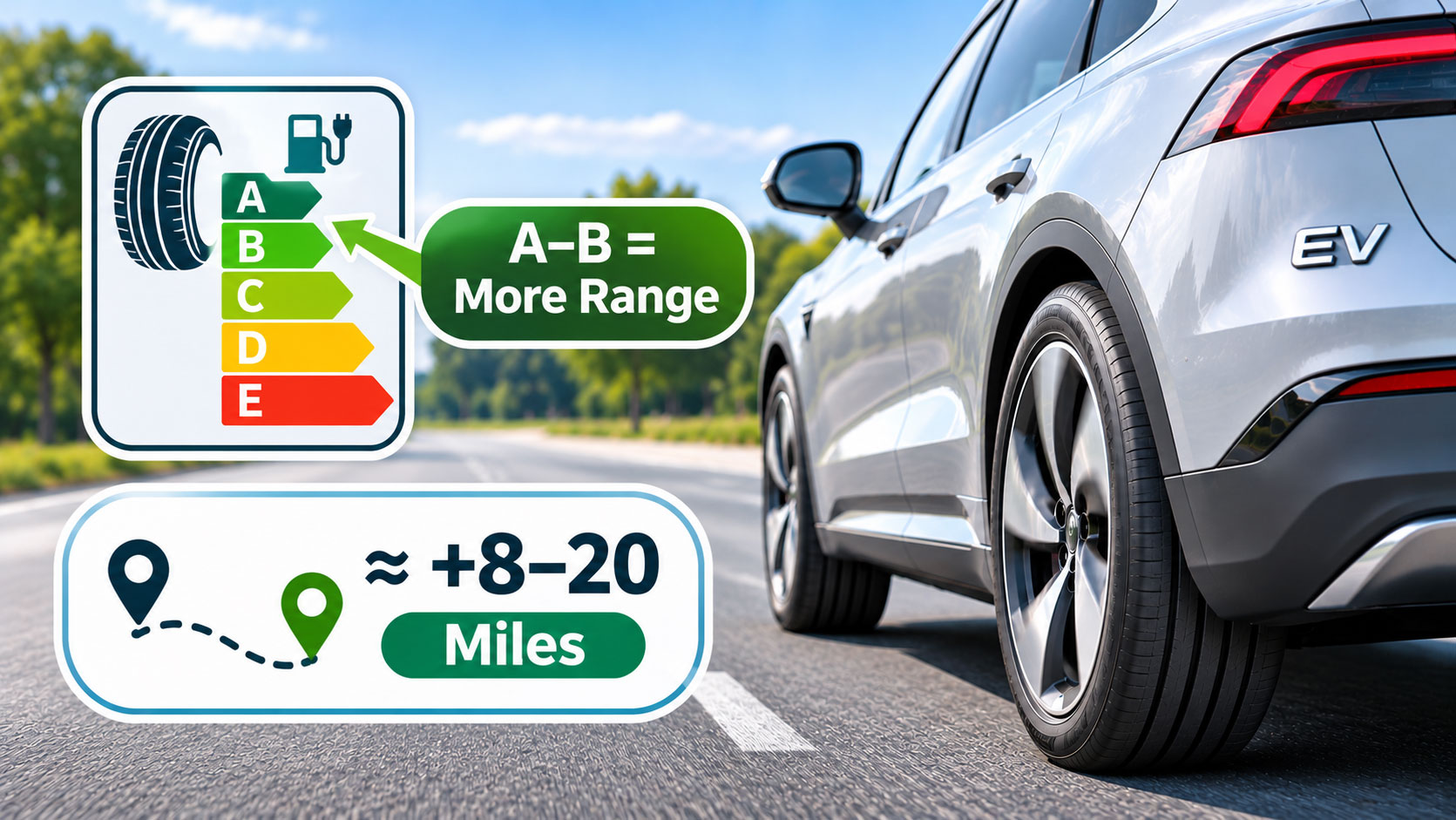
It is not a miracle, and anyone promising twenty percent is selling you something. But it is free once the tyres are on, it lasts the whole life of the set, and it costs nothing extra if you simply read the label before you buy.
Best EV Tyres for a Quiet Cabin
This is the complaint nobody warns new EV owners about. With the engine gone, the next loudest thing is the air trapped inside your tyres, which resonates like a drum at motorway speed and produces a low hum you cannot unhear.
The fix is a strip of polyurethane foam bonded to the inside of the tyre. Every major brand has a name for it, and it genuinely works, usually knocking several decibels off cabin noise.
Tyre
Noise technology
What you notice
Michelin Pilot Sport EV Acoustic
Acoustic foam liner
Aimed squarely at cabin drone; owners rate comfort well above its wet grip
Goodyear ElectricDrive 2
SoundComfort technology
A good all-round balance rather than a single standout
Worth Knowing Before You Pay Extra
Foam-lined tyres usually cost ten to fifteen percent more and can be slower to repair, because the foam has to be worked around. If your EV spends its life in town at thirty miles an hour you will barely notice the benefit. If you sit at seventy on the motorway every day, it is one of the few upgrades you feel immediately.
Best EV Tyres for SUVs and Heavier Electric Cars
Electric SUVs are where tyre choice stops being a nice-to-have. A large electric crossover can weigh well over two tonnes before anybody climbs in, and that weight goes through sidewalls that have to stay composed while the motors shove the car forward.
Here the load index is not a detail to check afterwards. It is the first thing to confirm, before you even look at the price. Many owners also move up to HL-rated sizes, which carry more weight than XL at the same pressure.
Tyre
Suits
Tread life, cabin and notes
Hankook iON evo SUV
Most electric SUVs and crossovers
Tread life ★★★★☆
Quiet cabin ★★★★☆
The best-scoring EV SUV tyre we found, at 9.7 out of 10 on test data
Goodyear ElectricDrive 2 SUV
Mid and large electric SUVs
Tread life ★★★★☆
Quiet cabin ★★★★☆
Strong tread life for the weight, with efficiency kept intact
Michelin Pilot Sport EV
Fast, heavy EVs with big wheels
Tread life ★★★☆☆
Quiet cabin ★★★★☆
Holds its shape under torque, but testers mark it down in the wet
Continental EcoContact 6 Q
Family electric crossovers
Tread life ★★★☆☆
Quiet cabin ★★★★☆
Wide size coverage and good label figures, though owners report quicker wear
Pirelli Scorpion Elect
Premium electric SUVs
Tread life ★★★★☆
Quiet cabin ★★★★☆
Often the original fitment, so the car feels as intended
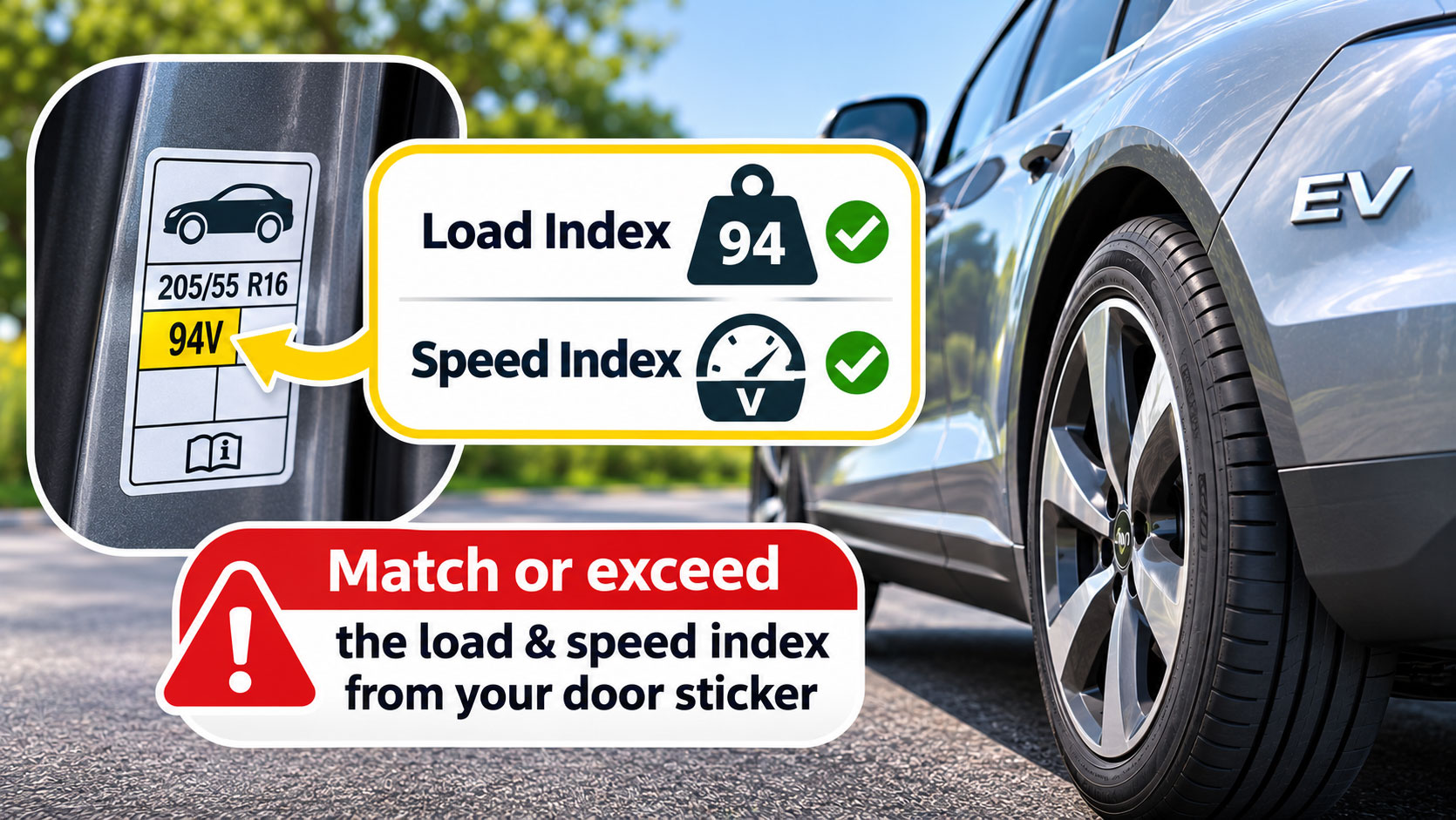
Load Index Warning
Match or exceed the load and speed index printed on your door sticker, not the one on the tyre you are replacing. Heavy EVs are the vehicles most often found running underrated tyres, usually because someone ordered on size alone. An underrated tyre on a two-tonne car is a genuine safety problem and can cause trouble with a claim after an incident.
If your EV is a crossover that sees the odd rough track, the same weight logic applies to grippier patterns too, which we cover in our round-up of tyres built for 4x4s and off-road use.
Best All-Season and Winter EV Tyres for UK Roads
British weather suits all-season tyres better than almost anywhere in Europe. We get long damp shoulder seasons, a handful of hard frosts and very little sustained snow, which is precisely the window an all-season pattern was designed for.
For EV owners there is a second reason. Cold weather already costs you range, because the battery and the cabin heater both want energy. A soft summer tyre in January adds a third penalty on top. An efficient all-season set removes the seasonal swap and keeps grip sensible when the thermometer drops below seven degrees.
Tyre
Type
Cold grip, range and notes
Hankook iON FlexClimate
All-season
Cold grip ★★★★★
Range ★★★★☆
Quiet cabin ★★★★★
Built as an EV tyre first, with winter certification and A-grade efficiency
Hankook iON evo AS
All-season
Cold grip ★★★☆☆
Range ★★★★☆
Quiet cabin ★★★★☆
Long tread life and low noise for commuting, but thin on owner data so far
Vredestein Quatrac Pro EV
All-season
Cold grip ★★★★☆
Range ★★★★☆
Quiet cabin ★★★★☆
Balanced wet and cold grip, with EV load ratings across common sizes
Michelin CrossClimate 2
All-weather
Cold grip ★★★★☆
Range ★★★☆☆
Quiet cabin ★★★★☆
Not EV-badged, but one of the safest year-round tyres you can fit
Nokian Hakkapeliitta R5 EV
Winter
Cold grip ★★★★★
Range ★★★☆☆
Quiet cabin ★★★★☆
For Scottish and upland drivers who genuinely see ice and snow
Hankook Winter i*cept iON
Winter
Cold grip ★★★★★
Range ★★★★☆
Quiet cabin ★★★★☆
An EV-specific winter tyre, so the range penalty is smaller than usual
Cold grip stars follow snow and ice test scores plus the three-peak snowflake certification, range follows the fuel efficiency grade on the label, and quiet cabin combines the noise rating with owner feedback. Winter tyres always cost some range, which is why the two dedicated winter sets score lower there than the all-season options.
Should an EV Owner Bother With Winter Tyres?
For most people in England and Wales, a good all-season tyre is the smarter answer. You avoid storing a second set, you avoid two fitting bills a year, and you get most of the cold-weather benefit.
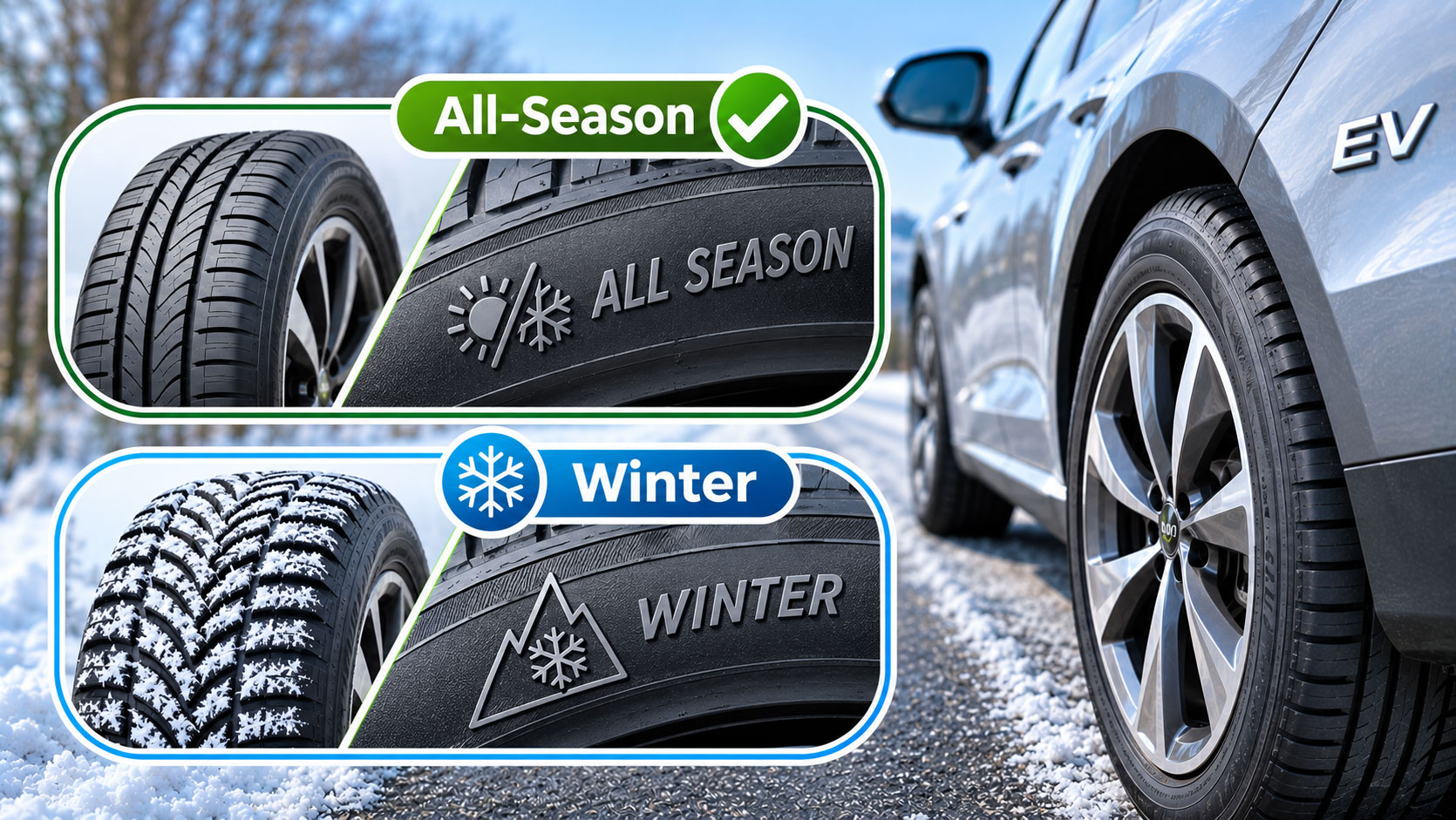
If you live somewhere that genuinely gets snow and ice for weeks at a time, a dedicated winter set still wins on safety. We go through the trade-off in detail in our guide to winter tyres for UK conditions.
Best Value EV Tyres: Good Options Without the Premium Price
Not every electric car needs a flagship tyre. A city EV doing 6,000 miles a year on urban roads does not need the same rubber as a 400bhp estate covering motorway miles, and spending as though it does is simply waste.
What you cannot compromise on is the load index and the fuel rating. Those two things are where an affordable set either works or quietly costs you more than it saved.
Tyre
Typical fitted price*
Rating and verdict
Goodyear EfficientGrip Performance 2
£105 – £145
Overall ★★★★☆ 4.3/5
Range ★★★★☆ Quiet cabin ★★★★☆ Tread life ★★★★★
The best-rated option here, 9.0/10 on test data and 85% from 131 owners
Michelin Primacy 4+
£130 – £180
Overall ★★★★☆ 4.3/5
Range ★★★★☆ Quiet cabin ★★★★★ Tread life ★★★★☆
Quiet and long lasting, though not EV-badged
Falken e.ZIEX
£95 – £130
Overall ★★★★☆ 4.0/5
Range ★★★★★ Quiet cabin ★★★★☆ Tread life ★★★☆☆
The least expensive genuine EV tyre worth fitting, at 8.7/10 on test data
Bridgestone Turanza All Season 6
£120 – £165
Overall ★★★★☆ 4.0/5
Range ★★★★☆ Quiet cabin ★★★★☆ Tread life ★★★★☆
One set for the whole year, at 9.4/10 and 79% from 44 owners
Vredestein Quatrac Pro EV
£110 – £150
Overall ★★★★☆ 3.7/5
Range ★★★★☆ Quiet cabin ★★★★☆ Tread life ★★★☆☆
An EV-specific all-season, but still thin on long-term owner data
*Indicative fitted price per tyre for a common EV size such as 215/55 R18 or 235/45 R19. Prices move with size, brand stock and season, and larger 20 inch and 21 inch EV fitments sit well above these figures. Stars and scores are built on the same evidence as the scorecard earlier in this guide, and the overall figure is the average of the three star columns shown.
Where Value Stops Being Value
Unbranded imports with a D or E fuel rating are the one category to walk away from on an electric car. The lost range alone usually wipes out the saving within a year, and heavy EVs chew through soft, poorly constructed rubber far faster than a petrol hatchback would.
If price is the deciding factor, our round-ups of mid-range tyre options and lower-cost tyres that are still safe explain exactly what you gain and give up at each tier. Just carry the load index rule over with you.
How to Choose the Right EV Tyre
Choosing well is mostly a process of elimination. You are not hunting for the single best EV tyre in existence, you are ruling out the handful that will disappoint you. Four checks do almost all the work.
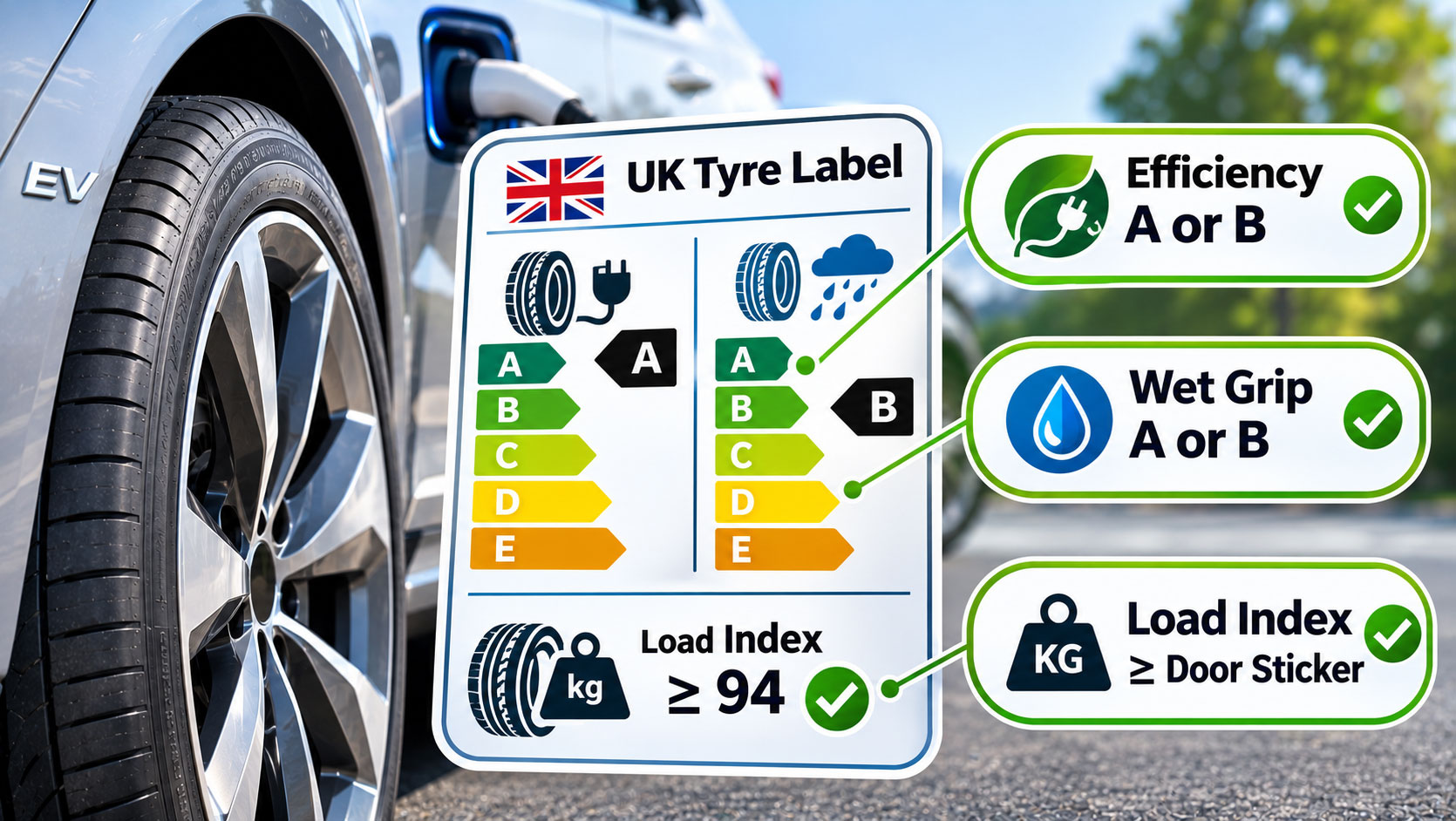
Reading the Tyre Label When You Drive an EV
Every new tyre sold here carries the same graded label. It is the closest thing to independent test data that costs you nothing, and on an electric car one of the three figures matters more than it does on a petrol car.
Label element
Scale
What it means for an electric car
Fuel efficiency
A (best) to E
This is your range. A to C is roughly five to ten miles on a mid-size EV
Wet grip
A (best) to E
Stopping distance in rain. Heavy cars need every metre, so hold out for A or B
External noise
A, B or C plus decibels
Matters more on an EV than anything else you drive, because nothing masks it
Snowflake symbol
Present or absent
Certified cold-weather grip, worth having if you keep one set all year
Load index
A number, not a letter
The one that is not optional. It has to meet your door sticker
The Simple Filter
Set a floor instead of chasing perfection: fuel efficiency A or B, wet grip A or B, load index at or above the door sticker. That single rule removes almost every tyre that would let you down and still leaves plenty of affordable options on the table.
Size, Width and Pressure: The Details That Cost You Range
Big wheels look superb on an electric car and quietly take miles off every journey. A wider tyre weighs more, pushes more air aside and usually carries a grippier compound, and all three add drag. Going up an inch for looks can cost a few percent of range permanently.
Pressure is the other free win. EVs are heavy, so they are usually specified at higher pressures than you expect, and a set running soft drags noticeably. Check them cold, once a month, using the figure on the door frame rather than the sidewall. Our full tyre pressure guide walks through where to find the right number for your car.
Five Checks Before You Say Yes
- Load index at or above the figure on your door sticker, front and rear
- Fuel efficiency rated A or B for your exact size
- Wet grip rated A or B, not just acceptable
- A DOT date code from within the last two years
- The same tyre on both ends of an axle, with no mixing of models
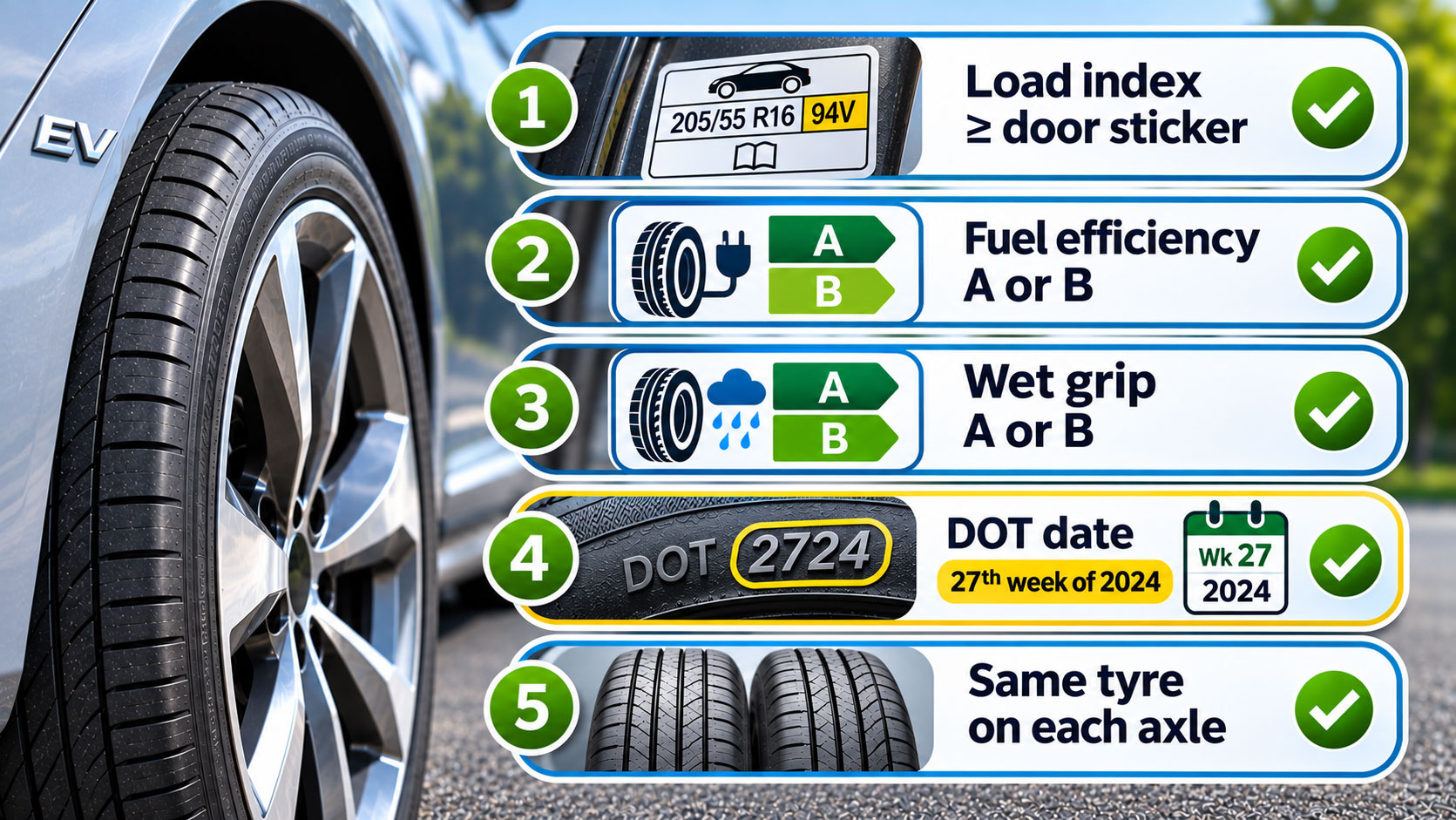
That last point is worth repeating. Mismatched tyres on one axle give you uneven braking in the wet, and on a torque-rich electric car the difference shows up sooner than it would on a petrol equivalent. It is the main reason there is a strong case for replacing tyres in pairs rather than one at a time.
Why EV Tyres Wear Faster, and How to Slow It Down
If you have come from a petrol car, the first set of tyres on an EV can feel like a shock. Wearing out a set twenty percent sooner is common, and on a heavy performance model it can be worse than that.
The good news is that most of the gap is in your hands. Weight you cannot change, but almost everything else on this list you can.
What causes it
What it does to the tyre
What you can do about it
Battery weight
More load through the shoulders, more heat
Fit the correct load index and keep pressures spot on
Instant torque
Scrubs tread off the driven axle
Ease off the first second of acceleration, it costs nothing
Regenerative braking
Feathered wear across the tread blocks
Use a lower regen setting on long motorway runs
Soft or uneven pressures
Shoulder wear and extra drag
Check cold, monthly, against the door sticker figure
Wheel alignment knocked out
One edge scrubbed bald in a few thousand miles
Have the geometry checked once a year or after a pothole
Leaving rotation too long
Fronts gone while rears look new
Swap front to back at the intervals in your handbook
The Two Habits That Make the Biggest Difference
Pressure and alignment, in that order. Under-inflation is the single biggest killer of tread life and it costs nothing to fix. Alignment is the quiet one: a car pulling half a degree out of true will ruin a shoulder long before the rest of the tread is worn, which is why it is worth knowing the signs that your wheels need aligning.
Keep an eye on depth as you go. TyreSafe and most safety bodies advise replacing at 3mm rather than waiting for the 1.6mm legal minimum, because wet braking falls away sharply below that point. Our guide to checking tread depth at home covers the 20p test, and how long a set should realistically last explains the wear patterns worth worrying about.
Can You Fit Ordinary Tyres to an Electric Car?
Yes, and plenty of people do. The question is not whether it is allowed, it is what you give up. Here is the honest comparison.
Factor
EV-specific tyre
Good standard tyre
Range
Built around low rolling resistance
Depends entirely on the label letter
Load capacity
Rated for battery weight as standard
Often too low in the same size, must be checked
Cabin noise
Usually foam lined
Rarely foam lined outside premium ranges
Tread life
Compound tuned for torque
Wears faster on a heavy, powerful EV
Price
Ten to twenty percent more
Lower upfront, sometimes higher per mile
Availability
Limited in older or unusual sizes
Far wider choice
So What Should You Actually Do?
If a well-rated standard tyre meets your load index and scores A or B for fuel and wet grip, fit it with a clear conscience. If the only thing separating it from the EV version is a foam liner and you mostly drive in town, you are not missing much.
Where the EV version genuinely earns the extra is on heavy cars, high motorway mileage, and anything with serious power. That is also where a badly chosen tyre fails soonest, and most electric cars have no spare wheel in the boot to get you out of trouble. Knowing the difference between Emergency Mobile Tyre Fitting vs Recovery Services saves hours when that happens, because a recovery truck moves the car while a mobile fitter actually solves the problem where you are standing.
It is also worth knowing whether your car came on run-flat tyres, since mixing run-flats with standard tyres changes how the car behaves, and whether you are on low-profile sizes, which are less forgiving of potholes.
The Verdict: What to Buy for Your EV
There is no single best EV tyre, only the best one for how you actually drive. Work out which line below describes you and the decision takes about a minute.
If you drive…
Fit this
And prioritise
A city EV doing low mileage
A well-rated efficient tyre, EV badge optional
Fuel efficiency A or B, correct load index
A family EV on mixed roads
An all-season EV tyre such as the iON FlexClimate
One set all year, no seasonal swap
A long-distance motorway commuter
Michelin e.Primacy or Goodyear ElectricDrive 2
Range first, then noise
A heavy electric SUV
A dedicated EV SUV pattern
Load index and HL ratings above all
A performance EV
Michelin Pilot Sport EV or Hankook iON evo
Grip and torque stability over range
Somewhere that sees real snow
A winter EV tyre, or CrossClimate 2 year round
Certified cold-weather grip
Replacing only two tyres
Match the axle exactly
New pair on the rear, whichever wheels drive
Final Thoughts
EV tyres are not a gimmick, but they are not magic either. The driver who reads the label, matches the load index and keeps the pressures right will get more range and more miles out of a sensible mid-range set than someone who buys the most expensive box on the shelf and never checks it again.
Spend where it counts, ignore the parts that do not apply to your driving, and put the difference towards keeping all four corners in good shape. A few simple tyre maintenance habits will do more for your range than any badge on the sidewall, and they are worth running through before any long trip too.
Where The Mobile Tyre Fitter Fits In
Once you have decided which tyres you want, the fitting does not have to mean a morning sat in a waiting room with a vending machine coffee. We come to you.
If you have already bought your EV tyres, we will fit and balance them at your home, your workplace or at the roadside. If you have not bought them yet, we carry stock across all the major brands at competitive prices with no hidden charges, so it is one visit, one job, one price. That is the whole idea of a one stop solution.
- Fitting at home, at work or on the roadside, including motorway call-outs
- Same-day and next day slots, with 24/7 and 24-hour cover for urgent, last-minute and emergency jobs
- Cars, vans, light commercials, 4x4s and SUVs, electric and petrol alike
- Wheel balancing and valve replacement handled at the same visit
Electric cars are exactly the sort of vehicle a mobile service suits, because most of them have no spare wheel and the jacking points need treating carefully. You can book a same-day slot near you, arrange fitting on your own driveway, or call us out for rapid roadside help if a tyre lets go away from home. For damage that cannot wait, there is immediate tyre replacement, and if tomorrow is soon enough, a next day appointment usually is.
Want the balancing sorted properly at the same time? That is covered under wheel balancing and valve replacement. You can check whether we reach your postcode on our coverage map, see what a fair total looks like in our breakdown of mobile fitting costs, or simply contact our support team and tell us what your EV needs.
Already Bought Your Tyres?
Bring them out of the garage and we will fit them. Have not bought them yet? We hold stock across all the major brands at competitive prices, so you can have the whole job done in one visit without hunting around first. Either way, talk to our support team and we will sort it from there.
Frequently Asked Questions About EV Tyres
Not legally, but the load rating is not optional. Electric cars are heavy, so your door sticker often asks for a higher load index than a petrol car of the same size, and many ordinary tyres in those dimensions do not meet it.
If a standard tyre meets the load index and scores A or B for fuel efficiency and wet grip, it is a perfectly sound choice. The EV badge mainly buys you a foam noise liner and a compound tuned for torque.
Across the mainstream brands the Michelin e.Primacy is the one most consistently chosen when range is the only priority, with the Falken e.ZIEX, Bridgestone Turanza Eco and Goodyear ElectricDrive 2 close behind on label figures.
Expect somewhere between three and eight percent more range against a poor set, not twenty. On a 250 mile car that is roughly eight to twenty miles back on every charge.
Three reasons stacked on top of each other: the extra weight of the battery, full torque arriving the instant you touch the pedal, and regenerative braking working the tread constantly at low force.
Wearing a set around twenty percent sooner than on an equivalent petrol car is normal. Correct pressures, a yearly alignment check and regular rotation claw most of that back.
Usually ten to twenty percent more for the equivalent quality, mostly because of the reinforced construction and the foam noise liner.
Per mile the gap is smaller than it looks, because a tyre built for the weight tends to last longer on a heavy car than a standard tyre fitted in its place.
It is the number just after the size, and it tells you the maximum weight that single tyre can carry. On electric cars it is the figure people most often get wrong.
Use the number on your door frame sticker, not the one on the tyre you are taking off, because a previous owner may already have fitted something underrated. Some EVs use HL sizes, which carry more than XL at the same pressure.
Yes, and for most UK drivers it is the sensible default. You avoid storing a second set, you avoid two fitting bills a year, and you keep useful grip when temperatures drop below seven degrees.
Choose one with the three-peak snowflake marking and a good fuel efficiency letter, so you are not trading away range for all-year convenience.
The foam-lined versions genuinely do. With no engine noise, the air inside the tyre becomes one of the loudest things in the car, and a bonded foam strip takes several decibels out of that low motorway drone.
If you mostly drive in town at thirty miles an hour you will barely notice. If you sit at seventy every day it is one of the few changes you feel the moment you pull away.
It depends entirely on the tyre rather than the price. A well-engineered tyre from an established manufacturer that meets your load index and carries A or B label grades is a safe, sensible buy.
What to avoid is an unbranded import with a D or E fuel rating. The lost range usually cancels out the saving inside a year, and heavy cars wear soft, cheaply built rubber alarmingly quickly.
Once a month, and always when the tyres are cold. Electric cars are specified at higher pressures than most people expect because of the weight, so a set running soft drags noticeably and costs you range straight away.
Cold weather lets pressure down on its own as the air contracts, which is a large part of why winter range always looks worse than summer range.
That is normal. Most electric cars ship with a sealant kit rather than a spare, because the battery takes up the space a spare wheel used to occupy.
A sealant kit only helps with a small tread puncture. Sidewall damage, a blowout or a badly kerbed wheel all need the tyre replacing, which is exactly the situation a mobile fitter is built for: the replacement comes to the car instead of the car being dragged to a garage.
Yes, and more than most people expect. A wider or larger tyre weighs more, pushes more air aside and usually carries a grippier compound, and every one of those adds drag.
Going up an inch for looks can cost a few percent of range permanently. Sticking to the size on the door sticker is almost always the efficient answer.
If you are only replacing two, fit the new pair to the rear, whichever wheels drive the car. Better grip at the back keeps it stable when you brake in the wet.
Whatever you do, keep both tyres on any single axle identical in brand, model and size. Mismatched tyres on one axle give uneven braking, and a torque-rich electric car shows that up sooner than a petrol one would.