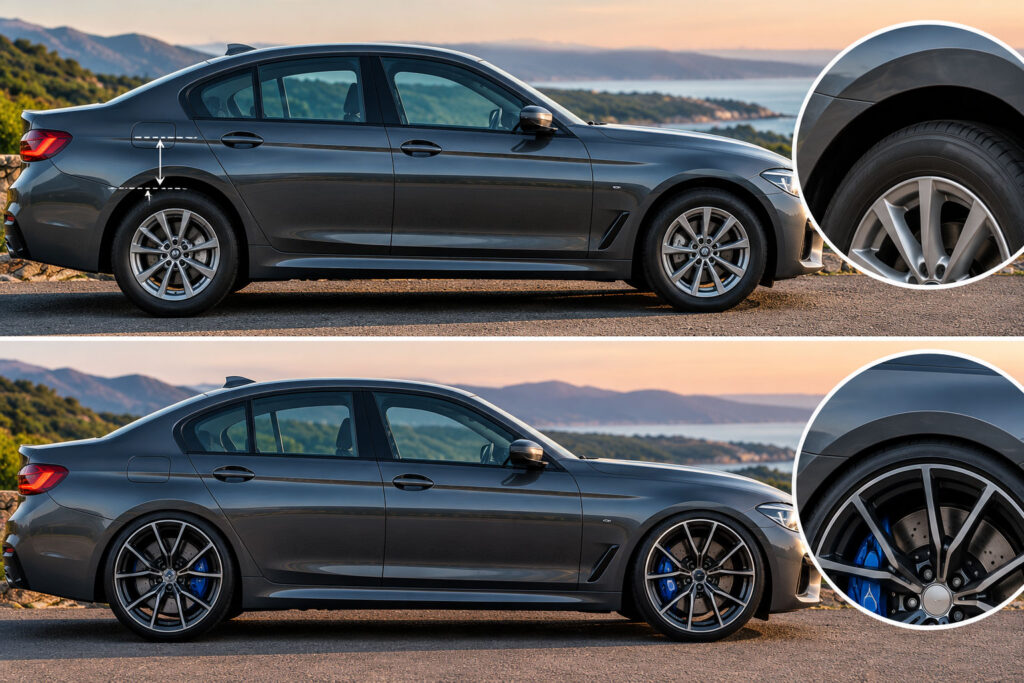
Park a modern car next to one from twenty years ago and the difference jumps out before you look at the badge. The wheels are bigger, and the rubber around them looks thinner. That thin band of rubber is a low profile tyre, and millions of UK drivers are now running them without ever choosing to.
Most people only start asking questions about them after something goes wrong: a pothole splits a sidewall, a new set costs far more than expected, or the ride suddenly feels hard after a wheel upgrade. This guide answers those questions in plain English, so you know exactly what you are running on, what it does for your car, and what it asks of you in return.
The short answer
- A low profile tyre has a short sidewall, so there is less rubber between the rim and the road.
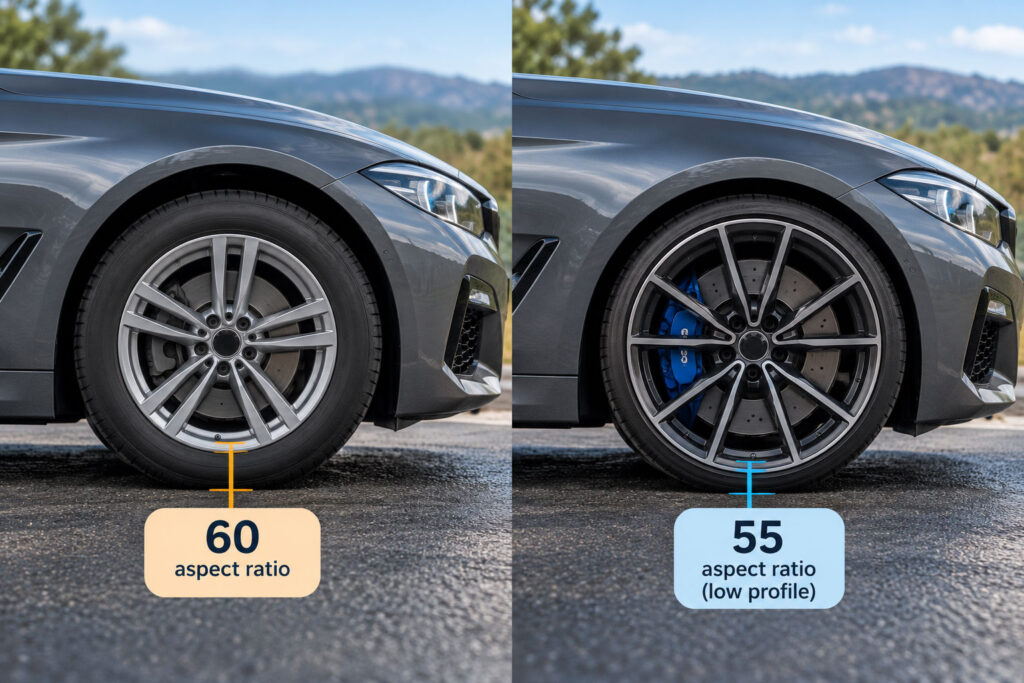
- The sidewall height comes from the middle number in your tyre size — the aspect ratio.
- In the UK, an aspect ratio of 55 or below is generally treated as low profile. Below 40 is firmly performance territory.
- You gain sharper steering, more cornering grip and shorter dry braking.
- You give up ride comfort, some pothole protection, and usually some money.
- They are completely legal in the UK as long as the size, load index and speed rating suit your car.
That is low profile tyres explained in short. The rest of this guide fills in the detail, in the order most drivers need it.
Jump straight to what you need
This is a long guide because low profile tyres touch everything from ride quality to your insurance. Pick the bit that applies to you.
- What a low profile tyre actually is
- Reading the numbers on your sidewall
- What counts as low profile in the UK
- Why car makers fit them
- Low profile vs standard tyres
- What you gain
- What you give up
- Do they wear out faster?
- Pressure, TPMS, balancing and alignment
- Potholes, kerbs and sidewall damage
- Can you go back to a taller tyre?
- Low profile tyres in winter
- Which brands do low profile well
- What they cost and how to choose
- Frequently asked questions
What a low profile tyre actually is
A low profile tyre is a tyre with a shorter-than-usual sidewall, which means there is less rubber between the edge of the wheel and the road surface. Nothing else about the tyre has to be different — the construction, the rubber compound and the tread pattern can all be ordinary. It is the height of the wall that earns the name.
That height is not a separate measurement. It is a percentage of the tyre’s width, written into the size on your sidewall as the middle number. The trade calls that number the aspect ratio; most drivers call it the tyre profile. They mean the same thing.
Worked example: 225/40 R18
Take a common size, 225/40 R18. The tyre is 225 mm wide. The 40 means the sidewall stands 40% of that width, so 225 × 0.40 = 90 mm of rubber between rim and road. Compare that with a 205/65 R15 on an older family hatchback: 205 × 0.65 = 133 mm. Almost half as much again.
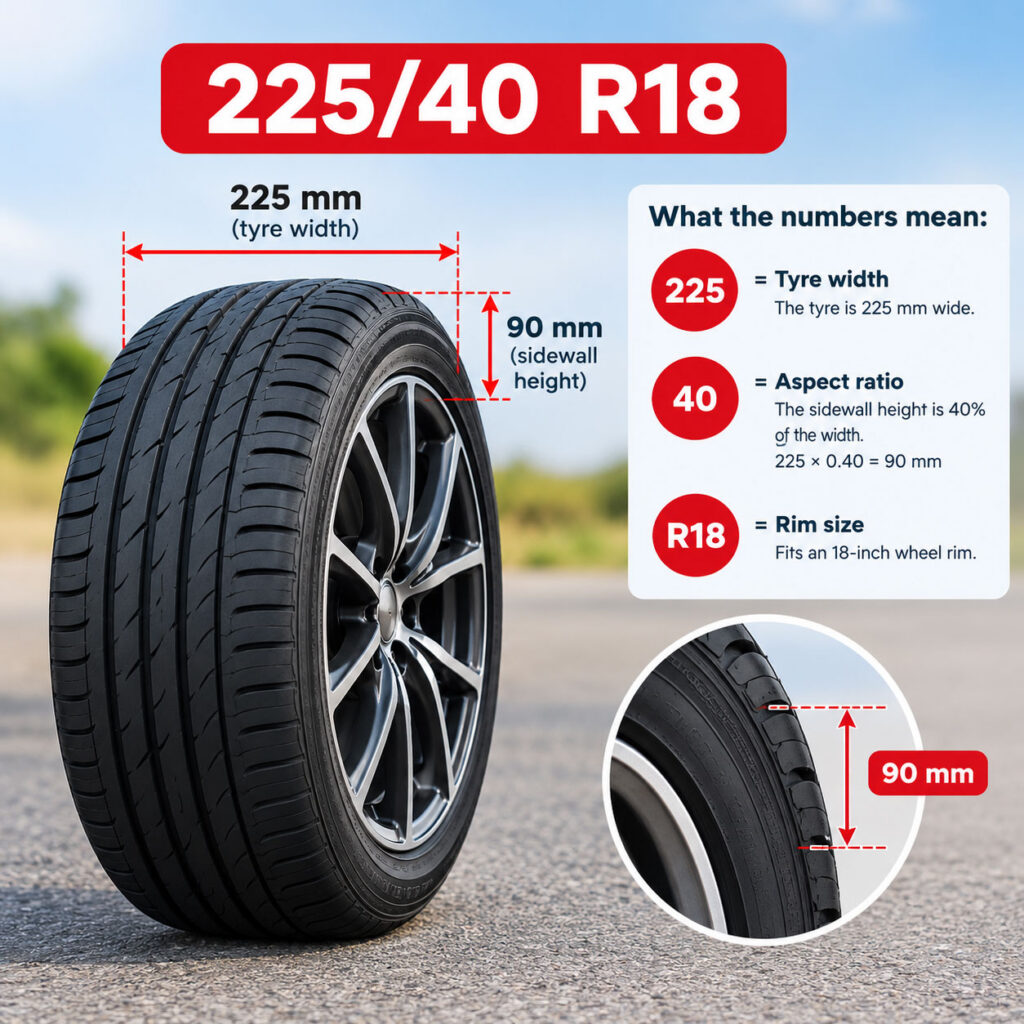
Those extra 43 mm are the cushion. Take them away and the wheel feels every change in the road surface more directly — which is exactly why low profile tyres both handle better and ride harder. One causes the other. There is no version of this where you get the sharp steering without the firmer ride.
The 10-second check on your own car
Look at the writing moulded into the outer edge of any tyre on your car. You will find a number like 225/45 R17 or 245/35 R20. If the middle number is 55 or less, you are running low profile tyres. If it is 60 or more, you are not. That is the whole test — no tools, no garage visit.
Worth knowing: low profile is not the same thing as run-flat, even though the two often appear on the same car. Plenty of drivers assume one means the other. If you want the difference set out properly, our guide to how run-flat tyres work covers it.
Reading the numbers on your sidewall
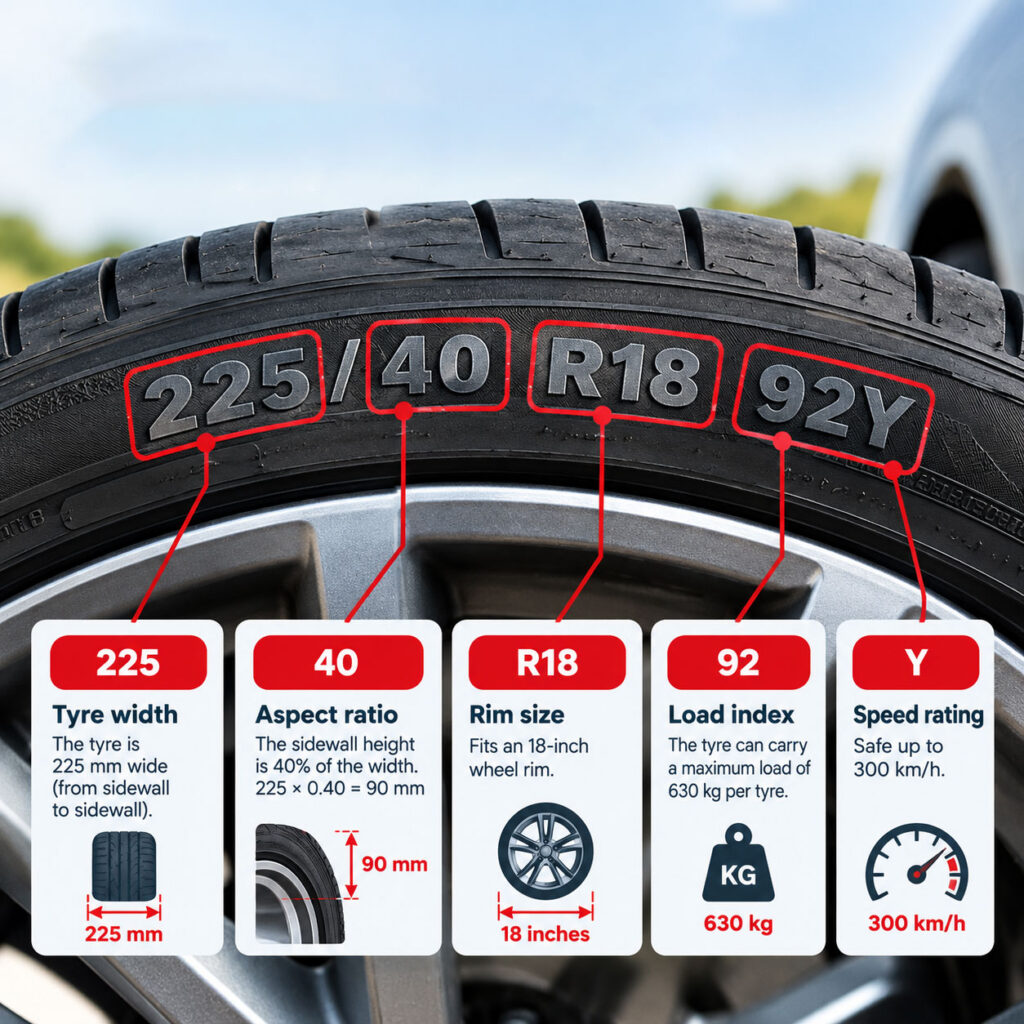
Once you can read a tyre size, buying tyres stops being guesswork. Every code on the sidewall tells you something you may need when you replace them. Here is 225/40 R18 92Y broken apart.
← swipe the table →
Code
What it is
What it means for you
225
Section width
The tyre measures 225 mm across the tread. Wider usually means more grip and more cost.
40
Aspect ratio
Sidewall height is 40% of 225 mm, so 90 mm. This single number decides whether the tyre is low profile.
R
Construction
Radial. Virtually every car tyre sold in the UK today is radial.
18
Rim diameter
Fits an 18-inch wheel. It must match your wheel exactly.
92
Load index
The maximum weight this tyre can carry. Never fit a lower figure than your car asks for.
Y
Speed rating
The maximum speed the tyre is built for. Your handbook states the minimum you need.
Extra markings you may see
- XL or Reinforced — a stronger casing for heavier cars. If your car came with XL, replace with XL.
- RSC, ROF, RFT, SSR or a circled exclamation mark — run-flat construction.
- M+S — mud and snow. On its own this is a marketing claim, not a certified winter tyre.
- Three-peak mountain snowflake — a genuine, tested winter tyre.
- A four-digit code in an oval — the week and year it was made. 3224 means week 32 of 2024.
Match the pair, not just the car
While you are down there, run your hand around the outer wall. Low profile tyres carry their damage where you can see it, and cuts, scuffs or soft lumps all mean something. We have set out what each one indicates in this breakdown of sidewall damage.
What counts as low profile in the UK
There is no legal cut-off. No regulation anywhere says “below this number, the tyre is low profile”. It is a trade term, and the industry has settled on roughly the same place: an aspect ratio of 55 and under. The table below shows what each band feels like from the driver’s seat.
← swipe the table →
Aspect ratio
Typically found on
How it rides
70–65
Older superminis, small vans, 4x4s on standard wheels
Soft and forgiving. Soaks up poor surfaces.
60
Family hatchbacks and estates on factory steel or small alloys
Comfortable, with steering that feels relaxed.
55–50
Most modern hatchbacks and saloons on 17-inch alloys
The crossover point. Noticeably sharper, still civilised.
45–40
Warm hatches, executive saloons, 18–19-inch alloys
Firm. Quick to respond. You feel expansion joints.
35
Performance cars and big optional wheel packages
Hard. Every ridge and manhole cover reports in.
30 and below
Track cars, show builds, very large aftermarket wheels
Uncompromising. Comfort is not part of the deal.
Why your car might be on both
Some manufacturers fit a taller tyre on the front axle and a lower one at the rear, or offer the same model with 16-inch wheels on the entry trim and 19s at the top. Two identical-looking cars on the same street can ride completely differently for this reason alone. If your car feels harsher than a friend’s, check the middle number before blaming the suspension.
Why car makers fit them in the first place
Low profile tyres are rarely something a buyer asks for by name. They arrive as a consequence of other decisions made long before the car reaches the showroom.
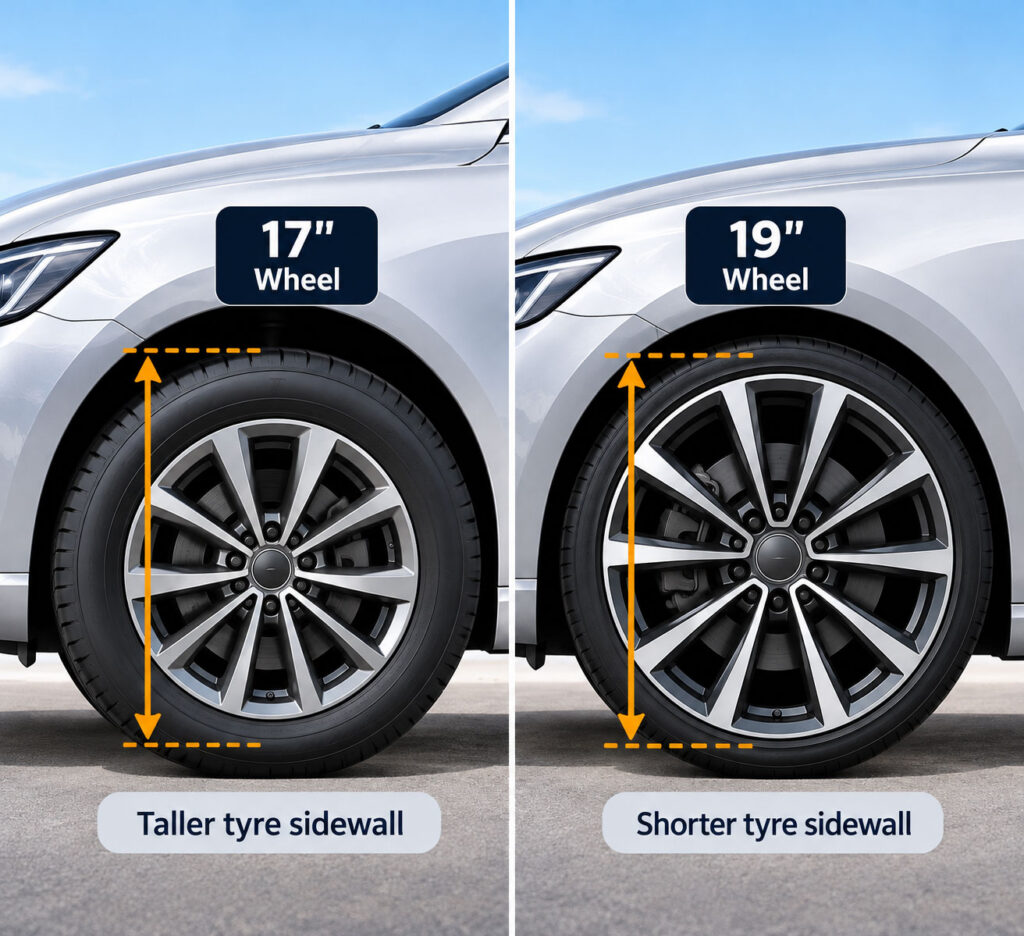
Bigger wheels need shorter tyres
A wheel arch is a fixed size. Fit a 19-inch wheel where an 17-inch one used to go and the only way the assembly still fits is if the tyre loses height to compensate. Big alloys sell cars, so the tyre gets squeezed.
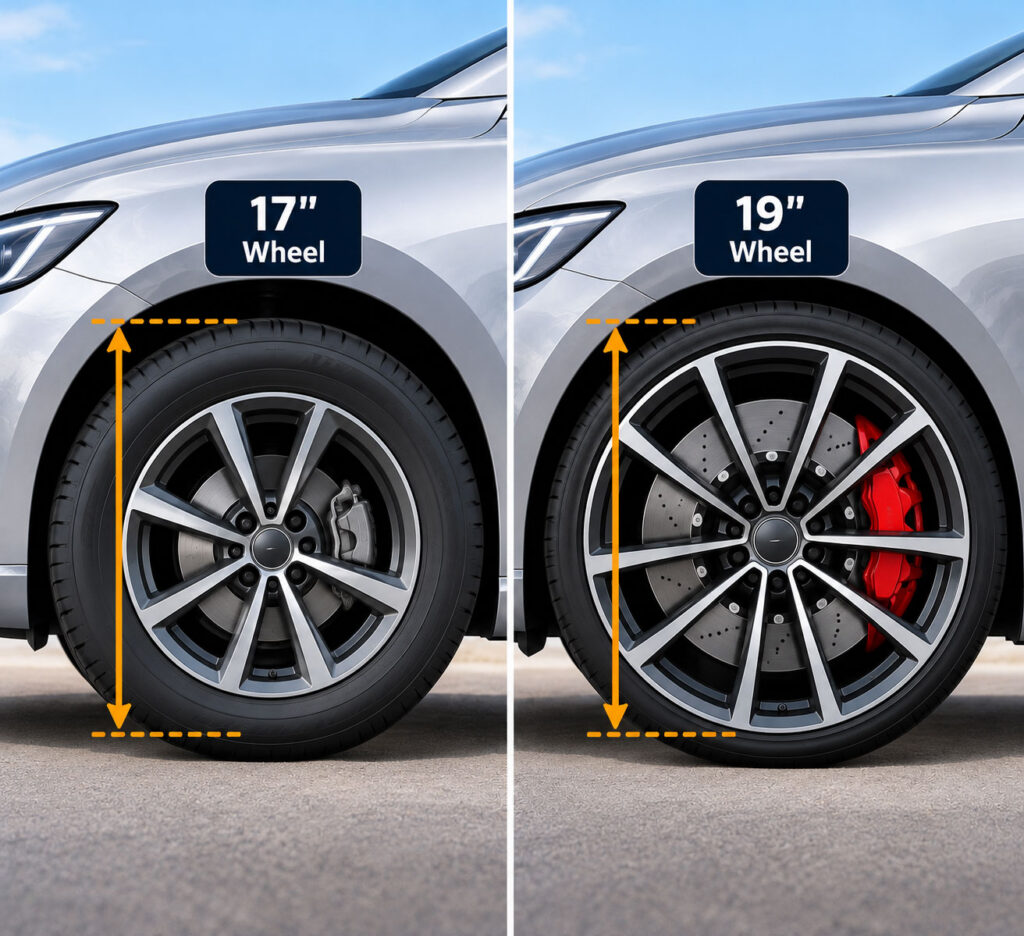
Brakes have grown
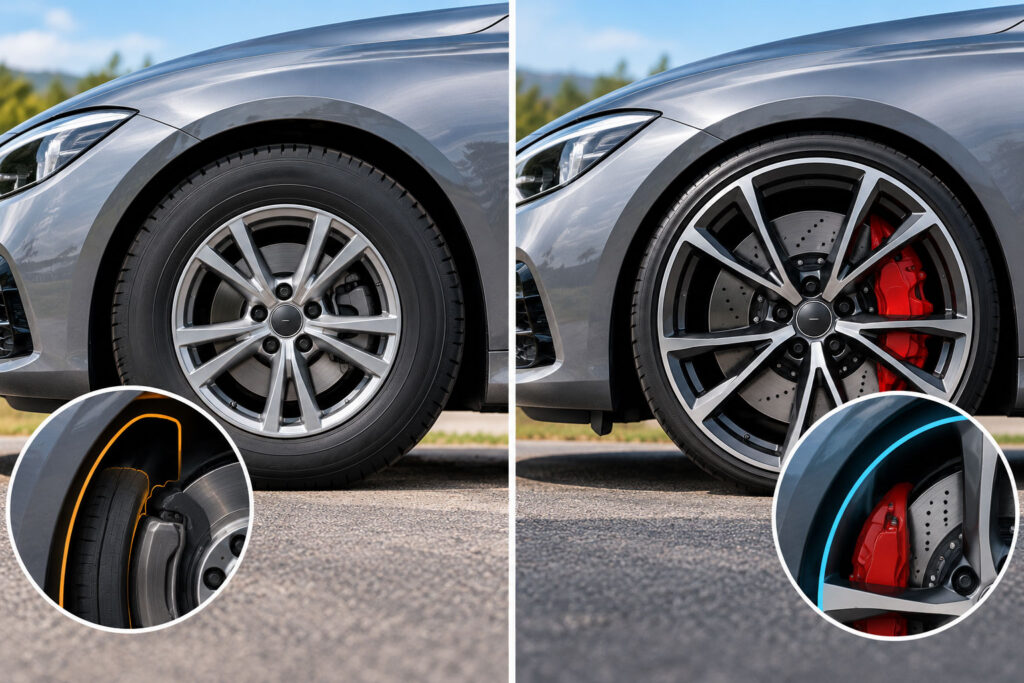
Heavier, faster cars need larger brake discs and calipers, and those have to live inside the wheel. Larger wheels create the clearance; shorter sidewalls keep the overall diameter unchanged so the gearing and speedometer still read correctly.
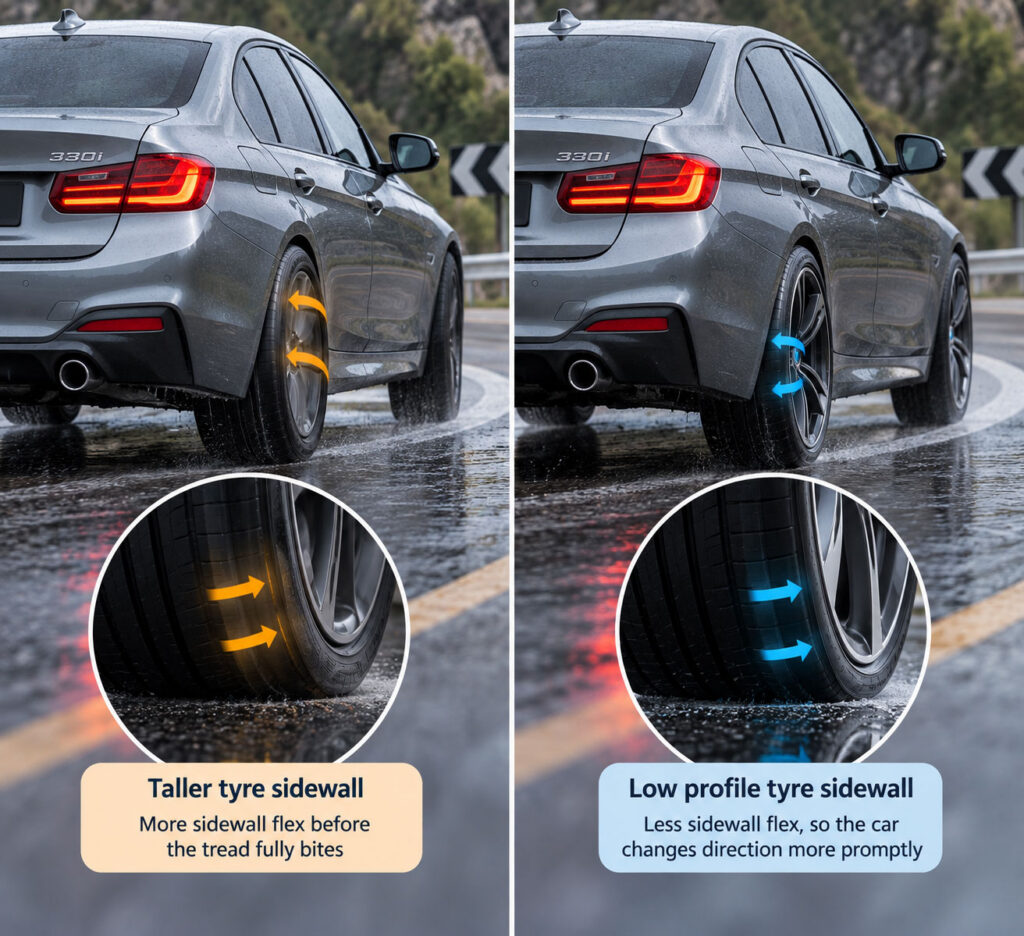
Steering response is measurable
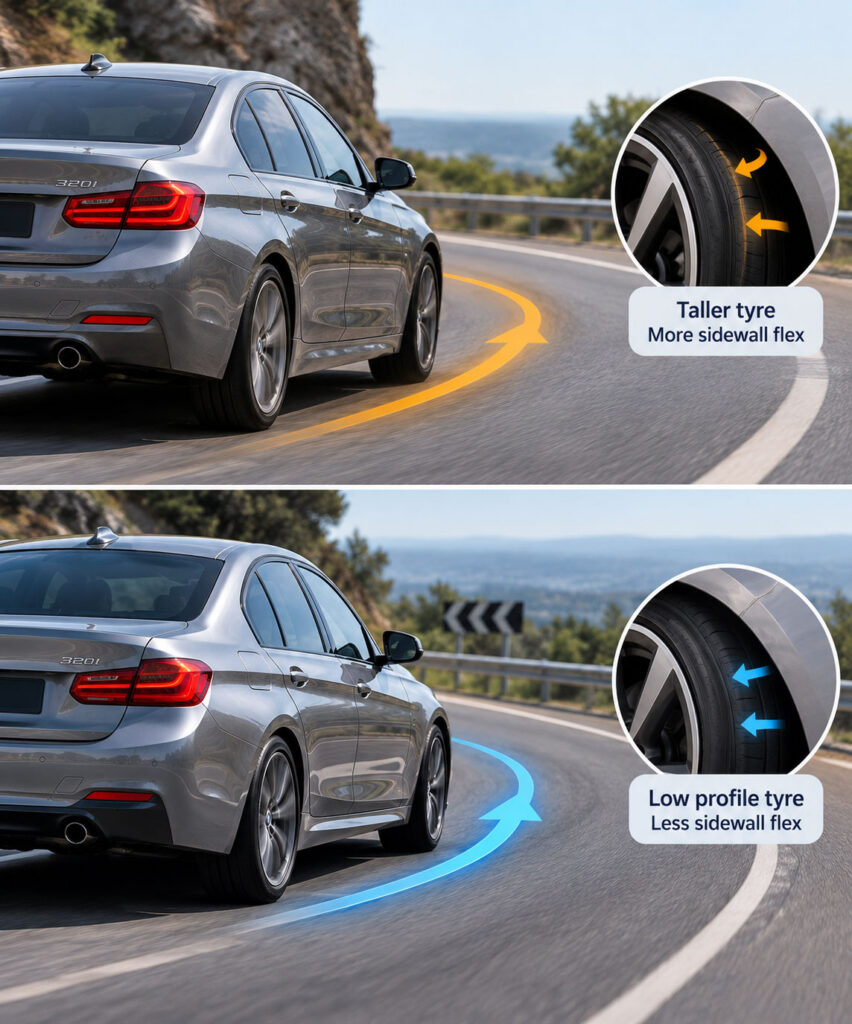
A tall sidewall flexes sideways before the tread fully bites. That delay is tiny, but it is real, and it shows up in the handling tests manufacturers are judged on. A short wall flexes less, so the car changes direction more promptly.
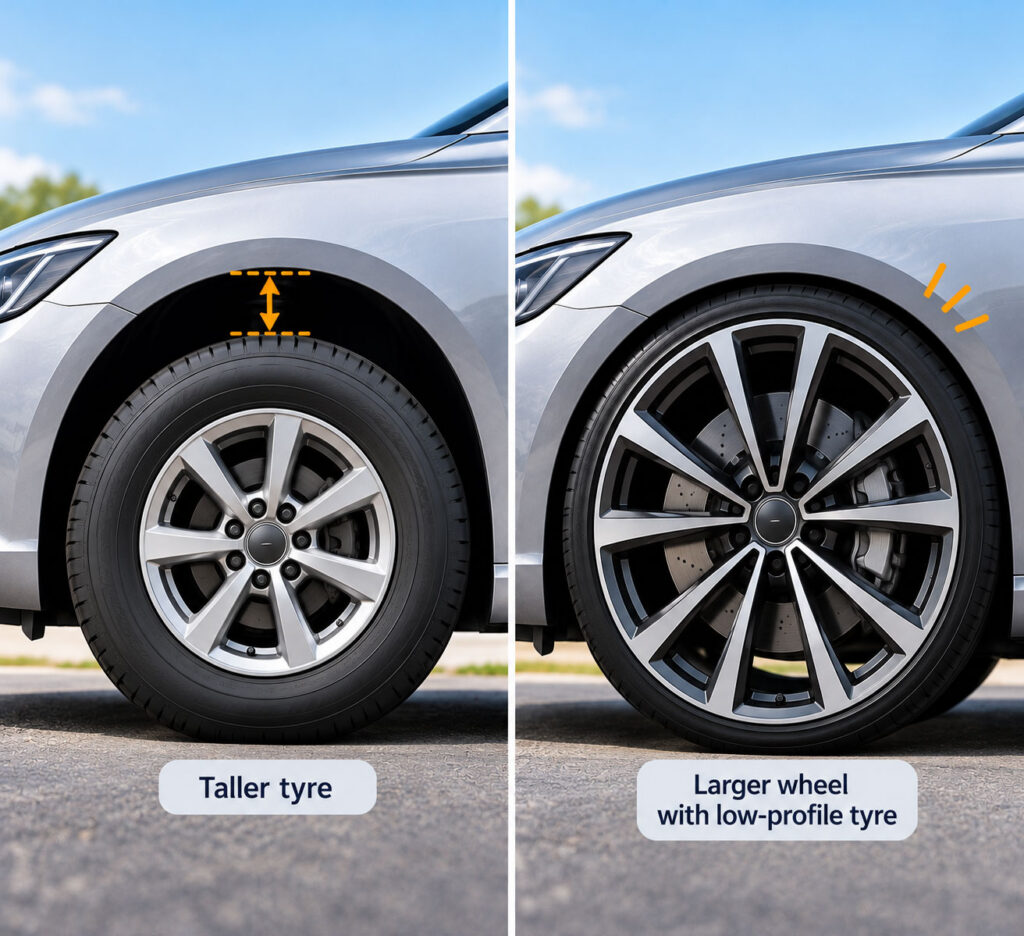
Looks matter more than most people admit
A wheel that fills the arch simply looks better to most buyers than a tall tyre with a visible gap. Manufacturers know this, which is why the photography in every brochure shows the largest wheel option.
That same thinking is behind a lot of factory tyre choices across the range, including the sizes used on German performance saloons — something we go into when looking at which tyres suit a BMW best.
Low profile vs standard tyres: an honest comparison
Neither type is better overall. They are tuned for different priorities, and the right answer depends on the roads you actually drive and what you want from the car.
← swipe the table →
What you are judging
Low profile (55 and under)
Standard profile (60 and over)
Steering response
Sharp — the car turns almost as soon as you do
Softer, with a brief pause before the car settles
Dry grip and cornering
Stronger, with less roll through bends
Adequate for normal driving, less composed when pushed
Ride comfort
Firm. Poor surfaces come through clearly
Cushioned. Ruts and ridges are smoothed over
Road noise
Usually higher, especially on coarse motorway surfaces
Generally quieter at a steady cruise
Pothole resistance
Lower — less rubber to absorb a sharp edge
Higher — the sidewall takes the hit first
Alloy wheel protection
Minimal. Kerbing the rim is easy
Better. The tyre bulges past the rim and shields it
Wet braking
Strong on a quality tyre; a cheap one is a real risk
Reliable across a wider spread of brands
Fuel economy
Often slightly worse due to wider, grippier tread
Often slightly better
Price to replace
Higher, and the gap widens above 18 inches
Lower, with far more choice at every budget
Winter capability
Workable, but fewer sizes and less give in the cold
Wide choice and more natural cold-weather compliance
Which one suits you?
What you gain with low profile tyres
The car answers the wheel faster
This is the difference most drivers notice within a mile. Turn the wheel and the nose moves with you instead of leaning first. On a roundabout or a tight slip road the car feels alert rather than lazy.
More grip when you need it most
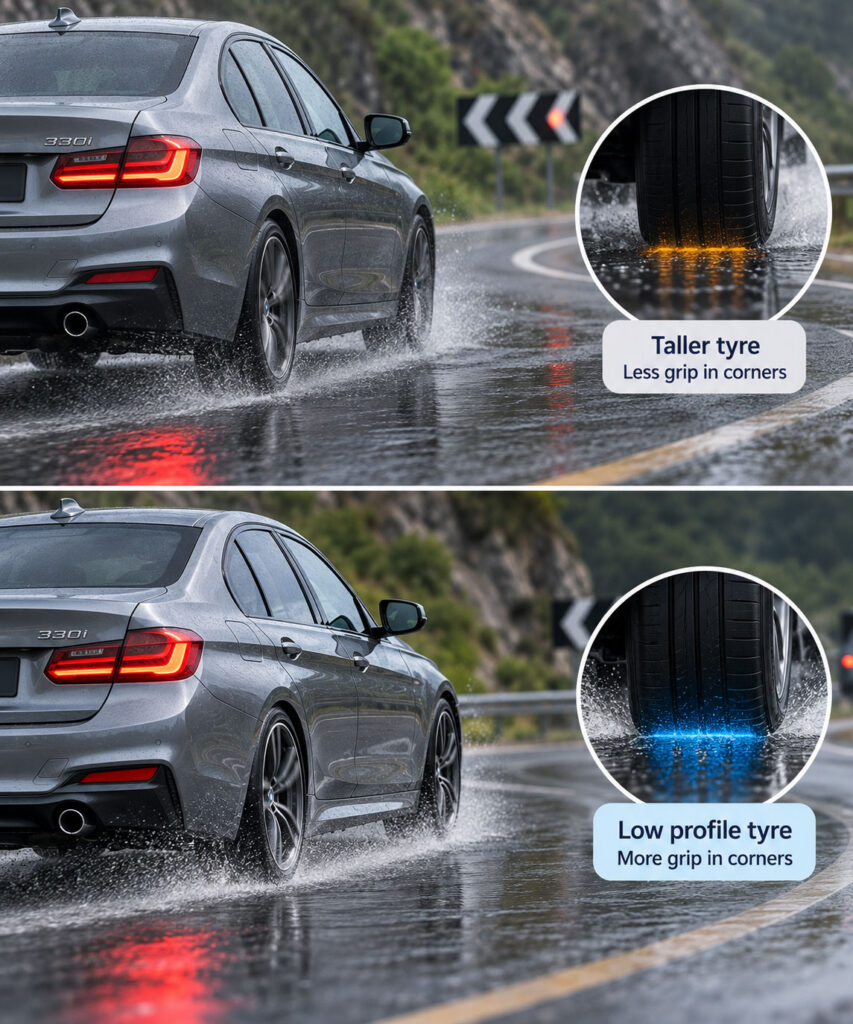
Low profile tyres tend to be wider, which puts more rubber on the road. Combined with a stiffer wall that keeps the tread flat under load, you get better cornering grip and shorter dry stopping distances — the kind of margin that matters when someone brakes hard in front of you.
Less wallow when the car is loaded
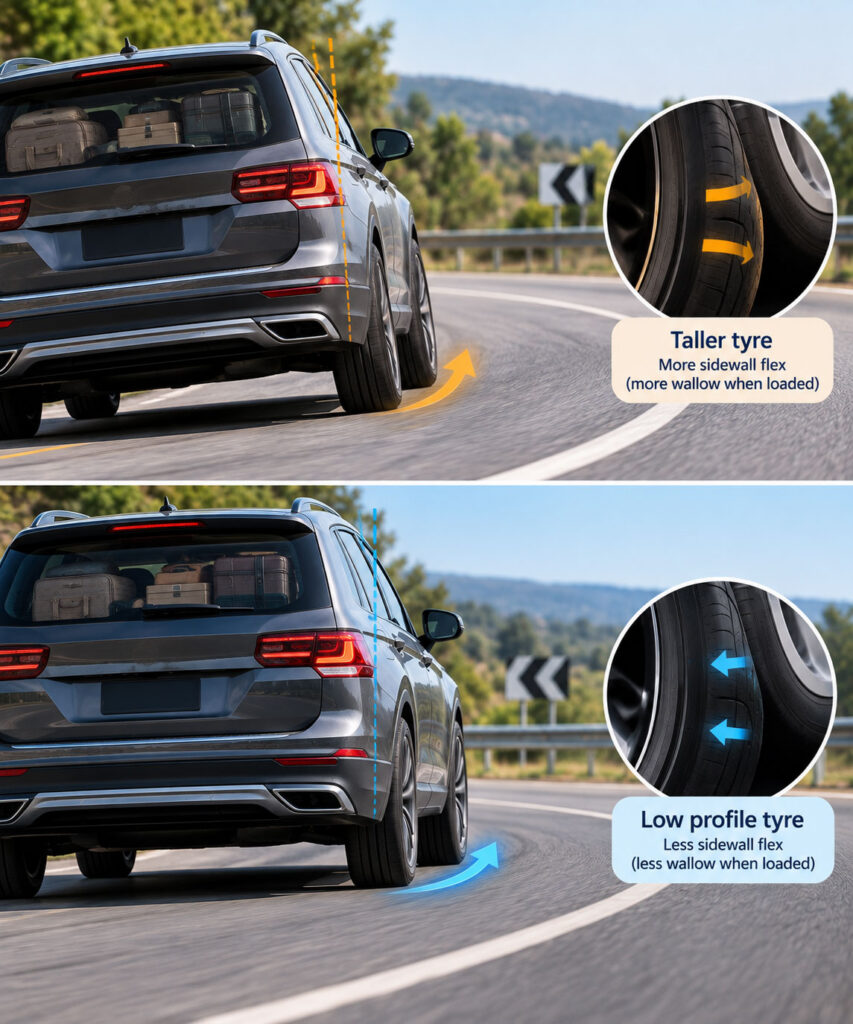
Four adults and a boot full of luggage will squash a tall sidewall and make the car feel vague. A short wall holds its shape, so the car stays more settled on a long run. If you are planning a trip, our checklist for getting tyres ready before a long drive is worth five minutes.
Room for proper brakes
The large wheels that low profile tyres come with allow bigger discs and calipers. On a heavy or quick car, that is a genuine safety benefit rather than a styling one.
The car looks the way it was designed to
This is subjective, but it is not trivial. Designers style a car around its largest wheel option, and the stance is part of what people buy.
What you give up, told straight
Dealers do not tend to dwell on this part. None of it should put you off, but you should know it before you commit to a wheel upgrade or a replacement set.
A firmer, busier ride
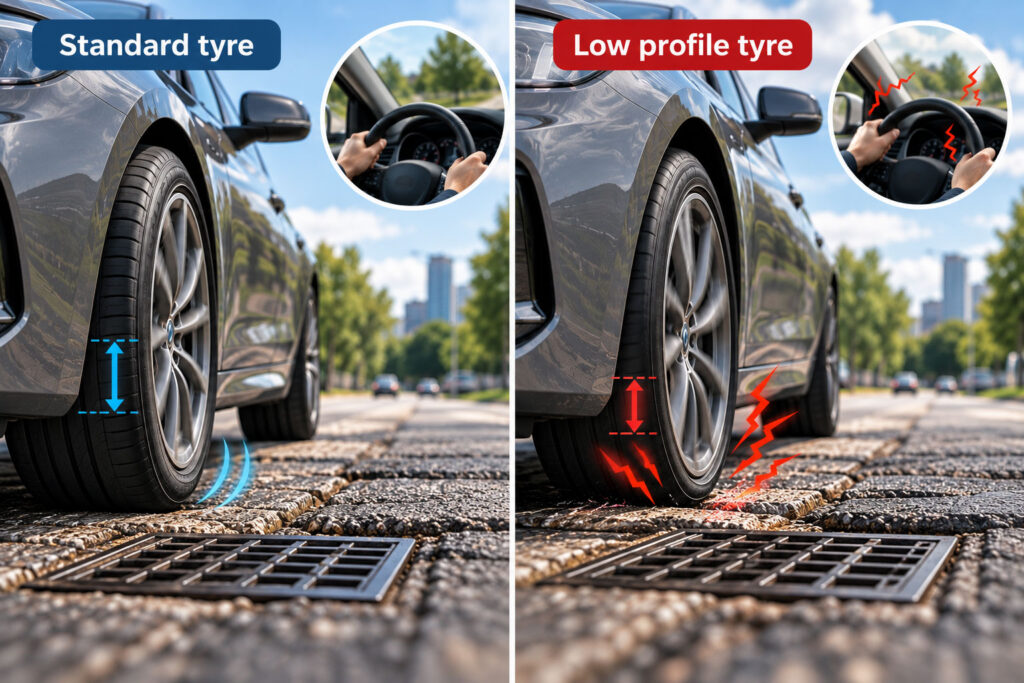
There is simply less rubber to absorb anything. Drain covers, patched trenches and sunken ironwork all come through to the cabin. On a short school run it is barely noticeable. On a two-hour motorway drive over a worn surface, it adds up.
More road noise
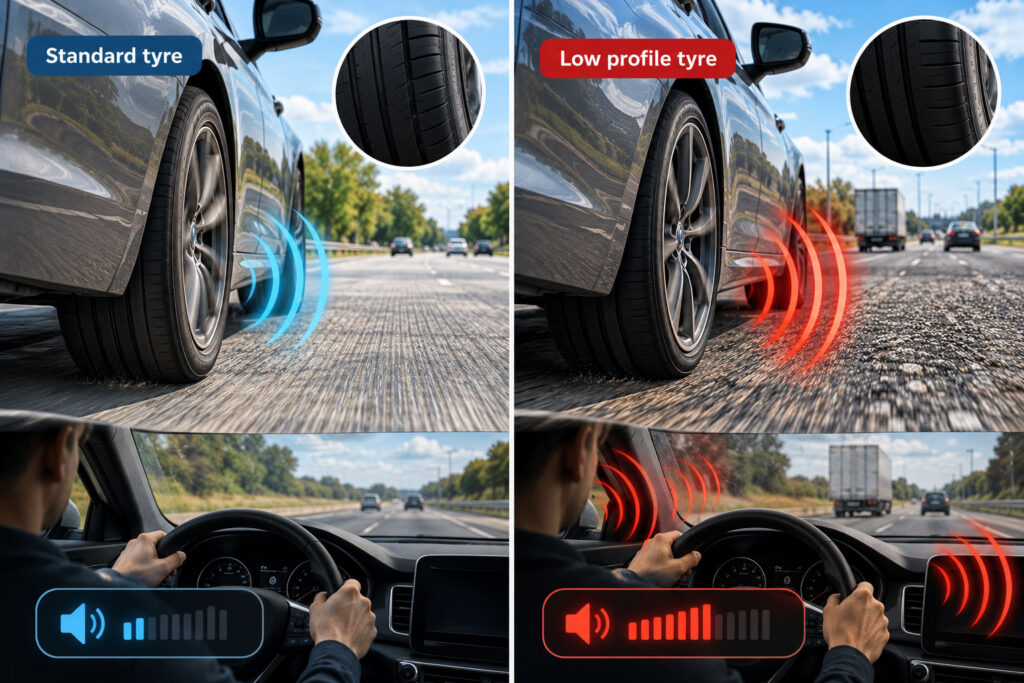
Wider tread blocks and a stiffer wall transmit more sound into the cabin, particularly on coarse concrete and chip-seal surfaces. Tyre choice makes a real difference here — the noise rating on the tyre label is worth reading before you buy.
Potholes and kerbs become expensive
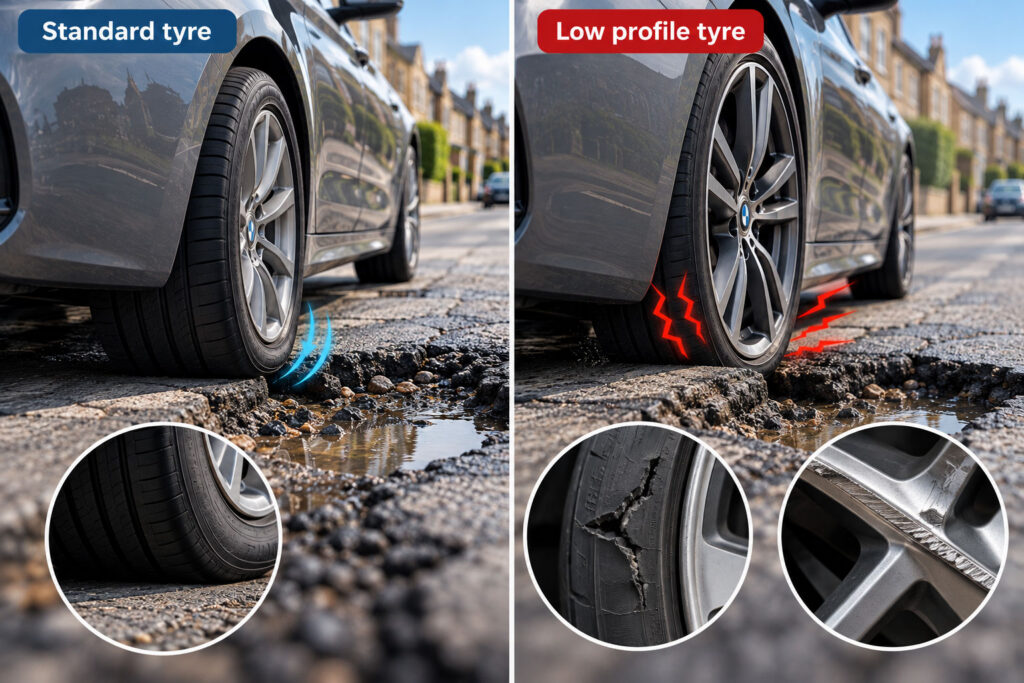
This is the big one in the UK. With a short wall, a sharp pothole edge can reach the rim before the rubber has finished compressing. The result is a split tyre, a buckled alloy, or both at once.
Higher replacement cost
Bigger rim sizes and performance speed ratings cost more to make and sell in smaller volumes. A 20-inch low profile tyre can be two to three times the price of a 16-inch standard one.
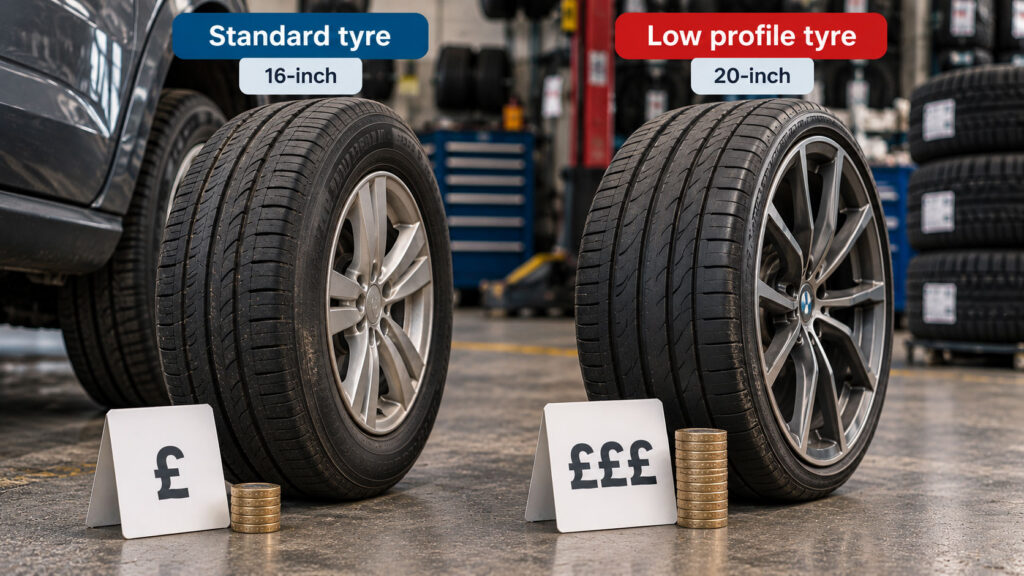
Pressure mistakes punish you faster
A short sidewall holds a smaller air volume, so the same small leak changes the pressure by a larger percentage. Underinflation shows up as uneven wear and poor grip much sooner than it would on a taller tyre.
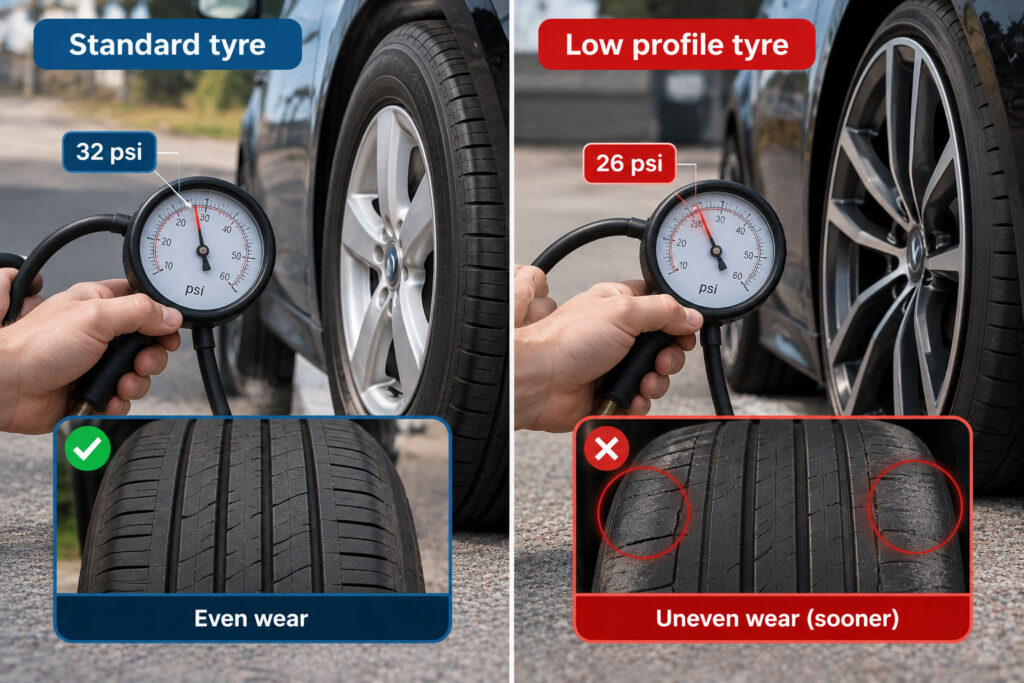
Repairs are refused more often
A puncture in the tread of a low profile tyre can usually be repaired. A puncture or cut anywhere near the shoulder or wall cannot be, because the repair cannot be relied on in an area that flexes under load.
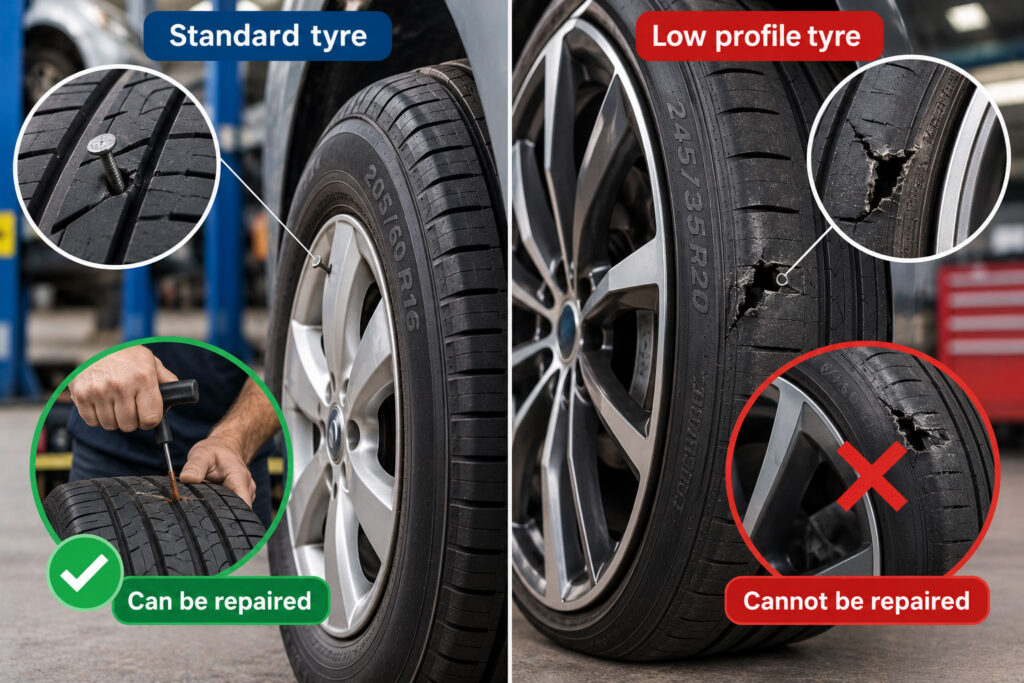
This is not a reason to avoid them
Do low profile tyres wear out faster?
Not because of the profile itself. A short sidewall does not scrub away tread. What actually wears a tyre out is the rubber compound, the alignment, the weight of the car and how it is driven — and low profile tyres happen to score badly on several of those at once.
Soft, grippy compounds are usually paired with low profile sizes because the cars wearing them are quicker. Soft rubber grips better and lasts less. Fit a performance tyre to a heavy car with keen alignment settings and 20,000 miles can disappear quickly.
← swipe the table →
Setup
Typical mileage before replacement
Why
Standard profile, touring compound
25,000–40,000 miles
Harder rubber, lighter loads, gentler use
Low profile, mid-range touring tyre
20,000–30,000 miles
Firmer compound aimed at longevity rather than lap times
Low profile, performance compound
12,000–20,000 miles
Soft rubber tuned for grip; rear tyres on powerful cars go first
Low profile, aggressive alignment or hard driving
8,000–15,000 miles
Camber and enthusiasm both scrub the inner shoulder
These are ranges, not promises. Two identical cars can land at opposite ends of the same row. What matters more is catching wear early, which means checking the tread depth yourself rather than waiting for a dashboard warning that will never come. The 20p coin method and a proper gauge check take a couple of minutes, and the legal minimum of 1.6 mm is a long way past the point where wet grip starts falling off a cliff.
Where to look first on a low profile tyre
Check the inner shoulder — the edge nearest the car. Negative camber, which most performance setups run, wears that edge first and it is the hardest part to see without turning the wheel on full lock. Plenty of tyres are declared legal on the outer edge while the inside is down to the cords. If you want the full picture of what different wear patterns are telling you, this guide to tyre lifespan and wear patterns goes through each one.
One more thing worth saying plainly: a worn low profile tyre is not a candidate for a cheap second-hand replacement. The risks around buying part worn tyres are higher on performance sizes, because the hidden damage that matters most is the kind you cannot see from outside.
Pressure, TPMS, balancing and alignment matter more here
Everything you are supposed to do for any tyre, you need to do more carefully for a low profile one. The margin for error is thinner because the tyre is thinner.
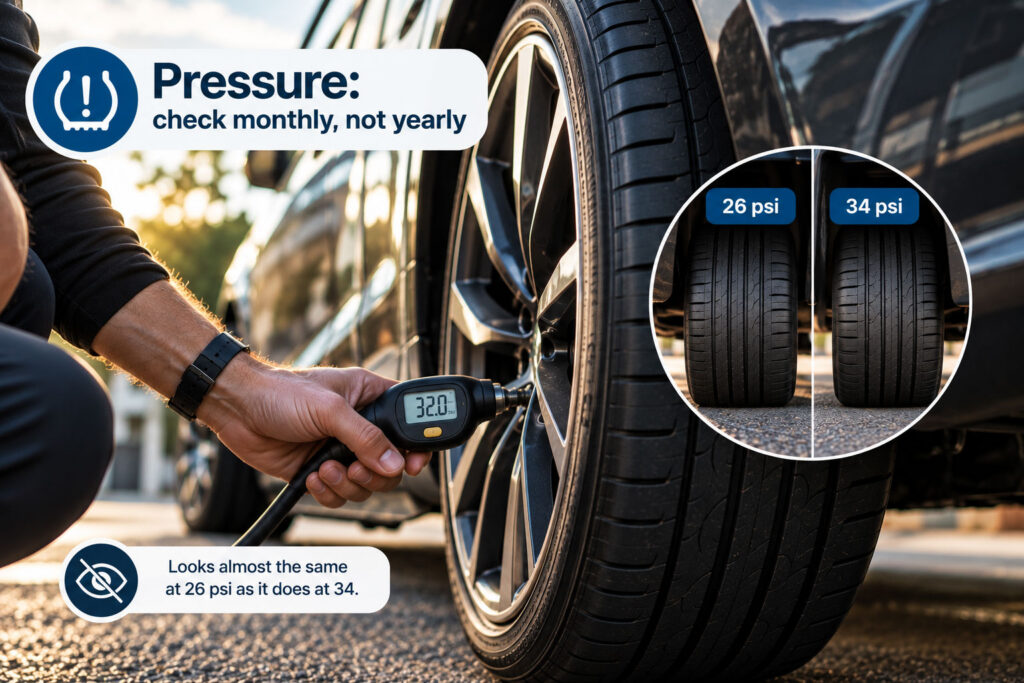
Pressure: check monthly, not yearly
A short sidewall contains less air, so a 4 psi loss is a far bigger proportion of the total than it would be on a tall tyre. You will not spot it by eye either — a low profile tyre looks almost the same at 26 psi as it does at 34. Use a gauge when the tyres are cold, and use the figure on the door shut or in the handbook, not the one moulded on the tyre. Our full tyre pressure guide explains how to adjust for a loaded car.
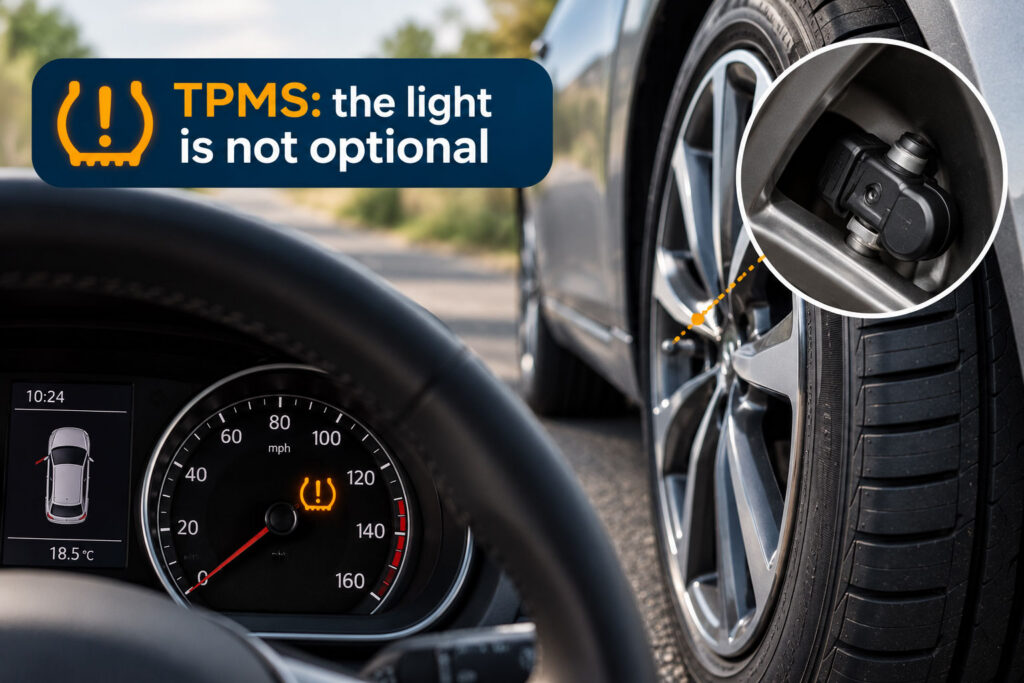
TPMS: the light is not optional
Cars first used from 2012 onward are expected to have a working tyre pressure monitoring system, and an illuminated TPMS warning light is an MOT failure. The sensors live inside the wheel and can be damaged during fitting, so it is worth using a fitter who handles them properly rather than the cheapest option on a comparison site.
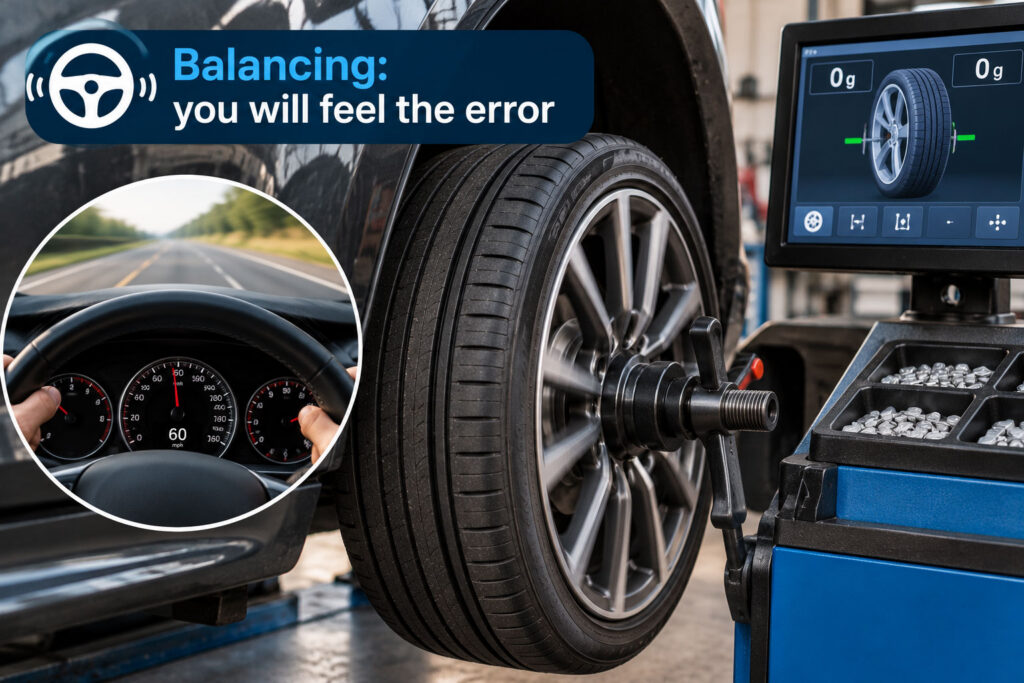
Balancing: you will feel the error
A few grams of imbalance that would go unnoticed on a tall tyre shows up as a steering wheel shimmy at 60 mph on a low profile one. Any new tyre should be balanced as part of fitting, and a wheel that has taken a knock should be rechecked. We cover what the job involves on our wheel balancing and valve replacement page.
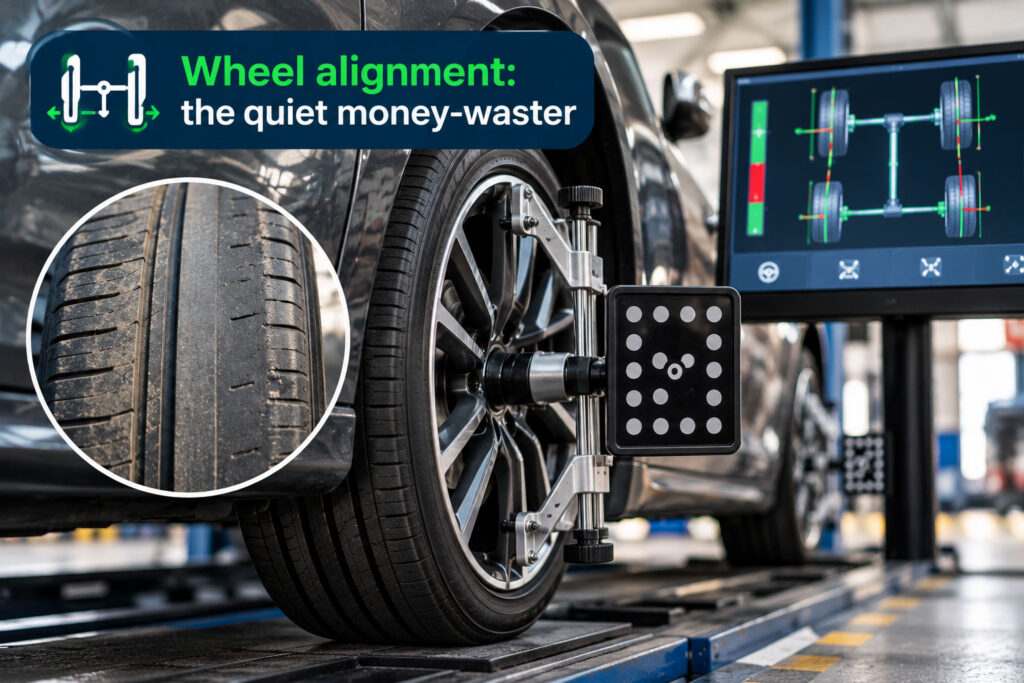
Wheel alignment: the quiet money-waster
Wheel alignment that has drifted out of specification scrubs tread off at a rate that will shock you when the bill arrives, and low profile tyres are expensive enough to make that bill sting. A kerb strike, a deep pothole or new suspension parts are all reasons to have it checked. The symptoms are covered in our guide to spotting alignment problems.
Build the habit
If you would like the wider routine rather than just the low profile specifics, our general tyre maintenance tips pull it together into one list.
Potholes, kerbs and sidewall damage
British roads are the real test for low profile tyres. A pothole that a 65-profile tyre absorbs without complaint can finish a 35-profile one, because the rubber runs out of travel and the rim takes the impact instead.
What a hard impact actually does
The tyre is pinched between the road edge and the wheel rim. That can cut the inner lining where you cannot see it, break the cords inside the wall, or bend the rim flange. Sometimes the tyre deflates straight away. More often it holds air and fails days later at speed, which is the version you do not want.
Check these four things after any big bang
- A bulge or egg shape in the sidewall — broken cords inside. The tyre is finished.
- A cut, gouge or exposed fabric anywhere on the wall — not repairable under any circumstances.
- A flat spot, lip or kink on the rim edge — the wheel may be buckled and will need checking.
- A steering pull or new vibration — balance or alignment has moved, and sometimes both.
Never drive on a sidewall bulge
If you are unsure whether to keep moving, the honest answer depends on the damage, and we have set the cases out in driving on a flat or damaged tyre. For a sudden failure at speed, the steps that actually keep you safe are in our guide to handling a blowout.
Changing one at the roadside is harder than it used to be
Low profile tyres are stiff and tight on the rim, the wheels are heavy, and a lot of modern cars carry a sealant kit instead of a spare — and sealant will not fix a split wall. Even if you are confident with changing a wheel yourself, a missing key stops the job dead, which is why a lost locking wheel nut is worth sorting before you need it. When the wheel cannot come off safely at the roadside, an emergency mobile replacement gets you moving without a recovery truck.
Can you go back to a taller tyre?
Often, yes — and for drivers on poor roads it can be the best money they spend. But it is a wheel decision, not just a tyre decision, and there are rules worth respecting.
Option 1: a taller tyre on the same wheels
This rarely works. Your current wheel has a fixed rim width, and a given rim width only accepts a narrow band of tyre sizes. Going from a 40 to a 55 profile on the same rim usually puts the tyre outside the approved range and changes the rolling diameter too much.
Option 2: smaller wheels with taller tyres
This is the one that works. Drop from 19-inch wheels to 17-inch, and fit a taller tyre so the overall diameter stays close to standard. Many cars have a smaller factory wheel option, which makes this straightforward: find the size the base model uses and fit that.
← swipe the table →
Check before you change
What to aim for
Overall rolling diameter
Within roughly 3% of the original, or the speedometer, ABS and traction control all read incorrectly
Load index
Equal to or higher than the figure your handbook specifies — never lower
Speed rating
Equal to or higher than the original, except where a winter tyre is being fitted
Brake clearance
The smaller wheel must physically clear the caliper. Check before buying
TPMS sensors
Must be transferred or replaced, then relearned, or the dashboard light stays on
Insurance
Declare a wheel size change. Most insurers accept it, but it must be on record
The legal position in the UK
One point people miss: mixing profiles across an axle is a bad idea even when both tyres are legal. The car will brake and corner unevenly, and an MOT tester can fail it for having tyres of significantly different construction on the same axle.
Low profile tyres in winter
Cold weather is where low profile tyres are least comfortable, and it is worth understanding why rather than just accepting it.
Summer and performance compounds harden as the temperature drops. Below about 7°C they stop keying into the road properly, and braking distances stretch. That happens on any tyre, but performance tyres in low profile sizes usually start from a softer, grippier compound, so they lose more when the temperature drops.
The short sidewall adds a second problem. There is less give to let the tread conform to a frozen, rutted or snow-covered surface, so the contact patch works less effectively exactly when you need it.
What to do about it
- Fit winter or all-season tyres in the same size. Low profile winter tyres exist in most common sizes up to about 19 inches.
- Consider a smaller winter wheel and tyre package. A 17-inch winter set on a car that runs 19s in summer gives you more sidewall, better snow performance and cheaper tyres.
- Look for the three-peak mountain snowflake marking. M+S alone is not a tested winter tyre.
- Check pressures more often. Cold air contracts, and a low profile tyre feels the drop sooner.
If you are weighing up a winter set, our winter tyre round-up covers which ones hold up in UK conditions, where the weather is more often cold and wet than deeply snowy.
Which brands do low profile well
Tyre brand matters more at low profile than it does at 65. A short wall gives the engineering less room to hide, so differences in wet braking, noise and wear show up clearly.
How the UK trade sorts brands into tiers
Walk into any fitting centre and the range will be split three ways: premium, mid-range and budget. It is a pricing convention rather than an official standard, but it is a useful shorthand for what you are buying.
← swipe the table →
Tier
What the money buys you
Brands usually placed here
Premium
Wet braking refined over many tyre generations, lower noise, longer tread life, and by far the widest choice of low profile and manufacturer-approved sizes.
Michelin, Continental, Bridgestone, Goodyear, Pirelli, Dunlop
Mid-range
Close to premium behaviour in most everyday sizes, usually giving up a little tread life or refinement. Low profile coverage is good up to about 19 inches.
Hankook, Falken, Toyo, Yokohama, Kumho, Avon
Budget
The lowest price per tyre. Dry grip is normally acceptable; wet braking and how long the tyre lasts are where the saving shows up.
Nankang, Sailun, Rovelo, Landsail, Davanti
Two things worth saying about that table. First, the tiers are a retail convention, so the same brand can be filed differently from one shop to the next — Hankook appears as premium on some sites and mid-range on others, and Vredestein and Nokian sit right on the boundary. Second, and more relevant here: the tier matters more the lower your profile goes. At 65 profile a budget tyre has a tall, forgiving sidewall doing some of the work for it. At 35 there is nothing to hide behind, so a cheap casing shows itself in wet braking and in how badly it copes with a pothole.
The brands worth knowing in low profile sizes
These manufacturers all have credible low profile ranges sold widely in the UK, and each is good at something slightly different.
← swipe the table →
Brand
Known for
Where it fits
Long wear life alongside strong wet performance
Drivers covering high mileage who do not want to replace tyres every other year
Consistently high wet braking scores
A safe default on a family car running 17 to 19-inch wheels
Original equipment on a lot of premium and run-flat applications
Matching what the car was signed off with
Performance sizes and manufacturer-specific homologated fitments
Sports and executive cars carrying a maker’s code on the wall
Strong value in the upper mid-range
Getting close to premium behaviour without the premium price
Strong dry grip and a deep range of wide, large-diameter fitments
Bigger wheels and SUV sizes where choice elsewhere runs thin
The most credible of the budget names, with a real motorsport range
A tight budget where you still want a known quantity
Where your money actually goes
The honest position is that the gap between a premium and a good mid-range tyre is smaller than it used to be, and the gap between a mid-range tyre and a no-name budget one is larger than most people expect — particularly in the wet, and particularly at low profile. If you are working to a figure, the mid-range options worth considering are usually the smarter buy, and we have also looked at which budget tyres are genuinely safe for anyone who needs to spend less. For the wider picture, our overview of tyre brands ranks them by what they are actually good at.
What low profile tyres cost and how to choose
Price climbs steeply with rim size. The figures below are typical UK guide prices per tyre including fitting, to help you budget before you shop — they move with brand, speed rating, stock levels and where you are in the country.
← swipe the table →
Size and profile
Budget
Mid-range
Premium
16–17 inch, 55–50 profile
£50–£75
£75–£105
£100–£150
18 inch, 45–40 profile
£65–£95
£95–£135
£130–£200
19 inch, 40–35 profile
£85–£120
£120–£170
£170–£260
20 inch and above, 35–30 profile
£110–£160
£160–£230
£230–£400+
Guide prices only, correct as a general range for 2026. Run-flat construction and manufacturer-homologated fitments sit above these figures. For what the fitting side of the bill looks like on its own, see our breakdown of mobile tyre fitting costs in the UK.
A five-step way to choose
- Start from the sidewall of the tyre already on the car, not from a website guess. Write the full code down, including XL and the speed rating.
- Decide what you want the tyre to be good at. Quiet motorway miles and long life pull you one way; dry grip and sharp steering pull you the other. Very few tyres do both.
- Read the tyre label. Wet grip is graded A to E, and on a low profile tyre that grade is the one worth paying for.
- Check the manufacturer code if your car has one — markings such as MO, AO, * or N0 mean the tyre was tuned for that model. Matching it keeps the car behaving as designed.
- Buy in pairs where you can, same axle, same model of tyre. Mixed pairs on low profile sizes are felt immediately.
If cost is the deciding factor, it is worth looking at lower-cost fitting options before you compromise on the tyre itself. Saving money on the fitting is sensible. Saving it on wet grip is not.
Getting low profile tyres fitted without the hassle
Low profile tyres are harder to handle than ordinary ones. The sidewalls are stiff, the wheels are heavy and easy to mark, and the TPMS sensor inside the rim is easy to damage if the machine is used carelessly. It is a job worth doing properly, and it does not need to involve a trip to a garage.
The Mobile Tyre Fitter comes to you — at home, at work, or at the roadside — with the equipment to fit and balance low profile sizes on site. If you have already bought your tyres, we will fit them. If you have not, we carry stock across the main brands in common low profile sizes at prices that stand up against the high street, so you can sort the whole thing in one visit instead of two.
- Fitting on your driveway while the car sits where it normally does
- Same-day appointments when a tyre has failed and you still need the car
- Next-day slots when the job can wait until morning
- Roadside callouts for a pothole split or blowout away from home
We work across most of the country — you can check whether we reach you on our service areas page. If you already know the size you need, or you have the code off the sidewall and want a straight answer on price and availability, get in touch with our team and we will tell you what we have in stock.
One stop, start to finish
Low profile tyres: frequently asked questions
Short, direct answers to the questions UK drivers ask most about low profile tyres.
It means the tyre has a short sidewall. The sidewall height is written into the tyre size as a percentage of the tyre’s width, so on a 225/40 R18 the wall stands at 40% of 225 mm, which is 90 mm. The lower that percentage, the less rubber there is between the wheel rim and the road, and the more direct the car feels.
Yes. Anything at 55 or below is generally treated as low profile in the UK, so 45 sits comfortably inside that range. It is one of the most common sizes on modern family and executive cars running 17 and 18-inch alloys, and it is usually regarded as the sweet spot between a sharp drive and a ride you can live with.
Almost always. They come in larger rim sizes, carry higher speed ratings and sell in smaller volumes than standard sizes, which pushes the price up. The step from an 18-inch tyre to a 20-inch one is usually bigger than people expect, so it is worth pricing a replacement set before choosing a larger wheel option on a new car.
They do not damage the wheel themselves, but they protect it far less. A taller tyre bulges out past the rim and takes the hit when you brush a kerb. A low profile tyre leaves the rim edge exposed, so kerbing and pothole impacts transfer straight into the alloy, which is why buckled and scuffed rims are more common on cars running them.
Usually a little, though the effect is small. They tend to be wider and use grippier compounds, which raises rolling resistance. The fuel efficiency grade on the tyre label is the useful number here, and choosing a well-rated tyre in your size matters more than the profile itself.
The short sidewall does not cause wear on its own. What shortens their life is the company they keep: softer performance compounds, heavier and faster cars, and keener alignment settings. A touring tyre in a low profile size can last 25,000 miles, while a performance tyre on the same car might manage half that.
If the puncture is in the central tread area and the tyre has not been driven on while flat, a professional repair is usually possible. Damage on the shoulder or sidewall cannot be repaired, because that part of the tyre flexes constantly under load and no repair can be relied on there. Low profile tyres pick up more sidewall damage, so refusals are more common.
They are at their weakest in the cold. Performance compounds harden below about 7 degrees, and the short wall gives the tread less room to conform to a frozen or snowy surface. Fitting winter or all-season tyres in the same size solves most of it, and a smaller winter wheel package solves the rest.
They use the pressure your vehicle manufacturer specifies, which is on the door shut or in the handbook, not a different one because the tyre is low profile. What changes is how closely you need to watch it. A short sidewall holds less air, so a small loss moves the pressure by a larger percentage and does more harm before you notice.
Because the tyres that came with the bigger wheels will have a shorter sidewall to keep the overall diameter the same. That cushion is what used to absorb ridges, joints and drain covers. Nothing is wrong with the car. Dropping back to a smaller wheel with a taller tyre reverses it if the ride matters more to you than the look.
Yes, entirely, provided the tyre is the correct size for the vehicle, meets or exceeds the load index and speed rating the manufacturer specifies, is in sound condition and has at least 1.6 mm of tread across the central three-quarters of the tread around its whole circumference. Below that limit the penalty is a fine of up to 2,500 pounds and three penalty points for each illegal tyre.
Not on the same wheels, in most cases. A rim only accepts a narrow band of tyre sizes, and a much taller tyre will usually fall outside the approved range and change the rolling diameter enough to upset the speedometer and the electronic systems. The workable route is a smaller diameter wheel with a taller tyre, keeping the overall diameter within about 3% of standard.