Nitrogen vs Air in Tyres: What Actually Changes Inside Your Wheels?
You book a tyre change, the fitter finishes the job, and then comes the question: would you like it filled with nitrogen for a few pounds more? It sounds technical enough to be important, so most drivers say yes without really knowing what they are buying.
Here is the short answer. Nitrogen does hold pressure slightly better than ordinary compressed air, but the gap is far smaller than the sales pitch suggests, and it does nothing whatsoever for a tyre that nobody checks for six months. The gas is a minor upgrade. The habit of checking pressure is the real one.
This guide walks through the nitrogen vs air in tyres question the way a UK driver actually meets it: what the two gases do differently, what the testing shows, when nitrogen tyre inflation is genuinely worth the money, and what you should spend your attention on instead.
What this guide covers:
- What is already inside your tyres
- Nitrogen vs air side by side comparison
- Does nitrogen hold pressure longer?
- Cold mornings and hot motorways
- The sales claims, checked
- How to tell which gas is in your tyres
- When nitrogen is worth paying for
- The everyday drawbacks
- Can you mix air and nitrogen?
- What matters far more than the gas
- Quick decision guide
What Is Already Inside Your Tyres Right Now?
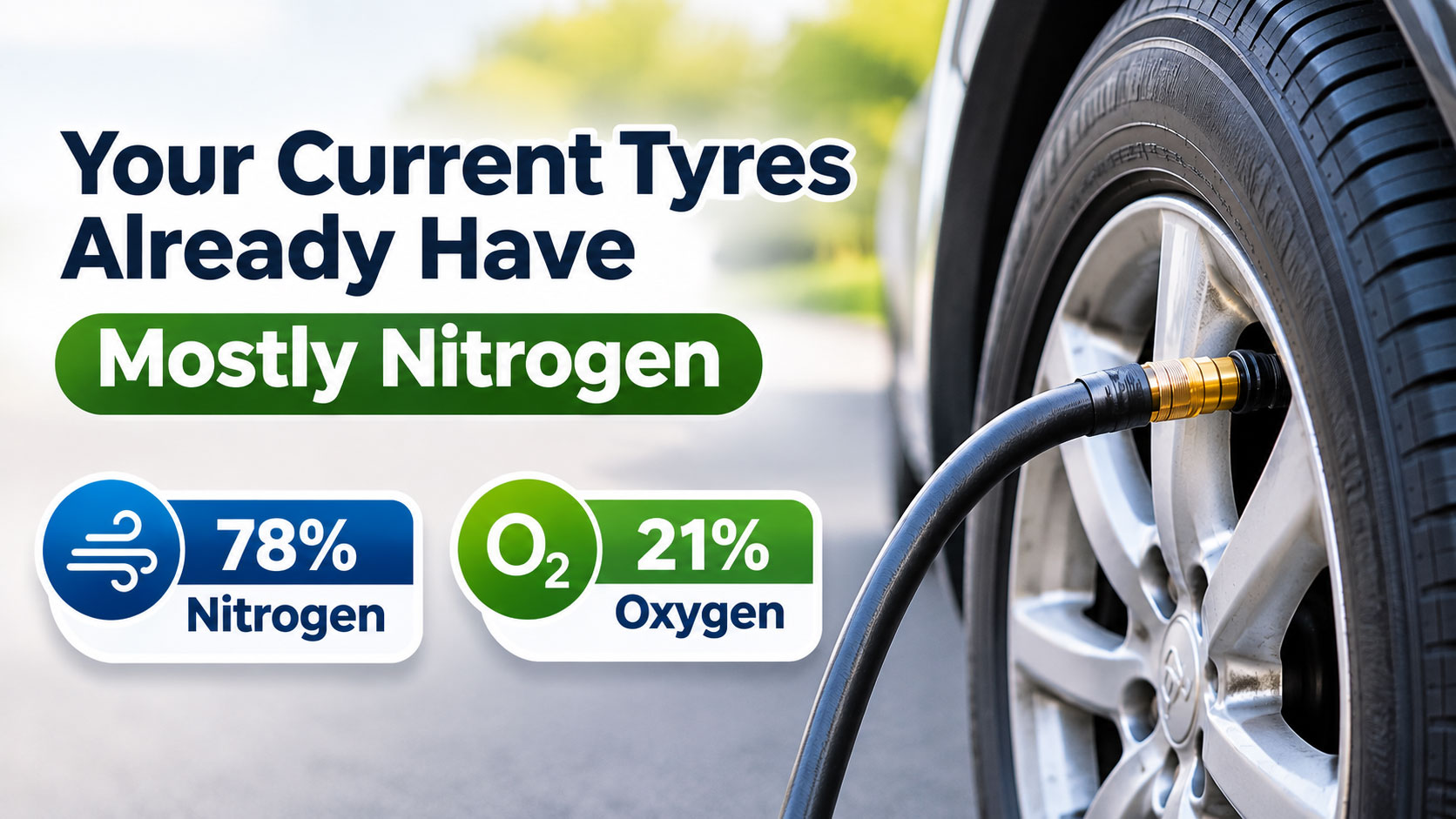
Ordinary compressed air is already mostly nitrogen. Dry air is roughly 78% nitrogen and 21% oxygen, with the last 1% made up of argon, carbon dioxide and whatever water vapour the compressor picked up along the way.
Nitrogen vs Air in Tyres: Side-by-Side Comparison
Put the two inflation gases next to each other and the pattern is easy to see. Nitrogen wins on paper in a couple of places, air wins on everything practical.
What drivers ask about
Compressed air
Nitrogen (93–95%)
Pressure held over a year
Around 3.5 psi lost from a 30 psi start in testing
Around 2.2 psi lost over the same year
Topping up
Any forecourt, any home compressor, free or pennies
Needs a garage with a nitrogen rig on site
Moisture in the tyre
Some water vapour comes in from the compressor
Dried out during the filling process
Effect on fuel use
Comes down to correct pressure, not the gas
No measurable gain in independent testing
Typical UK cost
Free or small change at a forecourt
A few pounds per tyre, each time
Monthly pressure checks
Still required
Still required
The Short Version
If you top up at supermarkets and petrol stations, air is the sensible choice. If a garage includes a nitrogen fill with the fitting at no extra charge, take it, because there is no downside to the gas itself.
Does Nitrogen Really Hold Pressure for Longer?
Yes, but by a margin most drivers would struggle to notice.
In a twelve-month test run by Consumer Reports, pairs of tyres were set to 30 psi and left outdoors. The air-filled tyres lost an average of 3.5 psi over the year. The nitrogen-filled tyres lost 2.2 psi. That is a difference of 1.3 psi across twelve months, or roughly a tenth of a psi a month.
Laboratory work at Clemson University found nitrogen held pressure some 35–55% better at room temperature. That sounds dramatic until you remember it is a large percentage of a very small number. Every tyre in both studies still lost pressure.
Measure
Compressed air
Nitrogen fill
Starting pressure
30.0 psi
30.0 psi
Pressure after 12 months
26.5 psi
27.8 psi
Total lost over the year
3.5 psi
2.2 psi
Average loss per month
About 0.3 psi
About 0.2 psi
The Part That Matters
Plenty of cars on UK roads are running 5 or 6 psi below the figure on the door placard. No inflation gas rescues that. A two-minute check with a gauge does. If you want the numbers for your own vehicle and how load changes them, our guide to correct tyre pressure sets it out.
Cold Mornings, Hot Motorways: Does Nitrogen Hold Steadier?
A common claim is that nitrogen-filled tyres do not expand when they heat up. That is not how gases work. Nitrogen and air both follow the same physics, and as a rough guide pressure shifts by about 1 psi for every 10°C change in temperature, whichever gas is inside.
The One Real Advantage: Dry Gas
Where nitrogen has a genuine edge is moisture. Compressed air carries water vapour, and water vapour behaves far less predictably than dry gas as the tyre warms up on a motorway run. Nitrogen rigs strip that moisture out, which is why Continental explains nitrogen as a gas that does not support moisture or combustion. On a road car the effect is small. On a race car doing repeated hot laps, it is worth having.
What This Means Through a British Winter
Pressures fall as the weather turns, and a tyre set in August can be noticeably soft by December on air or nitrogen alike. Check more often once the mornings turn frosty, especially if you have fitted cold weather tyres for the season.
Worth knowing: Nitrogen does not stop winter pressure drop. It only slows the slow leak that happens alongside it.
About Nitrogen Claims, Checked One by One
Most of the nitrogen pitch is built on claims that are half true. Here is what survives scrutiny and what does not.
The claim
What testing actually shows
What to do instead
“Nitrogen stops pressure loss”
Both gases escape through rubber and valves; nitrogen is only marginally slower
Carry on checking monthly
“You will use less fuel”
No measurable change in rolling resistance was found; pressure is what moves fuel use
Set pressures to the door placard figure
“Your tyres will last years longer”
Oxidation slows, but wear, kerbing and age finish a tyre long before that matters
Watch tread depth and tyre age
“Rims will not corrode”
Less oxygen and water helps at the margins, nothing more
Replace the valve with every new tyre
“Green caps mean nitrogen”
A cap is a cap; it proves nothing about what is in the tyre
Ask what purity the machine reached
The Fuel Saving Claim Deserves a Closer Look
Under-inflated tyres really do cost you money at the pump, so the logic is sound as far as it goes: better pressure, better economy. The flaw is the assumption that nitrogen is what keeps pressure correct. A gauge does that. We have broken down how much tyre pressure affects fuel consumption if you want the detail.
And the Longevity Claim
Oxygen does slowly oxidise rubber from the inside out. In practice, tread wear, sidewall damage and the simple passage of time retire almost every tyre first, which is the pattern we see in how long tyres realistically last.
How Can You Tell If Your Tyres Have Nitrogen or Normal Air?
There is no test you can do on the driveway. Nitrogen is colourless, odourless and behaves almost identically to air at the valve, so pressure readings, the sound of the air escaping and the way the tyre feels tell you nothing at all.
The only definitive answer comes from a nitrogen purity analyser, a handheld tool most tyre centres keep on the bench. It measures the oxygen content in the tyre in a few seconds: around 21% oxygen means ordinary compressed air, under about 7% means a genuine nitrogen fill.
How people check
What it really tells you
Reliable?
Green valve caps
Only that someone fitted green caps; they are sold by the bag and get swapped at every tyre change
No
N2 sticker on the door jamb or rim
That a nitrogen fill happened at some point, not what is in there today
Weak
Pressure holding well between checks
Good valves and a clean rim seal, which has nothing to do with the gas
No
The fitting invoice or service record
Whether you were charged for nitrogen, and when
Good
Asking the garage that last fitted the tyres
What they put in and the purity the machine reached
Good
Nitrogen purity analyser at a tyre centre
The actual oxygen percentage inside the tyre right now
Definitive
Why the Answer Often Stops Mattering
Even a confirmed nitrogen fill drifts back towards ordinary air over time. Every forecourt top-up pulls the purity down, and once it falls much below 93% the small advantage you paid for has largely gone. A tyre filled with nitrogen eighteen months and three top-ups ago is, for practical purposes, running on air.
Worth knowing: If you cannot remember whether your tyres were filled with nitrogen, that is your answer in itself: check the pressure and top up with whatever is to hand.
When Nitrogen Is Genuinely Worth Paying For
Nitrogen is not a con. It is standard in aviation and motorsport for solid reasons, including extreme heat, fire risk and the need for pressures that behave predictably under punishment. The question is whether nitrogen in car tyres solves a problem your own vehicle actually has.

Situation
Why nitrogen helps there
Worth the money?
Aircraft and motorsport
No moisture, no combustion support, stable pressure under extreme heat
Essential
HGV, coach and large van fleets
Fewer top-ups across dozens of wheels, slower casing oxidation
Often yes
Classics, caravans or cars laid up for months
Less to do when the vehicle comes back out
Reasonable
Low profile or large diameter wheels
Small air volume means every psi counts more
Nice to have
An everyday car, van or SUV driven weekly
The gain is a fraction of a psi a month
Only if free
Vehicles Where Pressure Discipline Matters Most
Some tyres punish low pressure harder than others. Low profile tyres hold less air to begin with, so a small loss shows up sooner. Heavier vehicles do the same: tyres built for electric cars carry significant extra weight, and 4×4 and SUV tyres are often run at higher pressures when loaded or towing. On all of them the answer is the same, and it is a gauge rather than a gas.
The Everyday Drawbacks for UK Drivers
The practical problems with nitrogen have nothing to do with the chemistry and everything to do with daily life.
- Top-ups are awkward. Air is on every forecourt. Nitrogen is only where a rig is installed, which usually means driving back to the same garage.
- Purity dilutes fast. One regular air top-up drops you well below the 93–95% the fill started at, taking most of the pressure retention you paid for with it.
- You pay again each time. A few pounds per tyre adds up across four wheels and several visits a year.
- It is no help at the kerbside. When a tyre goes down on a slip road, nobody is hunting for nitrogen. Getting the wheel off the road safely is the only priority.
- It breeds complacency. The worst outcome is a driver who believes the tyres now look after themselves and stops checking altogether.
That last point is the one that actually causes harm. Pressure that drifts low unnoticed is how sidewalls overheat, and driving on a deflated tyre ruins the casing within a few hundred metres. If it happens away from home, roadside tyre fitting is quicker than limping anywhere on a flat.
Can You Put Normal Air in Nitrogen-Filled Tyres?
Yes, and you should, if the pressure is low. Air and nitrogen mix freely, there is no chemical reaction, nothing is damaged and no warranty is affected. Remember that the tyre was already full of 78% nitrogen before anyone sold you an upgrade.
The Rule Worth Remembering
Correct pressure with ordinary air beats low pressure with pure nitrogen every single time. If the gauge says the tyre is soft, fill it with whatever is available and move on.
All that happens is the purity falls. If you want the nitrogen content back up afterwards, a garage can purge and refill it, though for most drivers that is money chasing a fraction of a psi.
What Matters Far More Than the Gas in Your Tyres
If the nitrogen debate has your attention, aim it at the things that genuinely change how a tyre behaves.
- Use the vehicle figure, not a guess. The placard inside the driver’s door or the handbook gives laden and unladen pressures. Getting those numbers right outranks every other decision here.
- Check cold, not warm. Pressure reads high on a hot tyre, so a reading taken after a long run tempts you into letting good air out. Michelin advises checking monthly and before any long journey, with the tyres cold.
- Trust a proper gauge. Forecourt machines are often out of calibration. A decent handheld gauge is inexpensive and settles the argument.
- Look after the valves. A perished valve or missing cap undoes any inflation gas. Valve replacement and wheel balancing belong with every new tyre.
- Watch the tread. The UK legal minimum is 1.6mm, and wet braking falls away well before that. Here is how to check tread depth with nothing more than a 20p coin.
- Fix uneven wear early. Pulling, feathered edges or a crooked steering wheel usually mean the alignment needs attention rather than new tyres.
- Replace sensibly. There are good reasons to change tyres in pairs across an axle instead of one at a time.
- Build the habit. A handful of simple tyre maintenance routines will save you more money than any gas upgrade.
A Five-Minute Monthly Routine
- Check all four tyres cold, first thing, before you drive
- Add the spare, or check the inflation kit if your car carries one instead
- Set each tyre to the placard figure for the load you are carrying
- Run your hand over the tread for uneven wear, and look for cuts or bulges
- Refit every valve cap properly before you put the gauge away
Doing that before a holiday run matters even more, which is why we put together a short checklist on preparing tyres for a long drive.
Nitrogen vs Air: A Quick Decision Guide
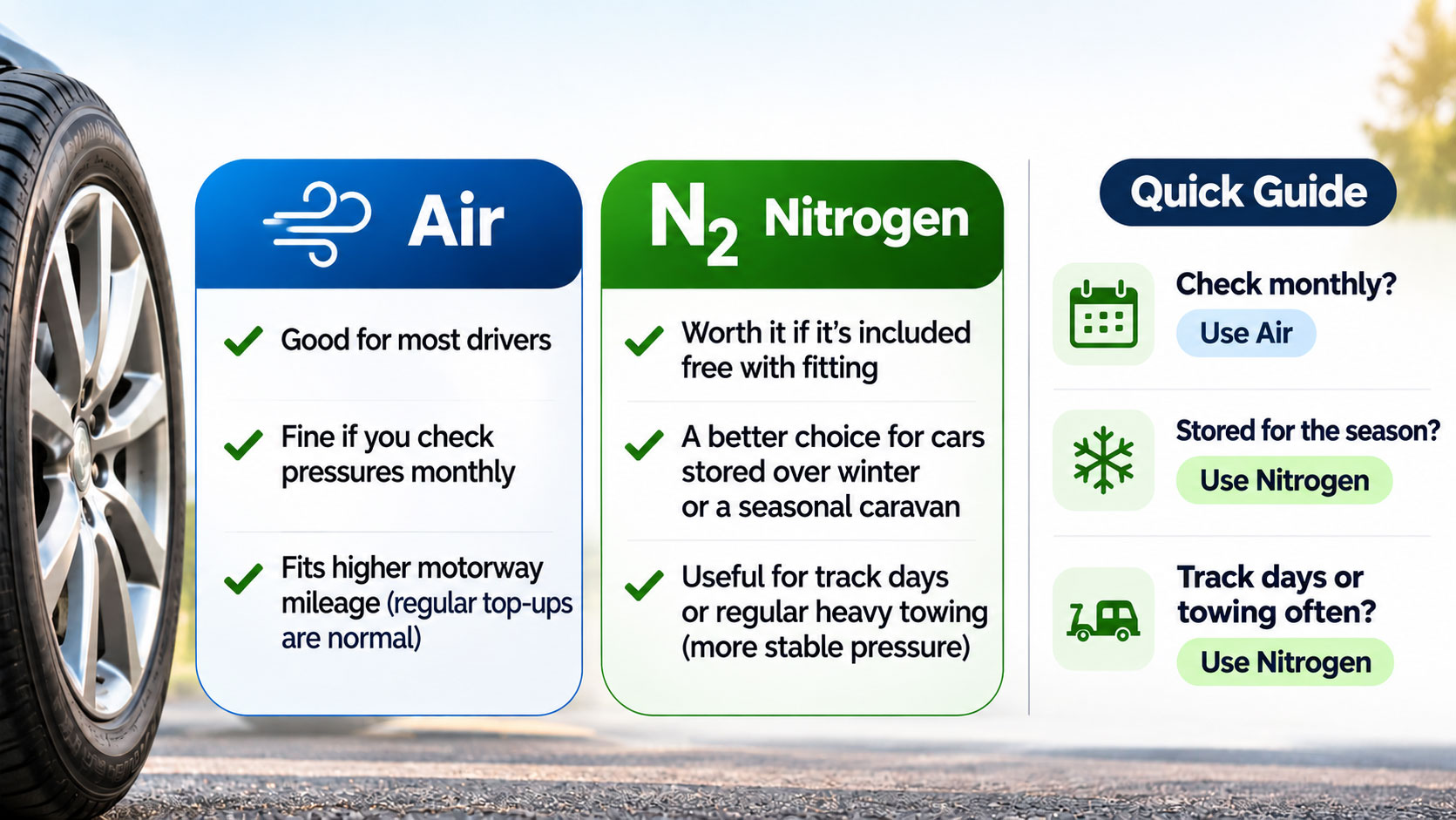
Find your situation in the left-hand column and the answer is in the next two.
Your situation
Better choice
Why
You check pressures every month
Air
The difference is a fraction of a psi
Nitrogen is included free with the fitting
Nitrogen
No downside when it costs nothing
Car stored over winter or a seasonal caravan
Nitrogen
Fewer top-ups, drier gas in the casing
You rarely check pressures at all
Either, but fix the habit
No gas replaces a gauge
High motorway mileage every week
Air
You will top up more often than purity survives
Track days or regular heavy towing
Nitrogen
More predictable pressures when hot
In One Line
For the best value, pay for good tyres fitted properly and keep them at the right pressure. The gas inside is the least important decision you will make about them.
Mistakes That Cost More Than the Gas Ever Will
These are the habits that actually shorten tyre life and put drivers on the hard shoulder.
- Letting air out of hot tyres. The reading is high because the tyre is warm, not because it is over-inflated.
- Topping up only the one that looks soft. Pressures should be set across the axle so the car brakes evenly.
- Ignoring the TPMS warning. The light is telling you something a glance cannot. It matters even more on run-flat tyres, which hide pressure loss by design.
- Forgetting the spare. A spare at 12 psi is no spare at all when you finally need it.
- Driving on to “get home”. A deflated tyre destroys itself quickly, and a sudden failure at speed is a different problem again, as our guide to a tyre blowout explains.
- Assuming nitrogen bought you time. It bought you about a tenth of a psi a month.
Key Takeaways
- Ordinary compressed air is already about 78% nitrogen, so a nitrogen fill changes roughly the last fifth of the mix
- Garage nitrogen reaches 93–95% purity, not 100%
- Testing shows nitrogen-filled tyres lost 2.2 psi over a year against 3.5 psi for air, a difference of 1.3 psi
- Neither gas removes the need for a monthly pressure check
- Fuel savings and dramatically longer tyre life have not stood up in independent testing
- Nitrogen earns its place in aviation, motorsport, large fleets and vehicles left standing for months
- Mixing air into a nitrogen-filled tyre is completely safe, and correct pressure always wins
- Valves, tread depth, alignment and load-correct pressures do far more for safety than the inflation gas
If You Remember Nothing Else
A tyre at the right pressure on ordinary air is safer than a soft tyre on pure nitrogen. Buy the gauge, not the upgrade.
Final Thoughts
Nitrogen tyre inflation is a small, real improvement sold as a large one. If it comes free with a fitting, enjoy it. If it costs several pounds a wheel every visit, that money is better spent on a reliable gauge and a reminder in your phone.
Keep the tyres you already have at the correct pressure and they will give you everything they were built to give. When one is worn past its best, damaged or simply too old to trust, The Mobile Tyre Fitter comes to you: we fit and balance at your home or workplace, offer same-day fitting where the schedule allows, and cover most of the UK.
We hold the major brands in stock at competitive prices, so if you are not certain which size, speed rating or pattern your car needs, contact our support team with the numbers from your sidewall and we will sort it in one visit. You can also check our mobile tyre fitting costs or compare mid-range tyre options before you decide. One stop, tyre fitted, job done.
Frequently Asked Questions
Slightly, on paper. Nitrogen escapes through the rubber a little more slowly and carries no moisture. In testing the difference came to about 1.3 psi over a whole year, which is far less than most drivers lose by never checking their pressures.
It leaks away gradually, just like air. Tyres filled to 30 psi lost roughly 2.2 psi over twelve months on nitrogen against 3.5 psi on air. Purity also falls every time you top up with ordinary air, so treat a nitrogen fill as a head start rather than a seal.
Yes. The two mix freely, nothing reacts and no damage is done. Your tyre was already around three-quarters nitrogen before the fill. If the pressure is low, top it up with whatever is available.
Not directly. Independent testing found no meaningful change in rolling resistance. What does cut fuel use is keeping every tyre at the pressure the vehicle manufacturer specifies, whichever gas is inside.
Absolutely. Tyre makers are clear on this point: nitrogen does not remove the need for regular checks. Valves, rim seals and road damage all leak regardless of the gas, so check monthly and before long journeys.
For most UK drivers, no. The gain is a fraction of a psi each month and it disappears the first time you use a forecourt air line. Take it if a garage includes it at no charge, and skip it if you are paying per wheel every visit.
Not reliably. Green caps are a workshop marker, nothing more, and they can be fitted to any tyre. The only way to know is to ask what purity the machine achieved at the time of filling.
No. All gases contract as temperature falls, so pressure drops by roughly 1 psi for every 10°C with nitrogen or air. Cold snaps are exactly when a monthly check pays for itself.