Understand When You Need a Wheel Alignment?
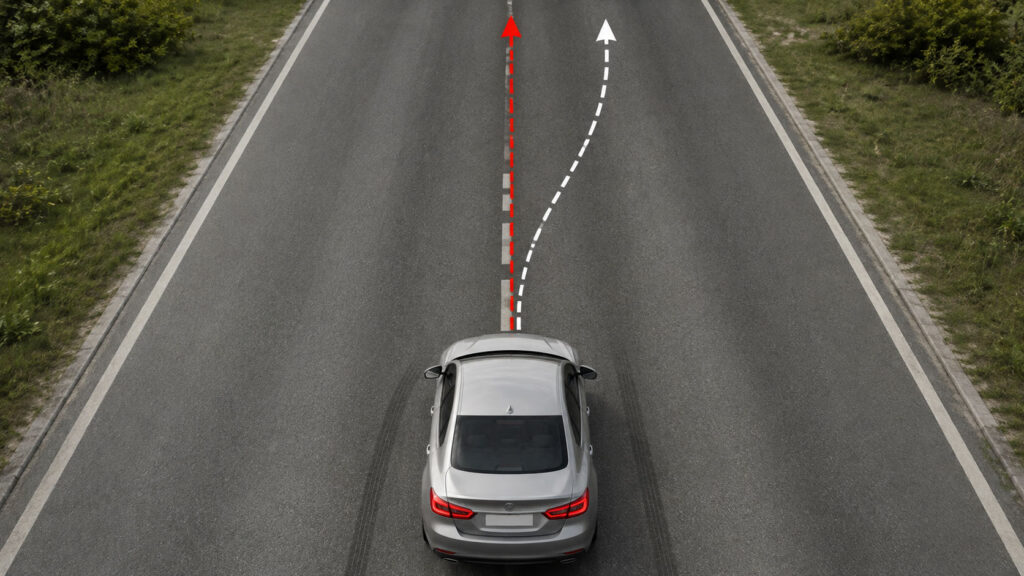
Your car will never put a warning light on the dash for this one. There is no beep, no message, no amber symbol. When the wheel alignment drifts out of shape, the car simply starts behaving a little differently – a gentle tug to the left on a straight road, a steering wheel that sits slightly crooked, one front tyre wearing thin along its inside edge while the other three look fine.
Most drivers live with those hints for weeks or months. The car still drives, still passes the school run, still gets to work. By the time somebody points at the tyres, the rubber has already paid the price – and rubber does not grow back.
That is the annoying part of misalignment. The fix is quick and inexpensive. The waiting is what turns it into a set of new tyres.
The Short Answer
You most likely need a wheel alignment if your car pulls to one side on a flat, straight road, your steering wheel sits off centre while you are driving straight ahead, your tyres are wearing unevenly across the tread, or the steering feels vague and slow to come back to centre after a turn. One of those on its own is worth a check. Two or more together makes wheel misalignment very likely.
This guide walks through every symptom worth taking seriously, shows you three checks you can run on your own driveway before spending anything, explains what knocks the geometry out in the first place, and tells you when the problem stops being a nuisance and starts being a safety issue.
Here’s what this guide covers:
- Ten signs your wheel alignment has drifted
- Three checks you can do on your own driveway
- Reading tyre wear patterns
- What knocks the alignment out
- Alignment, tracking and balancing explained
- Two-wheel or four-wheel alignment?
- How often to get the alignment checked
- What a wheel alignment costs in the UK
- What happens if you ignore it
- How your tyre brand affects the wear
- When to stop driving and get help
- Your 60-second alignment checklist
10 Signs Your Wheel Alignment Has Drifted
The signs you need a wheel alignment are all things you can feel through the car or see on the rubber. Wheel alignment – the trade also calls it tracking or suspension geometry – is the set of angles that decide how your tyres meet the road. When those angles slip out of the manufacturer’s specification, the car starts scrubbing rubber sideways instead of rolling cleanly. Here is how that feels from the driver’s seat.
1. The car pulls to one side on a straight road
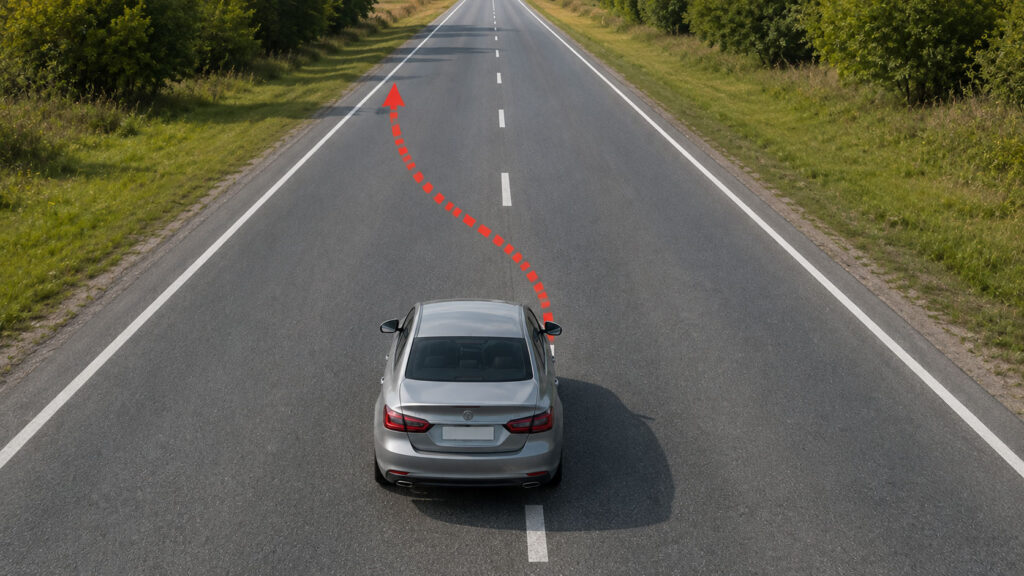
This is the classic symptom of bad wheel alignment and the one drivers report most. Find a quiet, level, straight stretch of road, get to a steady 30–40 mph, and briefly loosen your grip so the wheel is resting in your hands rather than being held. A healthy car tracks straight or drifts very gently.
Bear in mind that most UK roads are built with a slight camber so rainwater runs off to the kerb, which nudges every car a touch to the left. A soft, slow drift is normal. A firm, confident pull that has you steering against it the whole time is not.
2. The steering wheel sits off centre
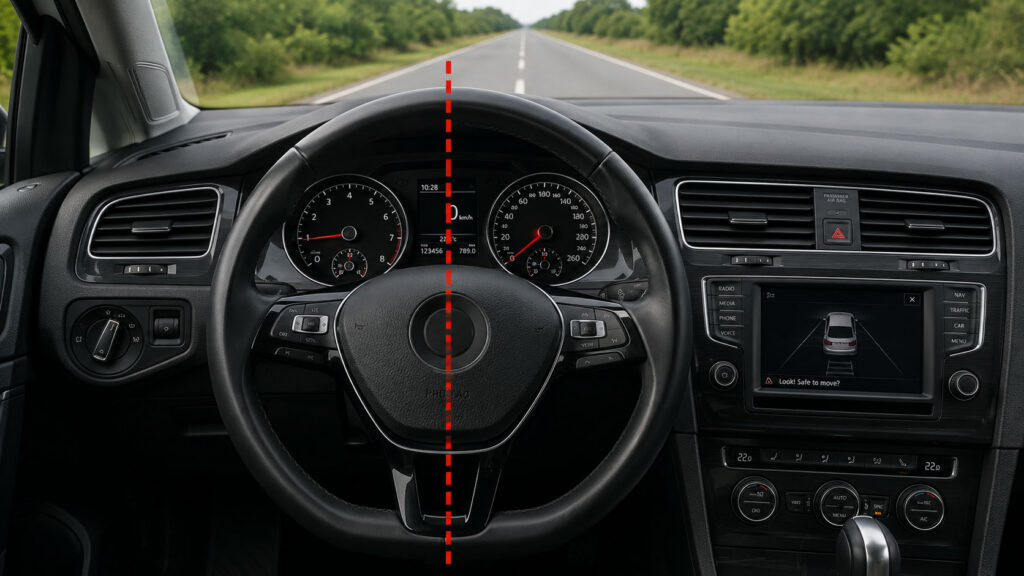
Drive straight and look down at the badge in the middle of your steering wheel. It should sit level. If the badge is tilted – even by ten or fifteen degrees – while the car is travelling in a straight line, the front toe setting has moved. A crooked steering wheel almost never fixes itself, and it is one of the clearest signs that you need a wheel alignment check.
3. Your tyres are wearing unevenly
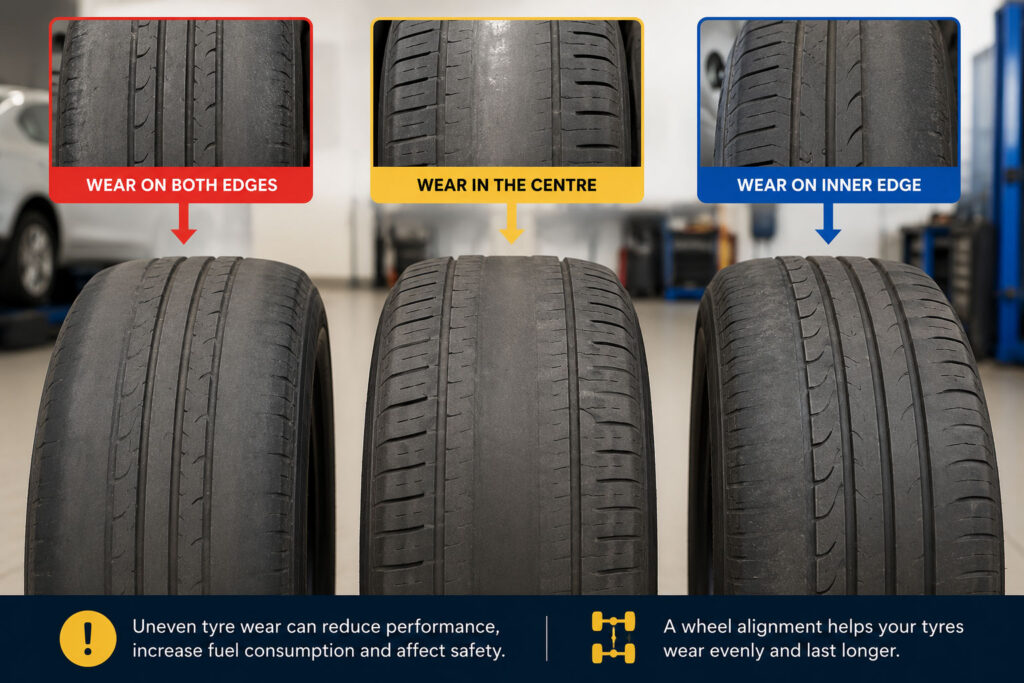
Uneven tyre wear is the evidence that stays behind long after the drive is over. Park up, turn the steering to full lock so you can see the inner shoulder of the front tyres, and compare them. A misaligned wheel usually eats one edge of the tread while the rest of the tyre still looks healthy.
If you are not sure what healthy looks like, our guides on how to check tyre tread depth and how long tyres last and how to spot wear show you exactly where to look.
4. The steering feels loose or wanders

Some drivers describe it as the car feeling “floaty” or needing constant small corrections on the motorway. You are never quite settled in the lane. That vagueness often comes from a caster or toe setting that has drifted, although worn steering and suspension parts can produce the same feeling – which is why a proper inspection comes before any adjustment.
5. The steering does not return to centre after a turn
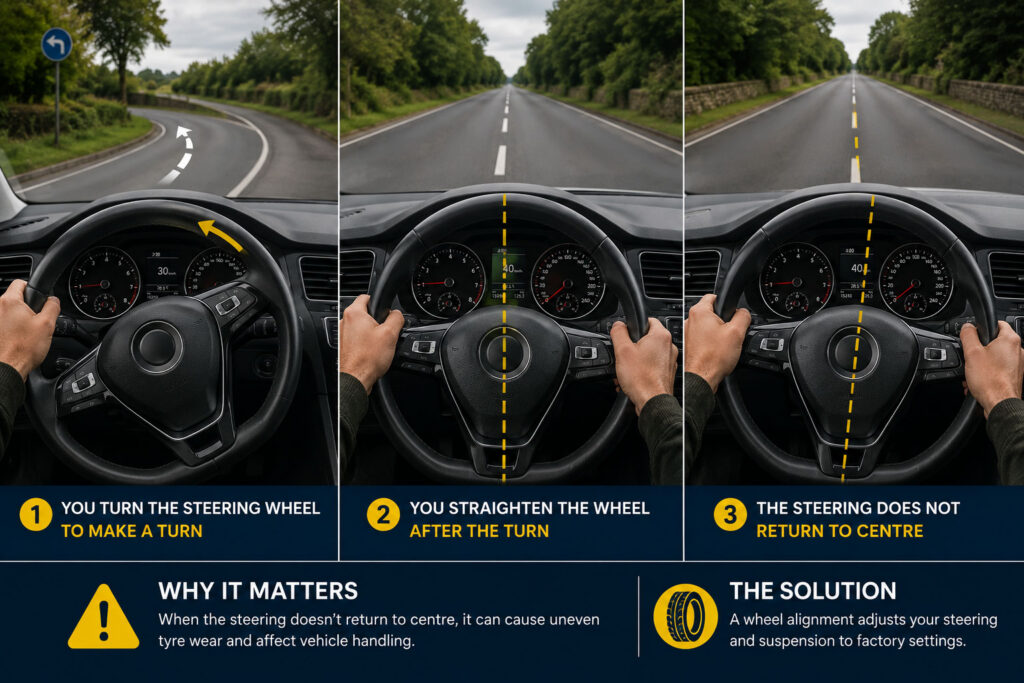
Come out of a roundabout and the wheel should unwind itself smoothly under your palms. If you have to drag it back to straight, or it comes back on one side more willingly than the other, that is a caster angle problem and a genuine alignment symptom.
6. Tyres squeal on gentle, low-speed corners
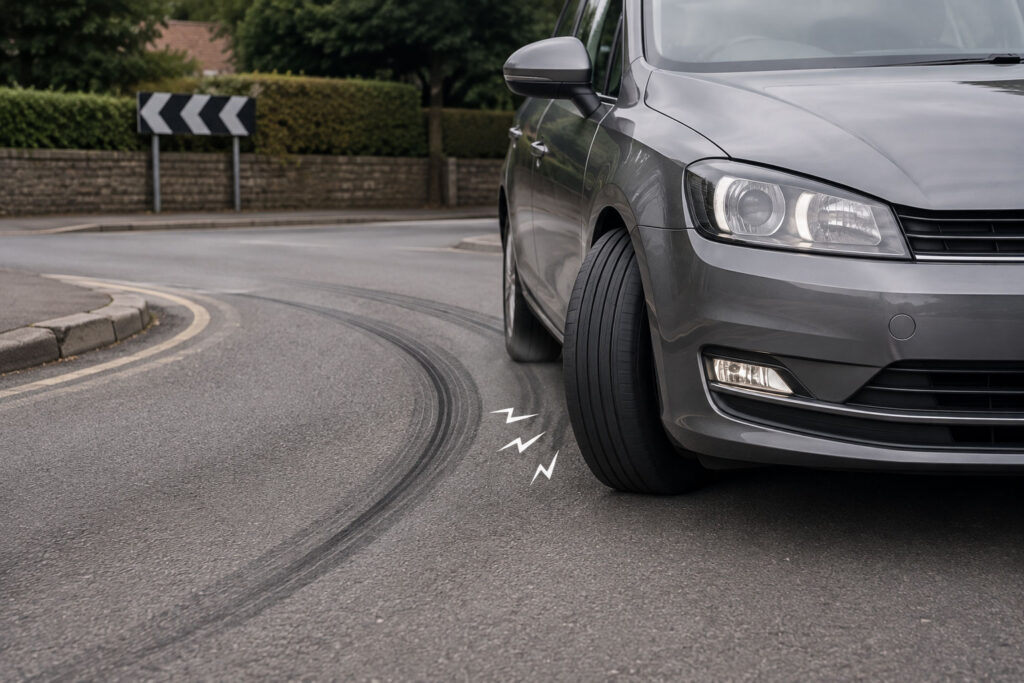
A chirp or scrub from the front on a slow car park turn, when you are nowhere near driving hard, means the tyres are being dragged slightly sideways rather than rolling. That is a toe error scrubbing rubber off with every mile.
7. Fuel economy has quietly slipped

Misaligned wheels fight each other. That extra rolling resistance shows up as a small but steady drop in miles per gallon. On its own it proves nothing – cold weather and city traffic do the same – but paired with any of the signs above it strengthens the case.
8.The car crabs slightly sideways
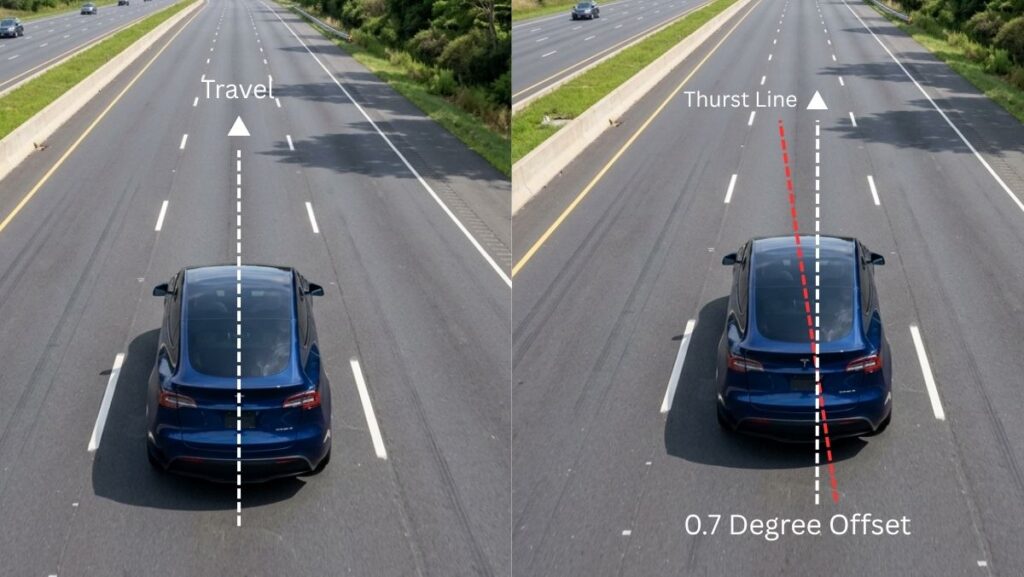
This one is hard to spot from the driver’s seat, which is why most guides skip it. The car travels very slightly at an angle to the direction it is pointing – the trade calls it dog-tracking or crab-walking. You will usually hear about it from somebody following you, or you will see it in the tracks the car leaves on a wet or gritted road: the rear wheels are not running in the front wheels’ lines.
The cause sits at the back, not the front. A rear toe or thrust angle error makes the rear axle push the car off its true line, and the steering wheel ends up sitting crooked as you unconsciously correct for it. Front tracking alone will never find this – it needs a four-wheel alignment.
9. The steering feels heavier one way than the other
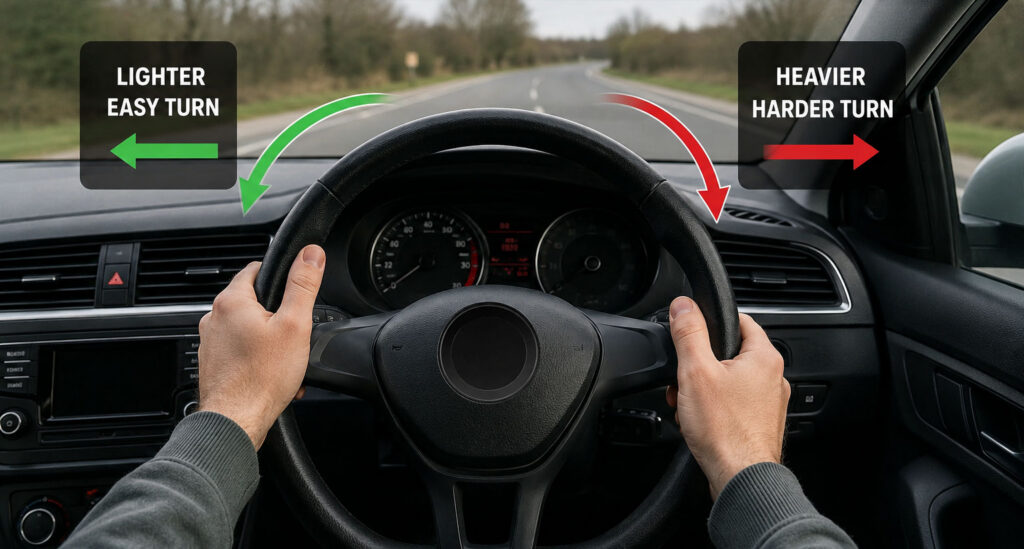
Turn the same amount left, then the same amount right, at the same low speed. The effort should feel matched. If one direction is noticeably heavier or the car settles more willingly one way, the caster or camber settings are likely to differ from side to side. It is a subtle symptom and easy to explain away as “how the car has always been”, but it is a genuine sign of wheel misalignment.
10. Vibration through the wheel or seat
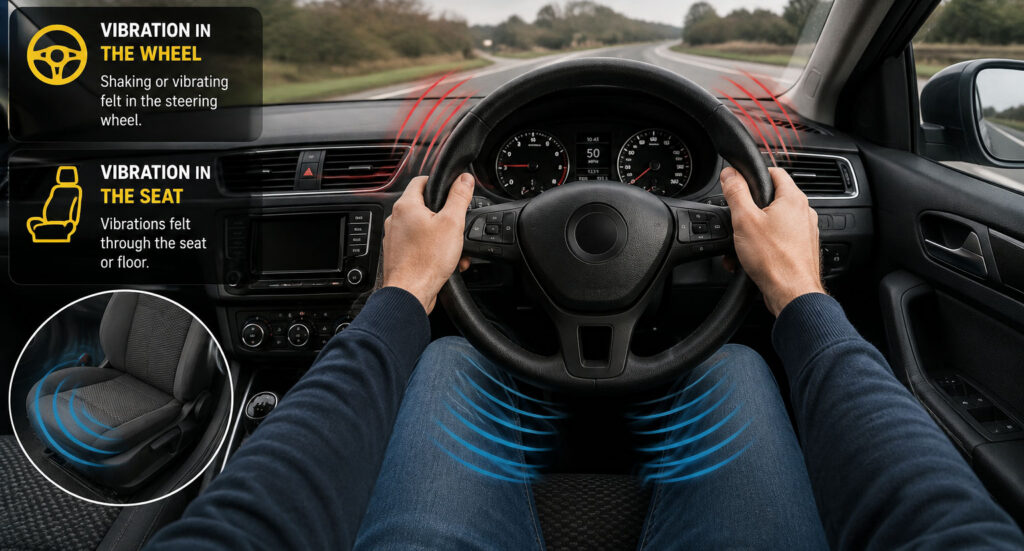
This one is the imposter. Steering wheel vibration gets blamed on alignment constantly, and it is usually the wrong culprit.
Here is the tell. A vibration that appears at around 50–70 mph and fades again is nearly always a wheel balance problem, not an alignment one. The two jobs are often sold together, so it helps to know which you actually need – our page on wheel balancing and valve replacement explains what that service covers.
Symptom Checker: What to Book
What you notice
Most likely cause
What to book
Firm pull to left or right
Toe or camber out of spec
Wheel alignment check
Steering wheel off centre
Front toe setting moved
Wheel alignment check
Wear on one tread edge only
Camber or toe error
Alignment + tyre inspection
Wear on both tread edges
Under-inflation
Reset pressures, re-check
Wear down the centre strip
Over-inflation
Reset pressures, re-check
Vibration at 50–70 mph
Wheel out of balance
Wheel balancing
Patchy, scalloped wear
Tired dampers or bushes
Suspension check first
Squeal on gentle corners
Tyres scrubbing from toe error
Wheel alignment check
Steering will not self-centre
Caster angle out
Four-wheel alignment
Car crabs or dog-tracks
Rear toe or thrust angle error
Four-wheel alignment
Steering heavier one way
Caster or camber differs side to side
Four-wheel alignment
3 Checks You Can Do on Your Own Driveway
None of these prove a diagnosis on their own, but together they tell you whether a wheel alignment check is worth booking or whether you can leave it another few months. All three take under ten minutes and cost nothing.
Check 1 – The straight-line drift test
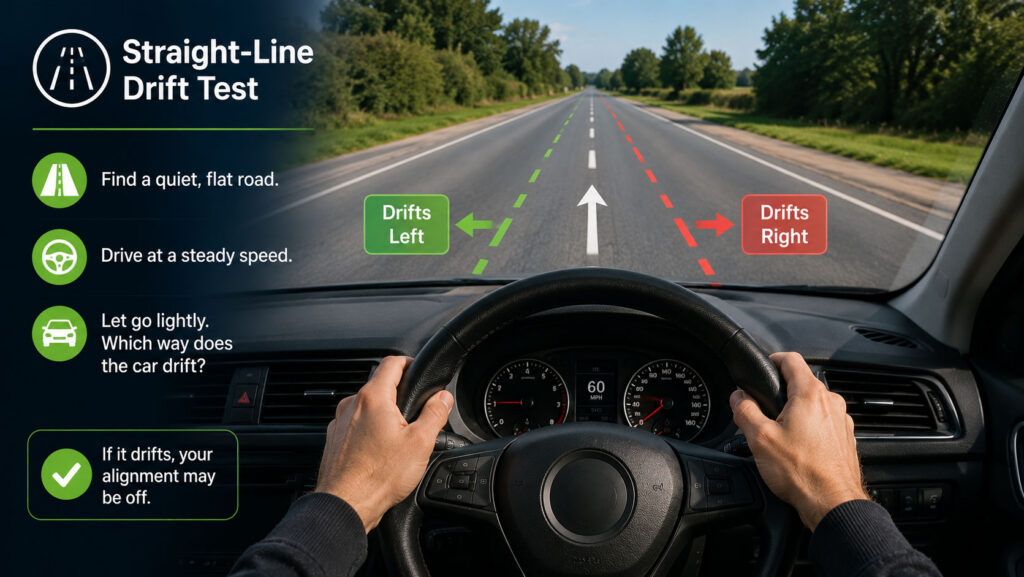
Pick a quiet, flat road with no traffic behind you. Hold a steady 30–40 mph and briefly rest your hands lightly on the wheel without steering. Watch what the car does over three or four seconds, then take control again. Repeat in the opposite direction on the same road. If the car pulls the same way both times, it is the car. If the pull swaps sides, you were reading the road camber.
Check 2 – The steering wheel badge test
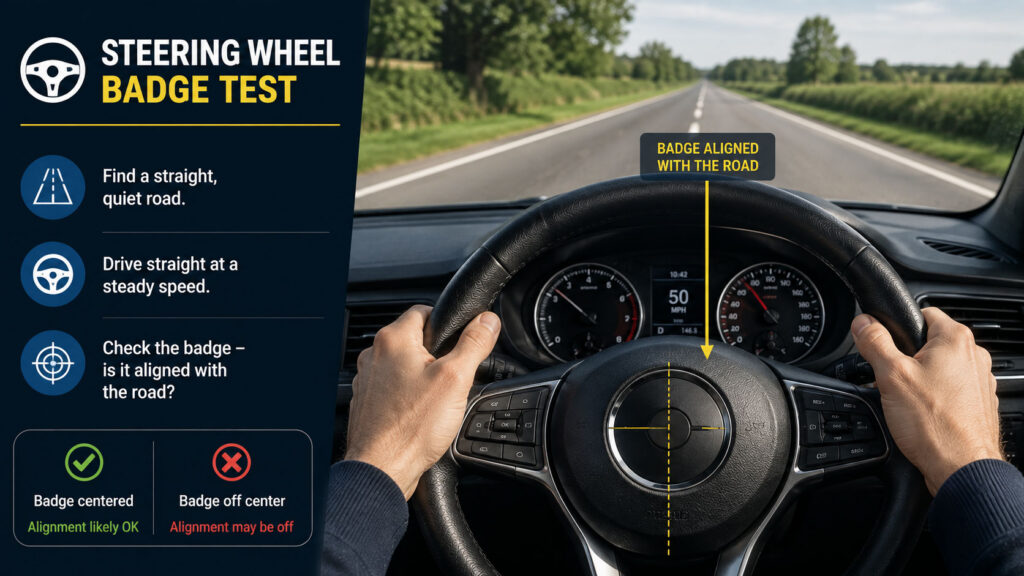
With the car travelling straight on that same road, glance at the badge. Level means the toe is probably fine. Consistently tilted means it is not. This is the single quickest indicator that your wheels are misaligned, and it takes two seconds.
Check 3 – The palm test across the tread
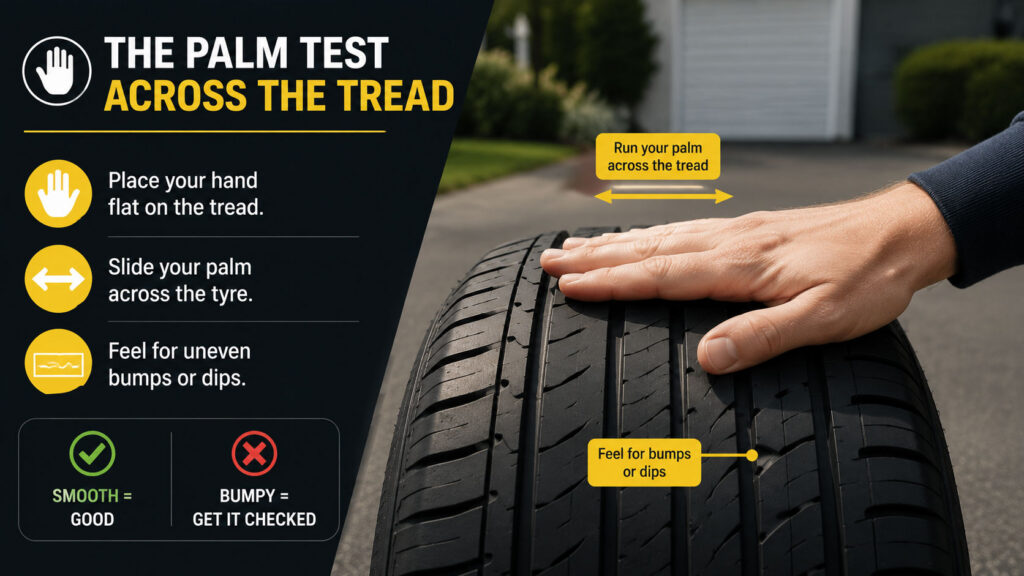
With the car parked and the engine off, run the flat of your hand gently across the tread from the inside edge to the outside edge, then back the other way. Smooth in both directions is good. If the tread blocks feel like a row of tiny ramps – sharp one way, smooth the other – that is feathering, and feathering is a toe problem almost every time.
Safety First
Wear a glove for the palm test. Worn tread can hide steel cords and small pieces of embedded flint. Never run your hand around the inside of a wheel arch while the car is jacked up, and never do the drift test in traffic, in the wet, or on a motorway.
Driveway Check Summary
Check
What you need
Time
A “fail” looks like
Straight-line drift
Quiet level road
5 min
Same pull in both directions
Steering wheel badge
Nothing
10 sec
Badge tilted while driving straight
Palm across tread
A glove
2 min
Sharp ridges one way only
Edge comparison
Full lock, torch
3 min
One shoulder far more worn
Pressure reset
Gauge or garage air
5 min
Pull remains after correction
Reading Tyre Wear Patterns: Your Tyres Keep the Records
A tyre is an honest witness. Whatever the suspension has been doing for the last ten thousand miles is written across the tread, and once you know the patterns you can usually name the fault before a technician puts the car on the ramp.
Wear Pattern Decoder
Wear pattern
Where you see it
Usual cause
What fixes it
Inner shoulder worn
Inside edge, fronts
Excess negative camber or toe-out
Alignment adjustment
Outer shoulder worn
Outside edge
Toe-in or hard cornering
Alignment adjustment
Feathered / sawtooth
Across the tread blocks
Toe error
Alignment adjustment
Both shoulders worn
Left and right edges
Under-inflation
Correct the pressures
Centre band worn
Middle of the tread
Over-inflation
Correct the pressures
Cupped or scalloped
Dips around the tyre
Worn dampers or bushes
Suspension repair, then align
One tyre only
A single corner
Bent arm or hub after impact
Inspection before alignment
Expert Insight
The tyre safety charity TyreSafe makes the point that correct alignment is what keeps each tyre’s contact patch doing its job. Get the angles right and the tyre lasts longer, the car tracks true and braking distances stay where the manufacturer intended. Let them drift and all three get worse at the same time.
Alignment Cannot Undo the Damage
This is worth being blunt about. Correcting the geometry stops the wear getting worse; it does not put rubber back. If one shoulder has already dropped close to the legal limit, that tyre needs replacing whatever the alignment printout says. Where a front tyre has to be replaced, it is usually sensible to look at its partner too – our article on why tyres should be changed in pairs explains when that matters and when it does not.
What Knocks the Wheel Alignment Out in the First Place?
Nothing dramatic has to happen. Suspension geometry is set in millimetres and fractions of a degree, so it does not take much to move it.
Potholes and kerbs
The number one cause on British roads. A pothole hit at speed sends a shock straight up through the wheel into the steering and suspension arms. Kerbing a wheel while parking does the same thing more gently but just as effectively. You do not need a bang or a bent wheel for the toe setting to have moved.
Ordinary wear in the suspension
Rubber bushes soften, ball joints develop play, springs settle a few millimetres over the years. None of that is a fault as such – it is simply age – but the sum of it changes the angles your wheels sit at.
Garage work, new springs or a lowered ride
Any job that disturbs the steering or suspension changes the geometry. Track rod ends, wishbones, shock absorbers, coil springs, a lowering kit: all of them need an alignment afterwards, and a decent garage will tell you so before they start.
Heavy loads, towing and speed bumps
Regularly running fully loaded, towing a caravan or trailer, or taking traffic calming humps at the wrong angle all put the suspension through movements it was not set up for. Vans and light commercials that live near their weight limit tend to need checking more often than a family hatchback.
Plain mileage
Even a car that has never met a pothole drifts a little over 12,000 miles. That is why an annual wheel alignment check earns its place alongside the rest of your tyre maintenance routine.
Trigger and Timing Guide
What happened
When to get it checked
Hard pothole hit at speed
Within the same week
Kerbed a wheel while parking
Within the same week
New tyres fitted
At the time of fitting
Suspension or steering parts replaced
Straight afterwards
Minor collision or heavy shunt
Before any long journey
Lowering springs or new wheels
Straight afterwards
Nothing unusual at all
Every 12 months or 12,000 miles
If You Have Just Hit a Pothole Hard
Pull over somewhere safe as soon as you can and look at the wheel and tyre. A bulge in the sidewall, a cut, a buckled rim or air escaping means do not carry on – our guide to tyre sidewall damage explains why sidewall injuries are never repairable. If the tyre has deflated, read can you drive with a flat tyre before you decide to press on, and if you need help where you are, our emergency roadside tyre fitting team comes to you.
Alignment, Tracking and Balancing Are Three Different Jobs
These three get mixed up constantly, and the confusion costs drivers money because they book the wrong one. Here is the plain version.
Which Job Does What
Job
What it actually does
Symptom it cures
Wheel alignment
Sets camber, caster and toe to the maker’s spec
Pulling, off-centre wheel, edge wear
Wheel balancing
Evens out weight around each wheel and tyre
Vibration at motorway speed
Tracking
The front-toe portion of a full alignment
Mild pull, feathered front wear
In everyday use, “tracking” is what most garages call a front-toe-only adjustment, while “wheel alignment” usually means the full four-wheel job. If you want the longer comparison, we have written it up in wheel alignment vs wheel balancing.
Camber, caster and toe in plain English
Angle
What it means
Symptom when it is wrong
Toe
Whether the wheels point slightly in or out, seen from above
Feathering, squealing, pulling
Camber
Whether the wheel leans in or out at the top
One-shoulder wear, pull to the leaning side
Caster
The tilt of the steering axis, seen from the side
Steering that will not self-centre
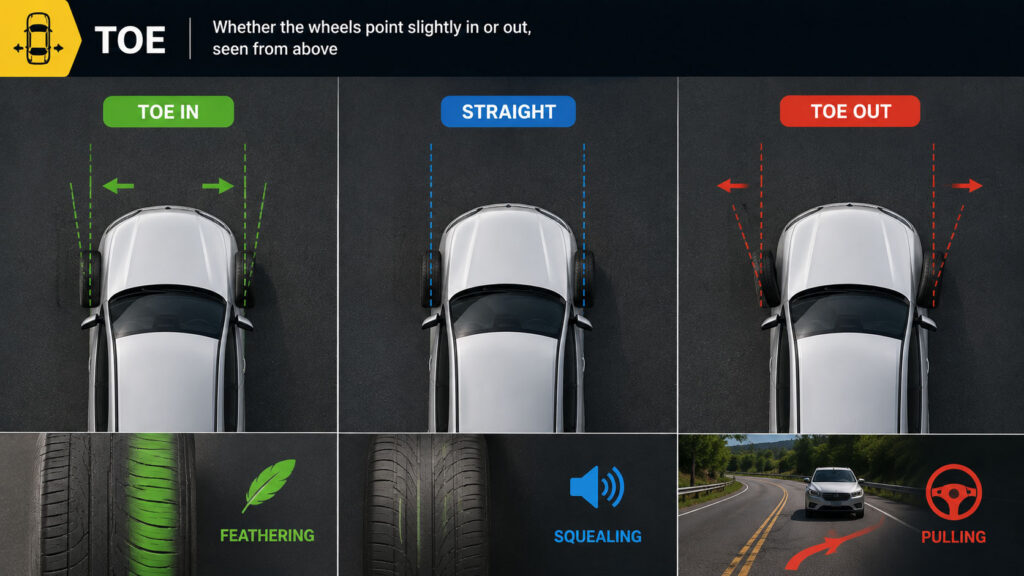
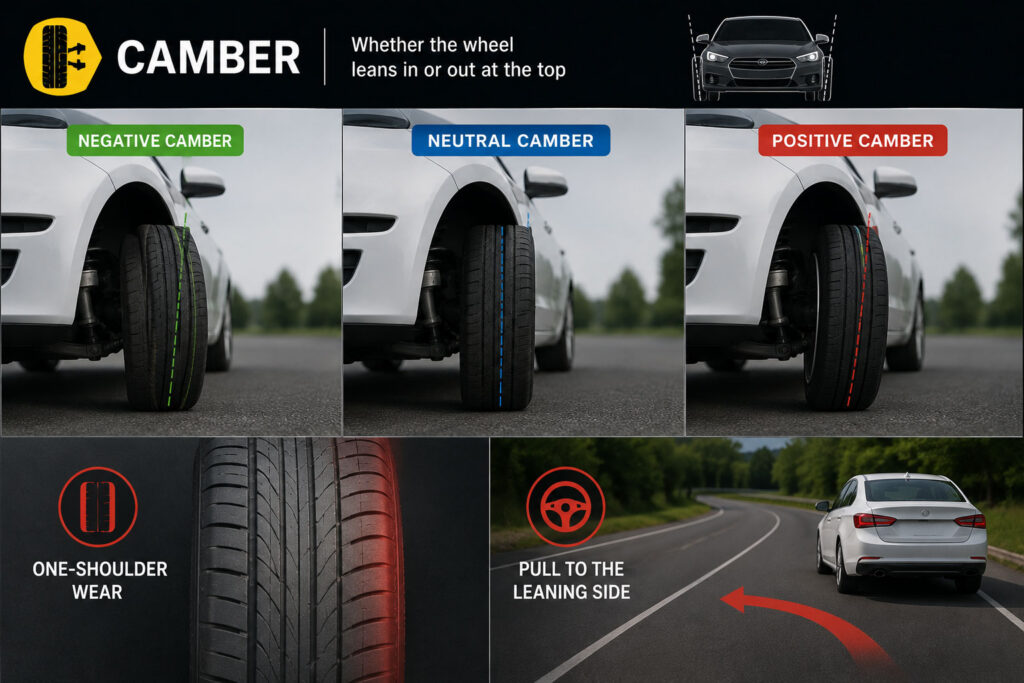
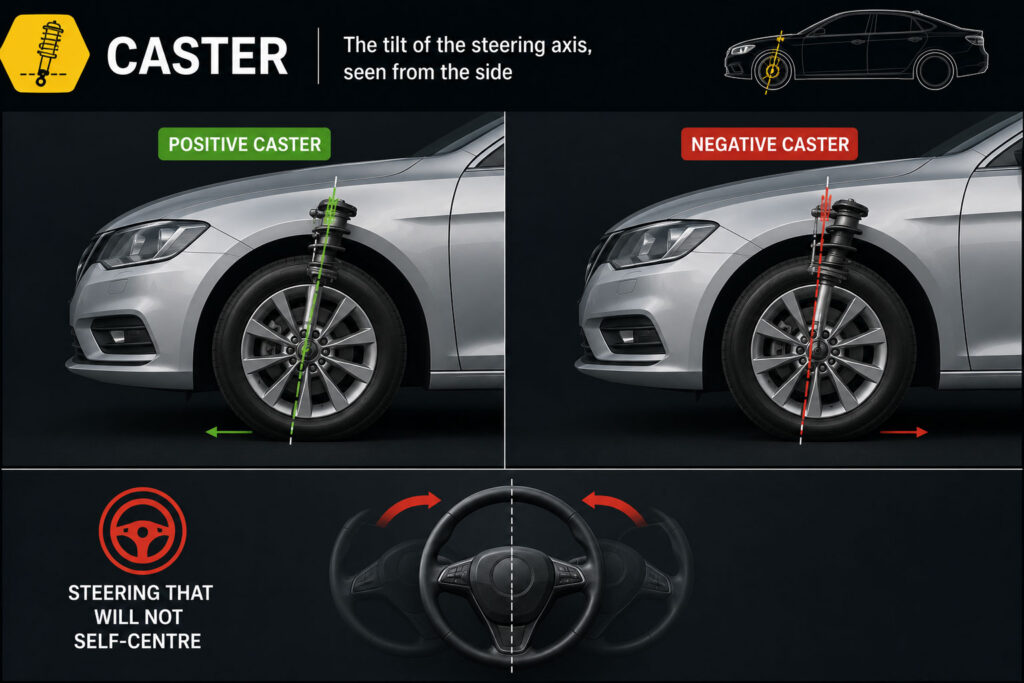
Toe is the setting that ruins tyres fastest, and it is also the one most easily knocked out by a pothole. Camber is usually adjustable only on some cars. Caster rarely moves unless something has been bent.
Do You Need 2-Wheel or 4-Wheel Alignment?
This is the question drivers ask the moment they see two prices on a board – 2 or 4 wheel alignment, as most garages write it – and the honest answer is that it depends on what your car has at the back rather than what it has at the front.
What front tracking actually covers
Front tracking measures and adjusts the toe on the two front wheels and nothing else. It is quicker, it costs less, and on the right car it does a perfectly good job. That right car is one with a beam or solid rear axle, where the rear wheels have no independent adjustment to speak of and are unlikely to have moved. Plenty of older hatchbacks, superminis and light commercials fall into that group.
The catch is that front tracking assumes the rear axle is pointing true. If it is not, the technician sets your front wheels to a reference that is already wrong, and the steering wheel ends up crooked even though the printout says the toe is in spec.
What 4-wheel alignment adds
A four-wheel alignment measures all four corners and, crucially, works out the thrust angle – the line the rear axle is actually pushing the car along. The front wheels are then set relative to that line rather than to the body of the car. This is the only way to find the crab-walking fault described earlier, and the only way to correct rear toe on a car that allows it.
It also catches side-to-side camber and caster differences, which is what produces the uneven steering effort some drivers live with for years without ever mentioning it.
Which One Fits Your Car
Type
What gets measured
Best suited to
Rough cost
Front tracking
Front toe only
Beam or solid rear axle, older cars
£30–£50
Four-wheel laser alignment
Front and rear toe, camber, caster, thrust angle
Independent rear suspension, most modern cars
£60–£100
Quick Rule
If your car was built in the last fifteen to twenty years, it almost certainly has independent rear suspension – and that means four-wheel alignment. Front tracking on a car with an adjustable rear axle is a false economy, because you pay to have the front set against an error nobody measured.
When four-wheel is not optional
- The steering wheel is crooked but the front toe reads correct.
- Somebody has told you the car looks like it is going slightly sideways.
- The rear tyres are wearing unevenly, not just the fronts.
- The car has been in a shunt, however minor.
- You drive a 4×4, SUV or anything with adjustable rear suspension.
- New tyres are going on and you want the full set to wear evenly.
If you are unsure which your car needs, the registration will tell a technician in seconds. Our team can confirm it when you get in touch, and while we are with you we can also handle wheel balancing and valve replacement or a straight tyre replacement in the same visit.
How Often Should You Get a Wheel Alignment Check?
As a baseline, once a year or every 12,000 miles, whichever comes first. That catches the slow drift that happens to every car without anything going wrong. On top of that, get it checked whenever one of the trigger events above has happened.
Two moments are especially worth flagging. The first is when new rubber goes on: fitting fresh tyres to a car with a toe error simply hands the fault a new set of victims. The second is before a long trip, alongside the rest of the checks in our long road trip tyre preparation guide.
Rule of Thumb
New tyres today means an alignment check today. It is the lowest-cost tyre insurance there is, and it is the one step most drivers skip.
Drivers who cover high mileage, run vans or light commercials, or spend most of their week on rough urban roads should shorten that interval to every six months. Our wider tyre maintenance checklist sets out what else belongs in that routine.
What a Wheel Alignment Costs and How Long It Takes in the UK
Prices move around depending on where you are, what you drive and whether anything is seized when the technician gets to it. Treat the figures below as a realistic guide rather than a quotation, and always confirm before you commit.
Typical UK Price Guide
Service
Typical price range
Time on site
Alignment check only
Free to around £25
10–15 minutes
Front tracking (toe only)
Around £30–£50
20–30 minutes
Four-wheel laser alignment
Around £60–£100
45–60 minutes
Seized or worn parts
Quoted separately
Varies
Set that against a single premium front tyre and the maths makes itself. An alignment that goes unchecked for a year can quietly write off two tyres. For a wider view of what roadside and at-home work costs, see our breakdown of mobile tyre fitting costs in the UK and our comparison of mobile tyre fitting against a traditional garage.
Worth Doing Even When Nothing Feels Wrong
A check produces a printout with your car’s actual angles against the manufacturer’s figures. Keep it. Next time you suspect something, you have a baseline to compare against instead of a guess.
What Happens If You Ignore Wheel Misalignment?
Nothing sudden. That is exactly why it gets left. The damage arrives gradually, and by the time it is obvious it is also expensive.
The Cost of Waiting
How long it is left
What tends to happen
A few weeks
Slightly faster wear, nothing visible yet
Two to three months
A wear edge starts to form on one shoulder
Around six months
Shoulder tread can drop near the legal limit
A year or more
Premature replacement, MOT advisory or failure
The legal minimum tread depth in the UK is 1.6 mm across the central three quarters of the tyre, right around its circumference. Most safety organisations, including the RAC, advise replacing well before that – usually around 3 mm – because wet braking distances get noticeably worse below that point. Uneven wear from bad alignment is one of the quickest ways to arrive there without noticing.
MOT Reality Check
An MOT tester looks at tread depth across the central three quarters of the tread. Wear concentrated on the very outer shoulder may pass while still being unsafe; wear that eats into that central band is a straight fail. Either way, the tester will normally note uneven wear as an advisory – which is your cue to book the alignment, not just the tyre.
Does Your Tyre Brand Change How Quickly Misalignment Shows?
It does, and knowing this helps you read the symptoms properly. Softer, grippier compounds give up rubber faster, so a toe error shows on the tread within a few thousand miles. Harder-wearing touring compounds hide the same fault for far longer – which sounds like good news until you realise the geometry has been wrong all that time.
Brand Behaviour Under Misalignment
Brand
Generally known for
How misalignment shows up
Whichever badge you choose, fit the same tyre across an axle and get the geometry checked at the same time. If you are weighing up options, our guides to the best tyre brands, best mid-range tyres, best value tyres and best winter tyres break down where each sits. Drivers with performance saloons may also want our notes on the best tyres for BMW, and anyone on run-flat tyres should be especially strict about alignment, because run-flat sidewalls are stiff and unforgiving of a toe error.
When to Stop Driving and Get It Looked At Straight Away
Most alignment faults are a booking, not an emergency. A few are not. Stop somewhere safe and get help if you notice any of the following.
- A strong pull that you have to fight to hold the car in lane.
- New wobble, clunking or knocking that appeared right after hitting something.
- A visible bulge, split or exposed cord anywhere on a tyre.
- A wheel that is visibly leaning compared with the one on the other side.
- Steering that has suddenly gone light, heavy or vague.
- A tyre losing pressure faster than you can top it up.
Key Rule
If the car does not feel like it is going where you point it, the problem has stopped being cosmetic. Get off the road and arrange immediate help before you try to diagnose it – especially on a motorway, where a wandering car is a hazard to everyone behind you.
If you are stranded, our emergency mobile tyre replacement service and roadside fitting team can reach you where you are, with a rapid 24/7 response for urgent callouts. If the car is still drivable but the tyre is finished, tyre fitting at your home or workplace saves you a trip, with fast same-day appointments, next-day slots and even Sunday fitting available across much of the country. Last-minute and 24-hour emergency bookings are handled the same way – one call, one van, no hidden charges added at the kerbside.
Need to get the spare on yourself first? Our step-by-step guide to changing a tyre covers it, and if the wheel will not come off, read what to do when the locking wheel nut key is missing. For a straight swap once you are home, see our mobile tyre replacement service.
Your 60-Second Wheel Alignment Checklist
Run through these six questions. Answer yes to two or more and it is time to book a wheel alignment check.
Quick Self-Assessment
Question
Yes means
Does the car pull on a flat straight road?
Strong alignment indicator
Is the steering wheel badge tilted when straight?
Strong alignment indicator
Is one tread edge more worn than the rest?
Strong alignment indicator
Do the tyres squeal on slow, gentle turns?
Likely toe error
Does the wheel refuse to self-centre?
Likely caster error
Have you hit a pothole or kerb recently?
Get it checked regardless
If your only symptom is a vibration that comes and goes with speed, start with balancing instead – you will find the reasoning in our alignment versus balancing comparison. And if a tyre has already failed on you, our emergency tyre burst guide covers what to do in the moment.
Wheel Alignment: Frequently Asked Questions
Use the speed test. Alignment problems are there at every speed and show up as pulling, an off-centre steering wheel or uneven tread wear. Balancing problems appear in a narrow band, usually 50–70 mph, as a vibration through the steering wheel or seat, and fade again above and below it.
If you have both symptoms, you need both jobs – they are commonly done in the same visit.
For a mild fault, yes, but every mile costs you tread. The car is still steerable and legal provided the tyres remain above the minimum depth and free of damage.
Stop driving and get help if the pull is strong, the steering feels vague, or you can see a bulge, split or exposed cord on any tyre.
Yes, that is exactly what it corrects. The technician centres the steering wheel and then sets the front toe to match, so the wheel sits level when the car is travelling straight. If it is still crooked afterwards, the alignment was set without the wheel being properly locked in the centre position.
A front tracking adjustment is typically 20–30 minutes. A full four-wheel laser alignment usually takes 45–60 minutes. Add time if a track rod or adjuster is seized and needs freeing off.
No. New tyres reset the clock, but if the geometry is still wrong the new rubber wears the same way as the old. Always have the alignment checked at the point of fitting, not months later.
Yes, though modestly. Misaligned wheels scrub sideways and create extra rolling resistance, so the engine works harder for the same distance. The saving is real but small – the bigger win is the tyre life you get back.
No. An MOT checks tyre condition, tread depth and damage, plus steering and suspension components, but the alignment angles themselves are not measured. Uneven wear is often recorded as an advisory, which is a strong hint to book a check.
Once every 12 months or 12,000 miles for normal use, and every six months for high-mileage drivers, vans and light commercials. Also check it after new tyres, after any suspension work and after any hard pothole or kerb impact.
Tyre replacement, wheel balancing and valve work are all routinely carried out at the roadside, at home or at your workplace. Full geometry work needs level ground and the right equipment, so speak to the team about what can be done where you are.
One Stop for Wheel Alignment and Tyre Replacement
At The Mobile Tyre Fitter, wheel alignment and tyre replacement are handled by the same team on the same visit, so you are not chasing two appointments at two locations for one problem. We diagnose the wear, correct what needs correcting and fit the replacement rubber while you get on with your day.
We also hold a wide range of tyres in stock at genuinely competitive prices – premium, mid-range and everyday budgets – covering cars, vans, light commercials, 4×4 and SUV fitments in the sizes UK drivers actually need. If you have spotted uneven wear, a pull to one side or a crooked steering wheel, contact our support team and we will confirm availability and pricing for your exact size before we come out, with no hidden fees added on the day.
One team, one visit, one stop. We cover London, Birmingham, Manchester, Leeds, Glasgow, Edinburgh, Bristol, Cardiff and many more locations across the UK.